49 works in this view — arrow keys or swipe to move between them.
Dance in Art
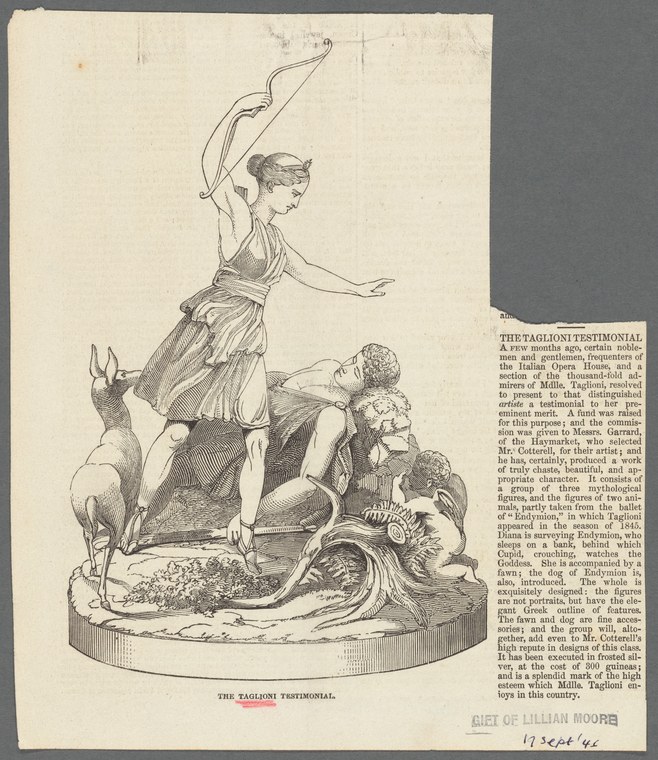
The Taglioni testimonial
Unknown artist
- Collection:
- Prints depicting dance
- Source:
- New York Public Library
- Rights:
- Public domain — free to use, share and adapt.
- Recorded as:
- Public Domain
This image captures how Romantic-era ballet was commemorated and mythologized—not as a record of technique or choreography, but as an ethereal art form worthy of classical allegory. For dancers and historians, it reveals the cultural aspirations of 19th-century ballet, the international celebrity of Marie Taglioni, and how printmakers translated the ephemeral art of dance into permanent, portable form. It is one of few visual records that positions a dancer herself as the subject of high art commemoration, rather than a supporting figure in a narrative scene.
What you are looking at
A monumental sculptural group depicts the Italian ballerina Marie Taglioni in apotheosis, surrounded by allegorical and mythological figures. Taglioni stands elevated at the center, posed in a graceful attitude with one arm raised and draped fabric swirling around her body. She wears a classical tunic and appears weightless, almost in flight. Clustered at the base are supporting figures: a male dancer or athlete in classical dress, a reclining female figure, a cherub or putto, and a fawn or young satyr with horned head. A dog and what appears to be a ram or goat complete the group. The composition is mounted on a substantial circular plinth, suggesting this was conceived as a monumental public work or presentation piece. The engraving technique renders the sculptural volumes with fine parallel lines and cross-hatching to convey three-dimensional form.
The dancing
Taglioni's pose embodies the romantic ballet aesthetic: elevated, ethereal, with elongated lines from her raised arm through her tilted head. Her weight appears to rest lightly on one leg in an attitude position, while the other leg bends beneath her. The surrounding figures—a male dancer in classical contrapposto, reclining attendants, and animal companions—create a narrative of homage and support. None of the figures adopt the rigid turnout positions of later academic ballet; instead, the gestures are fluid and compositional, arranged to create a theatrical tableau rather than demonstrate technical vocabulary.
The dance depicted
This is Romantic-era ballet, almost certainly depicting Taglioni's signature role or general achievement. The inscription identifies this as 'The Taglioni Testimonial,' a commemorative work created to honor the dancer. Taglioni (1804–1884) was the defining dancer of the Romantic ballet period (1830s–1840s), famous for her ethereal, weightless quality and technical mastery of pointe work—though pointe shoes are not visible here. The work celebrates her as an immortal figure, placing her among classical deities and allegorical personages. The surrounding figures likely represent the arts, nature, or abstract virtues attending upon her genius. This is not documentation of an actual dance but rather a tribute sculpture translated into printable form.
How it was made
This is a wood or steel engraving, a medium that allowed fine-art prints to be circulated widely among educated audiences in the 19th century. The artist has used parallel hatching and cross-hatching to build sculptural volume and suggest the play of light across draped fabric and human forms. The technique's precision and tonal range make it ideal for reproducing a three-dimensional work (likely a bronze or marble sculpture or a sculptural model) in a format suitable for publication, framing, or inclusion in a commemorative volume. The inscription and refined execution suggest this was a prestigious commission, intended for viewers who appreciated both sculpture and the subject.
About this work
This engraving memorializes Marie Taglioni, the dominant figure of Romantic ballet, by representing her as a timeless classical figure attended by allegorical companions. Rather than showing her mid-performance, the artist has frozen her in an idealized pose, elevated and surrounded by supporting figures drawn from mythology and the classical tradition. The work belongs to the 19th-century practice of honoring celebrated performers through monumental or emblematic portraiture, translating their achievement into sculptural form and then disseminating that form through print. It sits at the intersection of dance history, printmaking, and the cult of the Romantic ballerina that dominated European art and culture in the mid-1800s.
How to look at it
Look first at Taglioni's isolated, elevated position and the way her body appears to defy gravity—this captures the Romantic ideal of the ethereal ballerina, weightless and unworldly. Observe how the surrounding figures gaze upon or support her, establishing her as the center of a universe of classical and mythological reference. The engraver has chosen a moment of stillness rather than virtuosic motion, emphasizing poise and presence over pyrotechnics. Notice how the sculptor (and the engraver who reproduced the work) used classical drapery and mythological companions to anchor Taglioni in the tradition of high art, elevating her from entertainer to immortal figure.
The artist
The artist is not recorded in the catalogue. The quality and refinement of the engraving, the classical execution, and the prestige of the subject suggest this was made by a skilled reproductive engraver or fine-art printmaker working in mid-19th-century Europe, most likely in France or Italy where Taglioni's fame was greatest. The style and technique are consistent with major European printmaking houses of the 1840s–1860s.
The period
Marie Taglioni danced from the 1820s through the 1840s, reaching her height during the height of Romantic ballet (1830s–1840s). This period saw ballet transformed into a vehicle for expressing otherworldly, often supernatural themes, with the dancer—especially the female dancer—positioned as a ethereal being who transcended the material world. Taglioni's technical innovations (particularly her mastery of pointe work) and her dramatic presence made her the era's most celebrated performer. Commemorative prints and sculptures of famous performers proliferated in this period, creating a visual culture around celebrity dancers that had no precedent. The 'Testimonial' likely dates to Taglioni's retirement or the height of her fame, probably between 1840 and 1870.
Where it lives
This engraving is held in the New York Public Library's collection of prints depicting dance. The inscription 'The Taglioni Testimonial' and the label 'Gift of Lillian Moore' identify it as a curated acquisition by a major dance historian and librarian. Moore (1906–1984) was a pioneering dance scholar who assembled one of the first comprehensive collections of dance ephemera and prints in an American institution, establishing the NYPL as a primary resource for dance history.
Dance in this work
Questions about this work
Who was Marie Taglioni and why does she matter?
Marie Taglioni (1804–1884) was an Italian-Swedish dancer who dominated European ballet from the 1820s through 1840s. She was the first great star of Romantic ballet, famous for her technical mastery of pointe work, her ethereal and weightless stage presence, and her roles in ballets like *La Sylphide* (1832). She essentially defined what a prima ballerina was: technically accomplished, dramatically compelling, and capable of embodying supernatural beings. Her career established the template for the celebrated female dancer that persists today.
What is a 'testimonial' in this context?
A testimonial was a commemorative artwork or gift created to honor a celebrated performer, often presented at retirement or at the peak of their fame. It could take the form of a sculpture, an engraving, a bound volume of prints, or a formal gift. This testimonial—a monumental sculptural composition engraved for circulation—was a prestigious honor, positioning Taglioni alongside classical and mythological figures rather than treating her as an entertainer. Such works helped establish the cultural and artistic legitimacy of dance itself.
Is this showing an actual dance or a choreographed piece?
No. This is not documentation of a specific choreography or performance. Instead, it is an idealized commemoration, placing Taglioni in a timeless, allegorical composition. The pose captures the Romantic ideal of the ballerina—weightless, ethereal, and elevated—but the surrounding mythological figures and the sculptural context remove the work from the stage entirely. It is more akin to a classical monument than to a record of what Taglioni actually danced.
Why would a print of a sculpture be created instead of showing the original sculpture?
Prints were the primary way to circulate images widely in the 19th century, reaching educated audiences across Europe and beyond. An engraving of a sculpture allowed the work to be reproduced in books, given as gifts, framed for display, and preserved in collections. Fine engravings were also considered high art in their own right. This particular engraving is finely detailed and was clearly made to celebrate both the sculpture and Taglioni herself—it is as much a work of printmaking skill as it is a record of the sculptural original.
More dance artwork





