49 works in this view — arrow keys or swipe to move between them.
Dance in Art
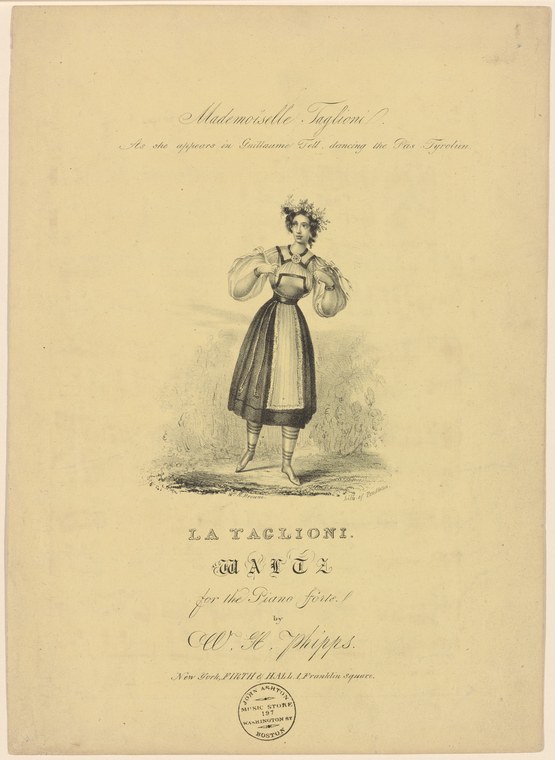
Mademoiselle Taglioni as she appears in Guillaume Tell, dancing the pas tyrolien: La Taglioni waltz for the piano forte, by W. H. Phipps
Unknown artist
- Collection:
- Prints depicting dance
- Source:
- New York Public Library
- Rights:
- Public domain — free to use, share and adapt.
- Recorded as:
- Public Domain
Taglioni was the defining figure of Romantic ballet, and this print is direct evidence of how her roles were marketed and remembered by her contemporaries. The print also captures a now-lost choreographic tradition—the insertion of character dances into narrative ballets—and shows the material forms (prints, sheet music) through which dance circulated to a non-dancing public.
What you are looking at
A young woman stands alone against a plain background, wearing a Tyrolean costume with a dark bodice, voluminous puffy sleeves, and a full skirt that falls to mid-calf, paired with light-colored stockings and dark slippers. She wears a floral wreath or headdress and holds her arms raised in a graceful, open position. Her pose suggests she is mid-movement, captured in a moment of the dance rather than at rest. The image is rendered as a lithograph or engraving with fine detailing, typical of dance prints from the 19th century. The composition is spare and formal, presenting the dancer as a study of costume and posture against an empty stage or studio setting.
The dancing
A single female dancer occupies the frame, her body turned slightly in three-quarter view. Both arms are raised to roughly shoulder height with palms facing forward or outward—a position that conveys lightness and openness rather than drama. Her weight appears to rest evenly, her legs straight beneath her, and her posture is upright and composed. The gesture is characteristic of a folk or popular dance style rather than the turned-out vocabulary of classical ballet, with a naturalistic arm carriage that suggests a regional or national dance tradition.
The dance depicted
This is a Tyrolean dance as performed by the renowned dancer Maria Taglioni in the ballet *Guillaume Tell* (William Tell). The work conflates two things: the image documents Taglioni's costume and stage presence in a specific role within a high-Romantic-era ballet, while the musical publication records a piano arrangement of the waltz music associated with that scene. The *pas tyrolien* was a character dance interpolation into a larger narrative ballet, allowing a celebrated ballerina to perform a regional folk dance in theatrical form. Taglioni (1804–1884) was the era's most celebrated dancer; her performance of this and other roles defined Romantic ballet for her generation.
How it was made
This is a lithographic print, rendered in black ink on cream paper. The technique allowed for fine-line detail and tonal subtlety—visible in the delicate shading of the bodice and the texture of the skirt fabric—and supported both the circulation of theatrical publicity images and the practical distribution of sheet music covers. The print combines a performance portrait with a music publication cover: the upper portion documents the dancer and choreography, while the lower portion advertises the instrumental arrangement for domestic use. This dual purpose made such prints economical for publishers and ensured wide distribution among music-buying households.
About this work
This is a theatrical portrait documenting a specific performance tradition: a Romantic-era ballerina in a character dance costume, preserved as both a stage record and a commercial music publication. The work sits at the intersection of ballet history, popular print culture, and domestic music consumption in the mid-19th century. It testifies to the celebrity of individual dancers and the public appetite for access to the music and imagery of celebrated theatrical roles. The Tyrolean waltz was one of several national and folk dances that Romantic-era choreographers incorporated into full-length ballets as a way of adding spectacle, local color, and variety to their narratives.
How to look at it
Pay attention to the arms and torso: the raised, open carriage and the absence of the turned-out épaulement of classical ballet reveal a different movement vocabulary, one closer to folk or social dance. Notice the costume itself—the Tyrolean bodice and peasant skirt create a narrative frame, positioning this as a character or national dance rather than a classical variation. The dancer's composed, frontal stance and the sparse setting are typical of how theatrical portraits were composed in this era: the figure is presented as a type or role, displayed for study and admiration, rather than caught in a dramatic narrative moment.
The artist
The print is not attributed in the catalogue record. The lithographer and the publisher (identified on the image as being in New York and printed by N. Mendal) remain unconfirmed. Such theatrical portrait prints were often produced by commercial print houses in response to celebrated performances, with authorship sometimes secondary to market demand. The style and execution are consistent with mid-19th-century theatrical lithography.
The period
This print dates to the height of the Romantic ballet era (roughly 1830–1860), when full-length narrative ballets set in exotic or distant lands were the fashion of European and American theaters. *Guillaume Tell*, choreographed by Filippo Taglioni (Maria's father) in 1837, premiered in Paris and traveled rapidly to other major cities. The incorporation of national dances—Spanish, Italian, Scottish, Tyrolean—was a standard feature of such ballets, offering both historical color and opportunities for celebrated soloists to display their technique and star power. The publication of sheet music arrangements for domestic piano performance was a key revenue stream for composers and publishers, and lithographic prints combining performance portraits with music covers were a cost-effective way to advertise both the original theatrical production and the domestic musical commodity.
Where it lives
The print is held by the New York Public Library as part of its collection of prints depicting dance. It is a theatrical publication—both performance document and commercial object—and reflects the circulation of dance through print media in the 19th century.
Dance in this work
Questions about this work
Who was Maria Taglioni?
Maria Taglioni (1804–1884) was an Italian-born dancer who became the leading ballerina of the Romantic ballet era. She was famous for her ethereal technique, the fluidity of her movement, and her iconic roles in ballets including *La Sylphide* and *Guillaume Tell*. Her father, Filippo Taglioni, was a celebrated choreographer who created many of her most famous roles.
What is a pas tyrolien?
A *pas tyrolien* is a character dance representing the Tyrolean region (in the Alps, straddling modern Austria and Italy). In 19th-century theatrical ballets, such national and folk dances were often interpolated as divertissements—spectacular interludes with distinctive costumes and music that showcased a star dancer's range and allowed for local color and variety.
What is *Guillaume Tell*?
*Guillaume Tell* (William Tell) is a five-act narrative ballet choreographed by Filippo Taglioni, with music by Gioachino Rossini, that premiered at the Paris Opéra in 1837. The story adapts Schiller's drama about the legendary Swiss archer and patriot; the *pas tyrolien* appears in Act III as a regional divertissement.
Why was a concert arrangement of this music published?
Sheet music arrangements for piano or small ensemble were essential products for music publishers in the 19th century. They allowed music from successful theatrical productions to reach amateur musicians and households, extending the commercial life of a ballet and the fame of its starring dancer. The lithographic portrait cover served as advertisement for both the original theatrical work and the domestic musical commodity.
More dance artwork





