49 works in this view — arrow keys or swipe to move between them.
Dance in Art
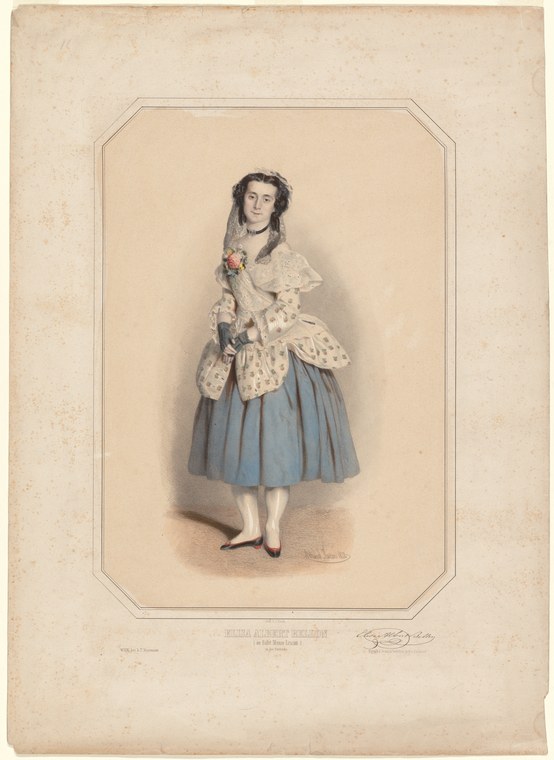
Elisa Albert Bellon im Ballet Manon Lescaut, in der Titelrolle
Unknown artist
- Collection:
- Prints depicting dance
- Source:
- New York Public Library
- Rights:
- Public domain — free to use, share and adapt.
- Recorded as:
- Public Domain
This portrait documents a specific performer and role in ballet history, offering material evidence of how nineteenth-century ballet was packaged, marketed, and experienced by audiences. For historians of dance, such prints are primary sources for understanding costume, casting, and the celebrity culture surrounding ballet in the period. For viewers today, it crystallizes the aesthetic that still shapes ballet: the fusion of technical virtuosity with romantic femininity and ethereal presentation.
What you are looking at
A young woman stands alone against a neutral background in a three-quarter pose, her body weight shifted slightly to one side in an attitude of graceful stillness. She wears a pale cream or ivory lace shawl or cape draped over her shoulders, its delicate patterned fabric creating volume and softness around her upper body. Beneath this, a cornflower-blue skirt falls to mid-calf in full, gathered folds. Her dark hair is styled in ringlets and crowned with a lace veil or headdress that frames her face. She holds a small fan or decorative object in one hand. The figure is rendered in hand-colored lithograph or engraving, with careful attention to the transparency and texture of the fabrics—the lace reads as almost luminous against the skirt's solid blue. The pose suggests a moment of repose rather than active movement, yet the composition carries theatrical deliberation.
The dancing
The dancer occupies center stage in solitary focus. Her posture is upright but yielding, with the weight of her body settled into one hip in a position suggesting either a pause between movements or the formal stance required for a principal character's introduction. Her shoulders are relaxed and level; her arms rest naturally at her sides. The tilt of her head and the angle of her gaze create an impression of modest introspection—a quality central to the Romantic ballet aesthetic. There is no visible footwork or active elevation; instead, the image captures the architectural presence of a costumed figure.
The dance depicted
This is a theatrical ballet portrait of the mid-nineteenth century, most likely depicting the title role in *Manon Lescaut*, a work that existed in multiple versions during this period. The catalogue identifies the subject as Elisa Albert Bellon, a performer whose name records in nineteenth-century ballet archives. The style of the costume—the full, gathered skirt; the fitted bodice; the romantic headdress and lace drapery—aligns with Romantic ballet aesthetics (approximately 1830–1870). The pose and presentation suggest this is a portrait of the character, not a moment of active dance, which was common for theatrical lithographs intended as souvenirs or publicity for ballet productions. The image emphasizes the visual spectacle and emotional character of the role rather than technical virtuosity.
How it was made
This is a hand-colored lithograph, a technique that allowed for relatively rapid, affordable reproduction and wide distribution. The base stone would have carried a drawn image, printed in black or dark brown, and then carefully hand-tinted with watercolor or gouache to add the blue skirt, flesh tones, and the subtle shadings of the lace. The lithograph process was ideal for theatrical promotion in the nineteenth century: images could be produced in modest quantities for sale as souvenirs, included in playbills, or collected by theater-goers. The hand-coloring meant that each impression was unique in its exact tonality, though the composition remained consistent. This technique speaks to a thriving market in dance imagery and suggests the performer and role were deemed commercially significant enough to warrant an illustrated souvenir.
About this work
A lithographed portrait of the dancer Elisa Albert Bellon in the title role of the ballet *Manon Lescaut*, rendered as a hand-colored print in the mid-nineteenth century. The image captures not a moment of dance but rather the figure of the character—a convention of theatrical imagery common to ballet promotion and collection. The costume, pose, and overall aesthetic locate this firmly in the Romantic ballet tradition. Such portraits served dual purposes: they functioned as marketing materials for the theaters and companies that produced them, and as collectible souvenirs for patrons who wished to preserve the memory of celebrated performances. The work belongs in a dance gallery because it documents the visual culture of ballet in the nineteenth century—how dancers were presented, how roles were conceived, and what the theatrical ideal of a ballet dancer and her character looked like at this moment in dance history.
How to look at it
Observe the careful rendering of the fabrics: the artist has distinguished between the delicate, translucent lace of the shawl and the matte, gathered fullness of the blue skirt, creating depth and tactility on the flat printed surface. Note how the pose—neither strictly frontal nor fully turned—creates a sense of the dancer's three-dimensional form within the frame. The expression and gaze are subtle; the face is idealized rather than individually characterized, which was typical of theatrical portraiture of the era. Finally, attend to the theatrical context: this is not a study from life but a formal, posed representation intended for an audience that knew the role and character through performance; the image thus asks you to imagine the character, not just the dancer.
The artist
The artist is not recorded in the catalogue. The lithograph bears what appear to be signatures or marks at the bottom, but these are not legible in reproduction. The work emerges from the mid-nineteenth-century European tradition of theatrical lithography, in which many printers, colorists, and draftspeople contributed to the production of ballet imagery. Such prints were often collaborative enterprises and were sometimes distributed without clear attribution to any single artist. The style and execution suggest a professional atelier accustomed to rapid production of ballet publicity.
The period
The mid-nineteenth century was the golden age of Romantic ballet, when works like *La Sylphide* (1832) and *Giselle* (1841) established the aesthetic of the ethereal, melancholic female dancer. Ballet was one of the most fashionable entertainments in Europe, and the stars of the stage—especially the *ballerinas* of the corps de ballet and principal ranks—enjoyed celebrity status comparable to opera singers. The period saw an explosion in lithographic printing technology and a corresponding boom in theatrical imagery: portraits of celebrated performers, scenes from famous ballets, and costume studies were sold in theaters and print shops. *Manon Lescaut* was adapted into ballet multiple times in the nineteenth century; the most celebrated version was choreographed by Léon Asafiev to music by Halvorsen (1926), but earlier versions existed. This print likely documents one of the earlier theatrical adaptations. The costume and style suggest the 1850s–1870s.
Where it lives
The print is held in the New York Public Library's collection of prints depicting dance. Such theatrical lithographs were produced in editions, often by European printers (French and German lithographic firms were particularly prolific), and distributed through theaters, print shops, and European art dealers. This holding suggests it was acquired as part of a broader collecting effort to document dance history through ephemeral performance materials.
Dance in this work
Questions about this work
Who was Elisa Albert Bellon?
Elisa Albert Bellon was a ballet dancer active in the mid-nineteenth century, when this portrait was made. She performed in *Manon Lescaut*, among other roles. Beyond this print and scattered references in theater records, little is documented about her individual biography, which is typical of dancers of this era whose careers were often brief and whose lives were not extensively recorded.
Is this image showing an actual moment from a ballet performance?
No. This is a formal portrait of the performer in costume, likely made in a studio or from a painted model, not captured during a live performance. The static pose and careful studio lighting reveal this. Such portraits were created specifically as theatrical souvenirs and promotional materials, not as documentary records of movement.
What is the lace garment she is wearing?
The pale, patterned garment draped over her shoulders is likely a theatrical cape or shawl, part of the character's costume. In Romantic ballet, such drapery was used to enhance the ethereal, feminine silhouette and to add visual interest and movement to the costume—even when the dancer was still, the fabric itself suggested flowing, delicate grace.
How was this print made and distributed?
This is a lithograph—an image drawn or transferred onto a polished stone surface, then printed. It was then hand-colored with watercolor or gouache, making each print slightly unique. Such prints were produced in editions and sold in theater lobbies, through print dealers, and by subscription to collectors of theatrical imagery. They were affordable mementos that allowed theatergoers to take home a keepsake of a celebrated performance.
More dance artwork





