49 works in this view — arrow keys or swipe to move between them.
Dance in Art
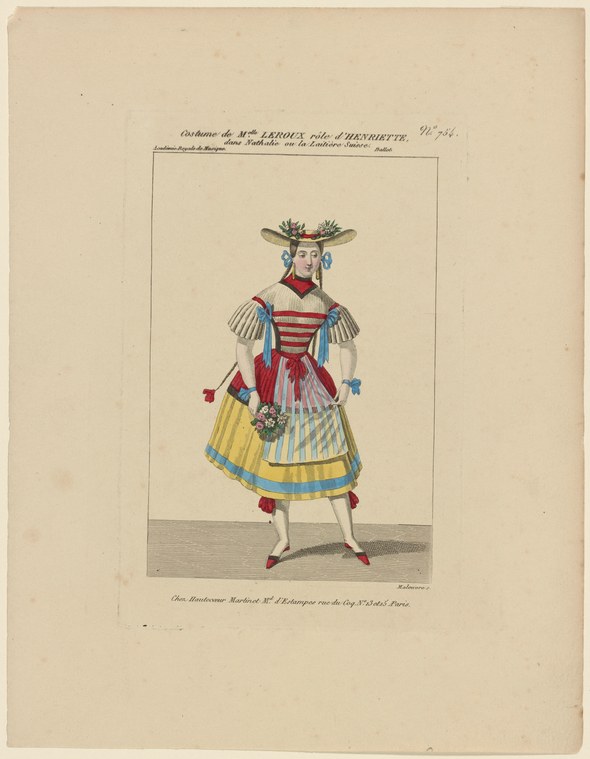
Costume de Melle. Leroux, rôle d'Henriette, dans Nathalie ou La laitière suisse, ballet, Académie royale de musique
Unknown artist
- Collection:
- Prints depicting dance
- Source:
- New York Public Library
- Rights:
- Public domain — free to use, share and adapt.
- Recorded as:
- Public Domain
Costume plates are among the most direct visual evidence we have of 19th-century ballet performance, because they were made from life for immediate documentary and promotional use. This plate shows us the exact silhouette, ornament, and color that a Romantic ballet dancer wore, and it tells us the name of the woman who danced this role—information that helps us reconstruct who performed what, when, and where, in an era when many performances were documented only through such prints. The Swiss milkmaid subject matter also situates this work within the broader Romantic fascination with exoticized rural and national characters.
What you are looking at
A single female dancer stands centrally against a plain background, posed in a moment of stillness that suggests a formal theatrical presentation. She wears an ornate costume typical of early 19th-century ballet: a fitted red bodice with horizontal striping, a voluminous skirt in yellow with blue horizontal bands at the hem, and pale stockings with red heeled shoes. Blue trim and tassels ornament the shoulders and sides of the skirt. She wears an elaborate headdress or crown adorned with feathers or plumes, and large blue earrings frame her face. Her posture is upright and formal, with one leg bearing her weight while the other extends slightly forward; her arms hang at her sides with hands held at her waist, suggesting either a pause between movements or a position of readiness. The figure is rendered in hand-colored engraving with meticulous attention to the patterning and ornamentation of the costume. The composition is a costume plate—a type of theatrical documentation showing the exact dress worn by a named performer in a specific role.
The dancing
The dancer's stance is upright and formally symmetrical, with minimal dynamic movement suggested by the pose. Her weight appears evenly distributed across both feet, with the extended leg showing a slight flexion rather than a fully turned-out extension. The arms are straight and restrained, not raised or gesticulating. The overall frame is one of presentation rather than action—the body is displayed frontally to show the costume's construction and ornamentation from a single, clear viewpoint. There is no indication of partner work or group formation.
The dance depicted
This is a costume plate for Mademoiselle Leroux in the role of Henriette from *Nathalie ou la laitière suisse* (*Nathalie, or The Swiss Milkmaid*), a ballet staged at the Académie royale de musique (Paris Opéra) in the early 19th century. The costume identifies the work as a Romantic-era ballet, likely from the 1820s-1830s based on the dress style. The image documents theatrical dress rather than choreographic content, but the upright formal posture and the restrained arm carriage are consistent with the petit allegro and demi-caractère vocabulary of early Romantic ballet. The Swiss-themed subject matter suggests the dance incorporated local or exotic character elements typical of the period.
How it was made
This is a hand-colored engraving (or possibly an aquatint), a production method that allowed for precise linear detail combined with applied watercolor or gouache to create the brilliant reds, yellows, and blues of the costume. The technique was standard for theatrical costume documentation in France during this period, enabling accurate recording of complex ornament and color for archival, promotional, and performance reference purposes. The quality of execution and the detailed rendering of textile patterns suggest this was a formal publication, likely distributed to Paris opera patrons or theatrical archives. The hand-coloring means each print would have been individually finished, making it both a functional document and a deluxe object.
About this work
This is a costume plate recording the dress worn by the dancer Mademoiselle Leroux in a specific role in a Romantic ballet performed at the Paris Opéra in the early 19th century. It is one of a type of theatrical print that was central to the documentation and promotion of dance during this period—a image-text pairing that fixed both the performer's name and the exact appearance of their stage costume. Such prints circulated among the theater's subscribers, in published collections of costume designs, and in the archives of the Opéra itself, making them a crucial source of knowledge about how dancers actually looked on stage. The work sits at the intersection of dance history, fashion history, and the history of theatrical production; it tells us not what the choreography was, but how it was dressed.
How to look at it
Notice the precision with which every detail of the costume has been recorded—the stripe pattern of the skirt, the tassels, the specific placement of color blocks, the headdress ornament—because these details are the point. The pose itself is not a caught moment of dancing, but a formal presentation stance designed to display the costume clearly and symmetrically from the front. The viewer should understand that this is not a capture of movement, but a standing studio portrait of a performer in costume, made to be a reference document. Pay attention to what is not shown: the back of the costume, the way the fabric falls when moving, the dancer's face in detail—such information was typically recorded on separate plates if at all.
The period
This plate was created during the heyday of the Romantic ballet (circa 1820–1850), when the Paris Opéra dominated European dance and French ballet achieved international prestige. The costume itself—the fitted bodice, the long gathered skirt that falls to the ankles, the heeled shoes, the decorative headpiece—belongs to the vocabulary of demi-caractère costume, a category used for roles with a national or domestic (non-mythological, non-tragic) identity. The subject of the Swiss milkmaid reflects a broader Romantic interest in folk cultures and the picturesque peasant, visible in works like *La Sylphide* and *Giselle*. Such costume plates were produced industrially by Parisian print publishers and sold to ballet enthusiasts as both souvenirs and references; they were an important medium for disseminating knowledge of Parisian dance practice across Europe.
Where it lives
This is part of a collection of prints depicting dance held at the New York Public Library. Such plates were typically published in Paris by theatrical print houses and sold to subscribers of the Opéra and to the broader public; this example's presence in a major American research collection suggests it circulated internationally as a valued document of European dance practice.
Dance in this work
Questions about this work
What was a costume plate and why were they made?
Costume plates were hand-colored engravings that recorded the exact appearance of costumes worn in specific theatrical productions, with the performer's name and role identified. They served multiple purposes: they were reference documents for costume makers and the wardrobe department, promotional items sold to theater subscribers and the public, and archival records of the production. For historians, they are invaluable because they show us how dancers actually looked on stage, in precise color and detail.
What does 'Académie royale de musique' mean?
This was the official name of the Paris Opéra, the state-supported opera and ballet institution. It was the most prestigious venue for dance in Europe during the 19th century, and the roles danced there by leading performers like Mademoiselle Leroux were major events documented in prints and reviews.
What is a demi-caractère costume?
Demi-caractère (or half-character) costumes were worn by dancers playing realistic or national characters—peasants, milkmaids, village girls—rather than mythological or purely allegorical figures. They typically included decorative but wearable dress that suggested a specific place or culture, as in this Swiss milkmaid costume. The term distinguished such roles from the ethereal, ethereal costuming of the Sylphide or fairy roles.
How was this print made?
This is an engraving (or aquatint), a technique that creates an image through incised or etched lines on a copper plate, which is then inked and printed. The black line and tone provided by the engraving were then hand-colored with watercolor or gouache applied by hand to each individual print, making each one unique and allowing the vibrant colors of the costume to be accurately represented.
More dance artwork





