49 works in this view — arrow keys or swipe to move between them.
Dance in Art
Hermine Blangy (de l'Académie royale de musique de Paris)
Unknown artist
- Collection:
- Prints depicting dance
- Source:
- New York Public Library
- Rights:
- Public domain — free to use, share and adapt.
- Recorded as:
- Public Domain
This is a rare named record of a specific Romantic-era ballerina and her signature role, making it valuable evidence for the history of French ballet and the construction of the dancer as a theatrical icon. The image also documents the technical vocabulary of early Romantic ballet—the épaulement, the sustained line, the emphasis on ethereality—at a moment when these qualities were becoming the hallmark of a new aesthetic.
What you are looking at
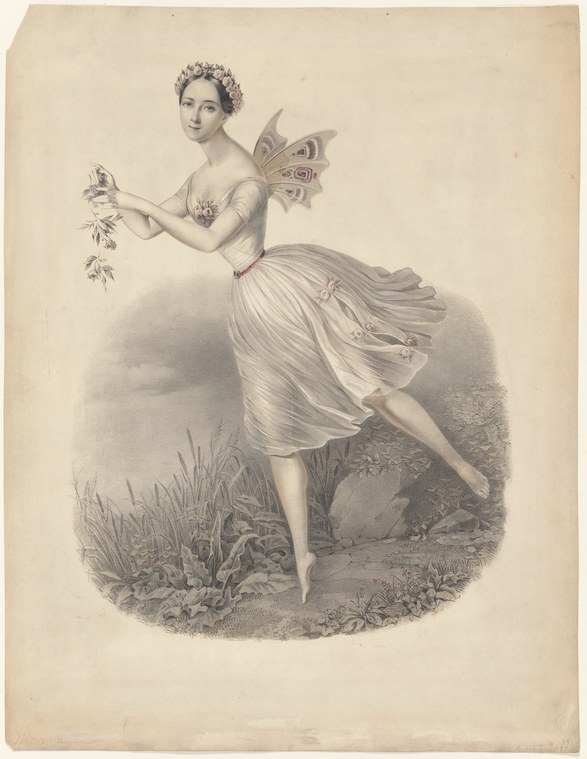
A young woman in a diaphanous classical dress is suspended in a balletic leap across a naturalistic landscape. She wears a fitted bodice and flowing skirt of fine pleated linen or muslin, her dark hair crowned with flowers, and her bare arm extends gracefully forward holding a bouquet of small flowers or herbs. A large pair of painted butterfly wings, rendered in warm earth tones with eyespots, are attached to her back. Her body is captured mid-flight, one leg extended behind in an arabesque or attitude derrière, the other bent beneath her. The background is a soft, shadowed garden or grotto with low vegetation and rocky outcrops rendered in mezzotint tone, while the foreground is left open to emphasize the figure's weightless elevation. The entire composition is framed as an oval vignette, a common format for theatrical portraits of the era.
The dancing
A single figure demonstrates a refined balletic port de bras and épaulement characteristic of early 19th-century Romantic ballet. Her torso is held upright and turned slightly away from the viewer, her head turned back toward the audience in a languid profile. The extended arm carries the bouquet with articulated grace; the supporting leg is fully stretched and turned. The pose suggests weightlessness and ethereality rather than the earthbound strength of classical technique. There is no partner or ensemble—this is a solo moment of transformation.
The dance depicted
This appears to be a portrait of a dancer—likely a ballerina of the Paris Opéra—performing in a pantomime or féerie with supernatural or allegorical content. The butterfly wings suggest a role as a sylph, fairy, or spirit creature; the flowers and naturalistic setting align with the taste for tales of enchantment that dominated French theatrical ballet in the 1830s–1840s. The balletic vocabulary visible—the épaulement, the lifted frame, the arabesque—confirms training in the Italian or French academic tradition. The portrait commemorates a celebrated performer (Hermine Blangy) in a specific role, making this as much a record of costume and character as of dancing body.
How it was made
This is a steel or copper engraving—likely a mezzotint or stipple engraving—printed and distributed as a sheet portrait. The soft modeling of tone, the fine detail in the fabric, and the vignette framing are all consistent with the reproductive engraving techniques that dominated theatrical portraiture in the early 19th century. This was a commercial print, intended for sale to theatergoers and collectors of dance memorabilia; the inscription naming the dancer and theater confirms it was marketed as a souvenir or collectible image of a star performer.
About this work
This is a commemorative engraved portrait of Hermine Blangy, a dancer of the Paris Opéra, captured in a moment of balletic flight as a supernatural or fairy character. The work documents both the Romantic aesthetics of early 19th-century theatrical ballet—the weightless elevation, the ethereal costume, the naturalistic fantasia setting—and the star system that elevated individual dancers to celebrity. Blangy was a significant performer of this era, and her image would have circulated among the Paris theater public as a souvenir or collectible.
The work belongs in this gallery because it is a primary document of how Romantic ballet was visualized and consumed. It freezes a specific moment of performance—the leap, the character, the body transformed by costume and role—and offers the viewer direct access to what a educated contemporary would have seen on the stage of the Académie Royale de Musique.
How to look at it
Pay attention to the moment arrested: this is not a leap of athletic power, but a sustained elevation that suggests weightlessness and disembodiment. The artist has chosen a pose of grace and reverie rather than effort. Notice the careful articulation of the arm and hand—the bouquet is held with delicate precision, and the épaulement (rotation of the shoulders) is pronounced, turning the torso away even as the head gazes back toward the viewer. This is the visual language of Romantic ballet, coded to suggest interiority and spiritual transcendence rather than bodily strength.
The artist
The engraver is not recorded. This portrait is from the commercial theatrical-print industry of Paris, which in the 1830s–1840s produced thousands of likenesses of celebrated performers in costume. The prints were usually engraved after drawings or paintings by theater artists or portraitists (names often not retained), and sold individually to the public. The style and execution suggest a competent professional practitioner working within the conventions of Parisian reproductive engraving.
The period
This portrait was created during the height of Romantic ballet, a moment when supernatural narratives, the ethereal ballerina, and the technical vocabulary of elevation and weightlessness came to dominate European dance aesthetics. La Sylphide (1832) and Giselle (1841) established the canonical Romantic ballet roles, and Blangy's image may document her participation in this repertory. The commercial print industry in Paris was flourishing in the 1830s–1840s, as the modern star system emerged and theatergoers purchased images of favorite performers to display at home.
Where it lives
This engraved sheet portrait comes from the New York Public Library's Prints depicting dance collection. It is one of thousands of such portraits produced for the theatrical market in the 19th century. Blangy's name and theater affiliation are inscribed on the print, suggesting it was marketed as a souvenir of her performance.
Dance in this work
Questions about this work
Who was Hermine Blangy?
Hermine Blangy was a ballerina of the Paris Opéra in the early-to-mid 19th century, performing during the height of the Romantic ballet era. She was prominent enough to be immortalized in printed theatrical portraits, indicating she was a celebrated performer. The specific dates and details of her career are not recorded here, but the quality and circulation of her image suggest she was a star attraction.
What are the butterfly wings?
The wings indicate that Blangy is performing a supernatural or fairy character—likely a sylph or spirit creature. This aligns with the taste for pantomime and féerie (spectacle) that dominated French theatrical ballet in the 1830s–1840s, especially after the triumph of La Sylphide (1832), which established the ethereal sylph as an iconic Romantic role.
Is this a print or a painting?
This is an engraved print—most likely a mezzotint or stipple engraving. It is not an original artwork but a reproductive print, mass-produced and sold to the public as a souvenir or collectible. The technique and style are consistent with Parisian theatrical portraiture of the 1830s–1840s.
What dance vocabulary is shown?
The pose demonstrates classical ballet technique of the Romantic period: an arabesque or attitude derrière, pronounced épaulement (rotation of the shoulders), a lifted and elongated frame, and a graceful port de bras (carriage of the arms). The emphasis on weightlessness and ethereality, rather than athletic power, is characteristic of the emerging Romantic aesthetic.
More dance artwork





