49 works in this view — arrow keys or swipe to move between them.
Dance in Art
Le diable boiteux
Unknown artist
- Collection:
- Prints depicting dance
- Source:
- New York Public Library
- Rights:
- Public domain — free to use, share and adapt.
- Recorded as:
- Public Domain
This image reveals the visual repertoire of eighteenth-century popular theatre—the costumes, character types, and gestural language that governed stage entertainment outside the court and concert hall. The Limping Devil was a stock comic character across European popular theatre; seeing how he was rendered in prints helps us understand what made audiences laugh and how theatre-makers built character through physical exaggeration and costume excess.
What you are looking at
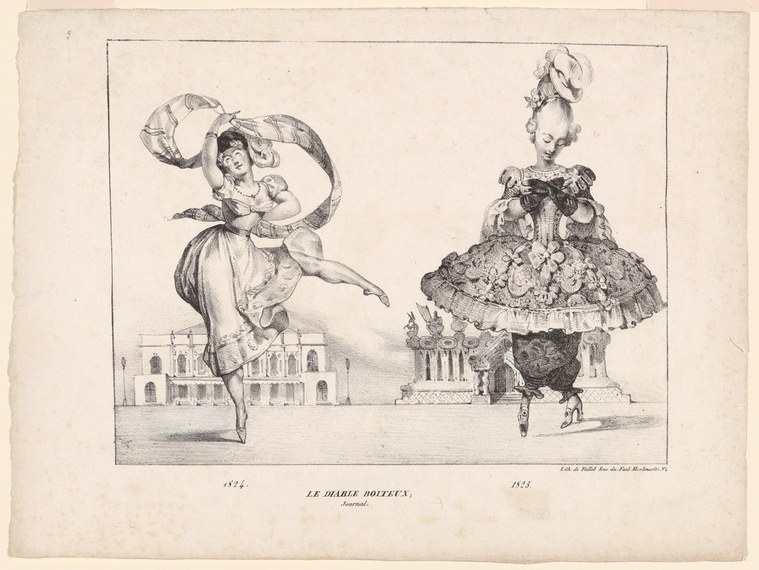
This engraving depicts two theatrical figures in exaggerated costumes against a backdrop of classical architecture. On the left, a dancer in a draped skirt with voluminous fabric caught mid-swirl wears a large feathered hat and appears caught in a dynamic, off-balance movement, one leg extended. The figure's posture suggests a hobbling or uneven gait. On the right stands a more static figure in an elaborate dress constructed entirely of gathered fabric with a prominent bow and ornamental headdress, positioned frontally as if for display. Both figures occupy a stage-like space defined by classical buildings in shallow recession behind them. The print's title, "Le diable boiteux" (The Limping Devil), references Lesage's picaresque novel and the commedia dell'arte tradition. The composition contrasts dynamic, precarious movement on the left with static presentation on the right.
The dancing
The left figure's body is twisted and off-kilter, weight shifted to suggest stumbling or hobbling—the hallmark of the "lame devil" character. The right leg is extended back and the torso leans forward dramatically, with arms raised in a gesture between balance-seeking and theatrical flourish. The right figure maintains an upright, symmetrical stance with arms at rest, positioned as a complementary foil. Neither figure displays the formal hold or frame of ballroom dance; instead, both occupy the exaggerated, asymmetrical vocabulary of theatrical burlesque and commedia dell'arte—grotesque, unbalanced, designed to provoke rather than instruct.
The dance depicted
This is theatrical burlesque or commedia dell'arte performance, not ballroom or concert dance. The work illustrates the character of Asmodeus (the limping devil from Lesage's 1707 *Le Diable boiteux*), a stock figure of 18th-century popular theatre. The image captures the character's defining trait—the uneven, stumbling gait—as theatrical vocabulary rather than virtuosic movement. This was entertainment for audiences of fairs, street theatres, and popular stages rather than court or concert halls, designed for broad, comic effect rather than technical display.
How it was made
The work is an engraving, made from a metal plate and printed as a relief image. The fine parallel lines (hatching) visible throughout create tonal modulation and define form. This technique allowed the image to be reproduced and distributed widely in printed form, making it accessible to a broad popular audience as a record of theatrical fashion and character types. Engravings of this kind were sold as prints at street fairs and theatrical venues, serving both as advertisement and as collectibles for theatre-goers.
About this work
This is a print documenting eighteenth-century theatrical burlesque, specifically the character of the Limping Devil from popular stage adaptations of Lesage's *Le Diable boiteux*. The work belongs not to the history of concert dance but to the visual culture of theatre, carnival, and street entertainment. The figures' exaggerated costumes and asymmetrical gestures tell us what audiences understood as theatrical comedy: grotesque departure from grace, visual excess, and the body deployed for mockery rather than beauty. It is a document of how the theatre communicated character type through costume and pose.
How to look at it
Look at the contrast between the two figures: the left dancer's body is all disequilibrium—asymmetrical, strained, caught in an ungainly moment—while the right figure presents a static, frontal display of costume as spectacle. This is not the aesthetic of grace or technical virtuosity; instead, the artist has frozen the moment of awkwardness and exaggeration that made the character funny. The feathered hat, the swirling skirt, the off-balance stance—all are designed to register visually as excess and comic transgression. The shallow stage space and architectural backdrop place the figures firmly in the theatre.
The artist
The artist is not recorded. The print is part of the New York Public Library's collection of prints depicting dance and theatre. Works of this type were often produced anonymously or by commercial workshop engravers rather than named artists, and many lost attribution over time. The style and technique suggest a commercial atelier working in the eighteenth century for a popular market.
The period
The Limping Devil was a persistent figure across eighteenth-century popular entertainment, appearing in pantomimes, fair-ground theatres, and street performances across Europe. The character drew on commedia dell'arte traditions (where physical deformity and exaggeration were comic staples) and on Lesage's literary figure. This was the age before the professionalization and canonization of dance that led to ballet's academy and the concert stage; theatrical movement inhabited the streets, fairs, and unlicensed theatres. These prints served as promotional material and souvenirs, reaching audiences who would never see a formal printed libretto.
Where it lives
This print is held in the New York Public Library's Prints collection, part of a broader assemblage of prints depicting dance from the eighteenth century onwards. It is a commercial print product, likely sold at street theatres or fairs as both advertisement and souvenir.
Dance in this work
Questions about this work
What is Le Diable Boiteux?
It is a picaresque novel by Alain-René Lesage (1707) about a lame demon who gains the power to fly and surveys human life. The story spawned numerous theatrical adaptations across eighteenth-century Europe, including pantomimes, comic operas, and fair-ground entertainments. The Limping Devil became a stock comic character.
Is this ballet?
No. This is theatrical burlesque or commedia dell'arte—popular, street-level entertainment designed for broad comic effect. The movement vocabulary is deliberately grotesque and unbalanced, the opposite of ballet's emphasis on elevation, turnout, and control. This reflects the vast world of eighteenth-century theatre that existed outside courts and concert halls.
What was the audience for this print?
Prints like this were sold at theatrical venues, fairs, and street stalls to theatre-goers and souvenir collectors. They served as both advertisement for upcoming performances and as mementos. The print format allowed commercial reproduction and distribution to a popular market, unlike hand-drawn theatrical designs which remained rare and expensive.
Who made this print?
The artist is unknown. It was likely produced by a commercial workshop rather than a named artist, as was common practice in eighteenth-century popular printmaking. Many prints of this kind lost attribution as they passed through multiple collections and sales over centuries.
More dance artwork





