49 works in this view — arrow keys or swipe to move between them.
Dance in Art
The "Favourite" quadrilles from Donizetti's opera of that name arranged for the piano forte by W. H. Montgomery
Unknown artist
- Collection:
- Prints depicting dance
- Source:
- New York Public Library
- Rights:
- Public domain — free to use, share and adapt.
- Recorded as:
- Public Domain
This print documents the intermediate world of theatrical dance arrangement in the 19th century, when ballroom dances like the quadrille were restaged as ballet by composers and choreographers seeking to capitalize on fashion and operatic celebrity. For historians of Romantic ballet and for musicians interested in the stage life of 19th-century opera, it provides concrete evidence of how canonical dances were transformed for theatrical consumption and the female form celebrated within that transformation.
What you are looking at
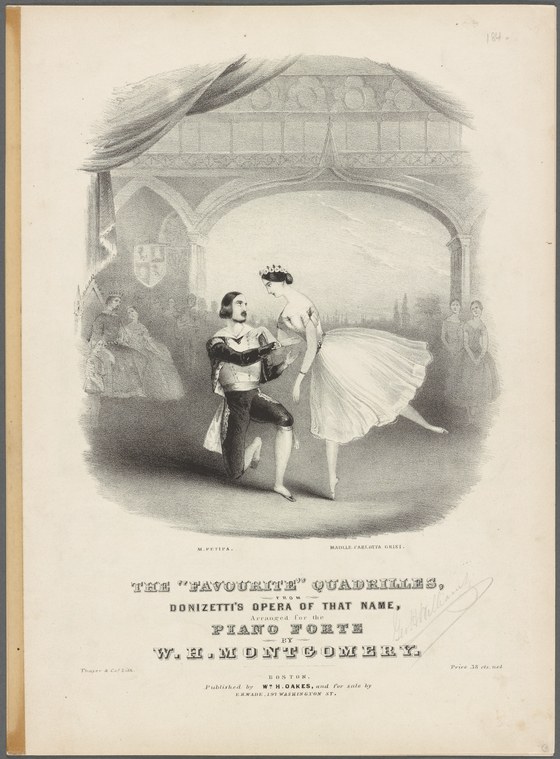
A theatrical scene of a female dancer in a white tulle skirt and dark bodice, caught in a moment of balletic movement on a stage. She appears to be executing a pirouette or similar turn, with her skirt billowing outward in a characteristic bell shape that defines the Romantic era of ballet. A male dancer in dark clothing attends her from the left, shown in a supporting gesture. The setting is a theatrical interior with architectural framing—arched doorways and draped fabric suggest a stage box or interior scene, while the background shows a distant cityscape with spires, establishing a narrative context. The lighting is dramatic, with sharp contrasts of light and shadow creating depth and focus on the central female figure. The composition is intimate and focused, typical of theatrical prints intended to capture a specific moment from a performance or act.
The dancing
The female dancer is captured mid-rotation, with her weight seemingly centered over one leg while her extended leg and skirt create a broad horizontal plane. The male figure stands in an attentive pose with arms positioned to support or frame her movement, displaying the partnered relationship central to Romantic ballet vocabulary. His posture is upright and formal, reflecting the supporting role in the pas de deux. Both figures are rendered in classical ballet positions with turned-out legs and held upper bodies, though the precise angle and the billowing skirt make exact footwork difficult to assess from this print.
The dance depicted
This is a Romantic ballet scene from Gaetano Donizetti's opera *La favorite* (The Favorite), arranged as a quadrille for piano. The quadrille was the most fashionable ballroom dance of the 19th century, and theatrical arrangements of operatic themes as quadrilles were hugely popular both for stage performance and domestic music-making. The image shows not actual quadrille steps (which are geometric figures danced by four couples) but rather a theatrical pas de deux or solo moment from the opera, captured in the Romantic ballet idiom of the period. The print is a theatrical souvenir, designed to commemorate a specific performed arrangement rather than to depict the dance structure of the quadrille itself.
How it was made
This is a lithographic print, recognizable from the tonal gradations and the characteristic soft crayon-work visible in the shading and drapery rendering. Lithography allowed rapid, economical production of theatrical prints in quantity, making it ideal for the flourishing market in operatic and dance imagery during the 1830s–1850s. The level of detail and the dimensional treatment of the stage space suggest a skilled theater lithographer working from a theater design or actual performance. The print would have circulated as a theatrical souvenir sold at the opera house, functioning as both advertisement and memento.
About this work
This is a theatrical souvenir print documenting a staged musical arrangement of Donizetti's opera *La favorite*, arranged as a quadrille for piano and set by choreographer W. H. Montgomery. It captures a moment of Romantic ballet technique—a pivoting turn by a female dancer in canonical Romantic dress (dark bodice, voluminous white tulle skirt) with a male partner in attendance. Rather than depicting the geometric social structure of the quadrille itself, the image shows a theatrical pas de deux framed within the conventions of stage ballet, which had become the dominant language for such operatic arrangements in the 1830s–1850s. The work sits within the vast category of theatrical prints that served as both documentation of specific performances and objects of consumption for ballet and opera enthusiasts of the Romantic era.
How to look at it
Look at the moment chosen: not a static pose but a captured turn, with the skirt's trajectory suggesting the centrifugal force of the rotation. The artist has chosen a moment of visible motion, which was the domain of performance lithography—freezing an instant of kinetic energy rather than presenting a formal position. The scale and prominence of the female figure, with the male dancer subordinated to the side, reflects the gendering of Romantic ballet spectatorship, in which the female body in motion was the primary object of visual attention. The architectural framing and theatrical setting anchor this as theatrical entertainment rather than social ballroom practice.
The artist
The artist is not recorded in the catalogue, but the lithograph bears a signature or mark characteristic of mid-19th-century theater lithographers. Such prints were typically created by theater workshop printers and lithographers whose names were often not recorded or credited, working from sketches by stage designers or directly from theater designs. W. H. Montgomery, credited as the arranger of the quadrille, may have been the stage choreographer or composer associated with the production.
The period
This work dates to the height of the Romantic ballet period (approximately 1830s–1850s), when the female dancer in the ethereal white tutu became the primary focus of theatrical spectacle and desire. Donizetti's *La favorite* premiered in 1840 and was enormously popular throughout Europe; operatic arrangements as quadrilles were a standard commercial product, aimed at ballrooms and drawing rooms that wished to dance to themes from successful operas. The quadrille itself was the dominant social ballroom dance of the period, and its theatrical adaptation represented a form of cultural cross-pollination between the opera house and the ballroom. Theater lithographic prints flourished as a market category during this period, enabling the wide circulation of ballet and operatic imagery.
Where it lives
This lithographic print is held in the New York Public Library's collection of prints depicting dance, part of their broader holdings in theatrical and dance imagery. It is a commercial theatrical souvenir, one of many such prints produced to document and promote opera and ballet performances in the 19th century.
Dance in this work
Questions about this work
What is a quadrille arrangement in the 19th century?
A quadrille is a ballroom dance for four couples, typically structured in five figures and set to popular melodies. In the 19th century, composers and choreographers frequently arranged famous operatic themes as quadrilles for ballroom and theatrical consumption. This allowed people to dance or watch performed versions of music from operas they had attended or loved. The theatrical arrangement shown here transforms the social dance into a staged ballet spectacle.
Who was W. H. Montgomery?
The catalogue records Montgomery as the arranger of this quadrille, but biographical details are not available in the current record. He may have been a theater choreographer, composer, or music arranger associated with the production of this operatic arrangement during the 1830s–1850s.
Is this showing the quadrille dance itself?
No. The quadrille is a geometric, multi-couple formation, whereas this image shows a Romantic ballet pas de deux or solo with a partnered male dancer. This is a theatrical arrangement of operatic music in ballet form, not a depiction of how the quadrille was actually danced in ballrooms. The print is a souvenir of a specific staged performance.
Why is the female figure so much larger and more prominent?
This reflects the aesthetics and power structures of Romantic ballet, in which the female dancer became the primary focus of spectacle. The male dancer is positioned in a supporting, attending role, a convention that dominated ballet stagecraft from the 1830s onward.
More dance artwork





