49 works in this view — arrow keys or swipe to move between them.
Dance in Art
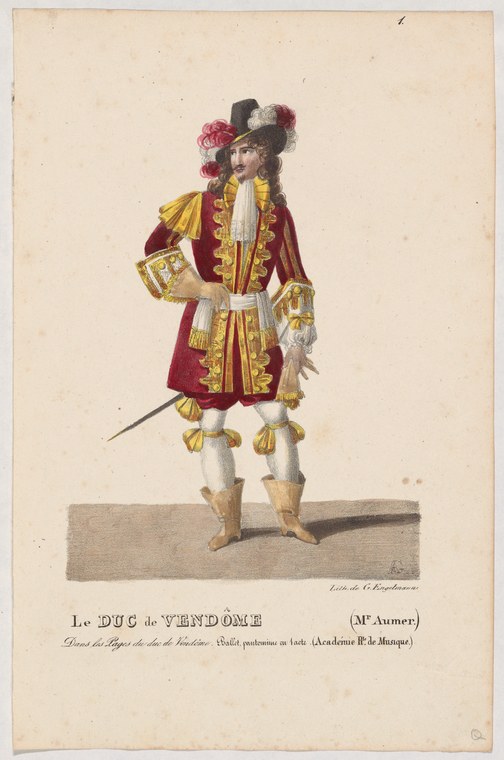
Le duc de Vendôme (Mr Aumer) dans Les pages du duc de Vendôme, ballet pantomime en 1 acte (Académie Rle. de musique)
Unknown artist
- Collection:
- Prints depicting dance
- Source:
- New York Public Library
- Rights:
- Public domain — free to use, share and adapt.
- Recorded as:
- Public Domain
This image provides rare visual documentation of early 19th-century ballet costume and the physical presentation of male dancers in noble or danseur roles at a time when theatrical prints were among the few ways performances reached the public beyond Paris. Aumer was a significant figure in ballet history—both as a dancer and as a choreographer who bridged classical and Romantic styles—and this portrait contributes to the visual record of his career and the conventions of male ballet costume in the Romantic era.
What you are looking at
A single male dancer stands in profile against a pale ground, isolated in an empty stage space. He wears the costume of 18th-century French court nobility: a richly embroidered coat in deep crimson or wine-red, heavily trimmed with gold braid and ornamental buttons down the front and along the sleeve edges. Beneath the coat, white stockings cover his calves, and he wears heeled shoes. His upper body is framed by the coat's dramatic sideseams and skirts. He holds a sword at his left side, its blade angling downward in a gesture of ease rather than aggression. His head is turned slightly, wearing a dark tricorn hat adorned with what appears to be white plumes or ribbon cockade. One arm hangs naturally; the other is bent, the hand positioned near his hip. The figure stands in a composed, noble posture characteristic of court presentation rather than active movement—weight appears settled and formal.
The dancing
A single male figure in an upright, static stance with weight centered and evenly distributed. The posture is one of formal presentation: shoulders back, chest open, head held high in the manner of court nobility. The arm positions are symmetrical and restrained—one arm hangs to the side while the other bends slightly at the elbow. There is no suggestion of balletic turnout, extension, or the explosive energy of stage combat. Instead, the body language conveys courtly bearing and aristocratic dignity—the dancer is being seen rather than performing an action.
The dance depicted
This appears to be a costume study or character portrait from a theatrical ballet rather than a depiction of active dance movement. The inscription names this as 'Le duc de Vendôme' performed by 'Mr Aumer' in a one-act ballet pantomime titled *Les pages du duc de Vendôme* at the Académie Royale de Musique (the Paris Opéra). The work likely dates to the early 19th century based on costume and printing style. The figure represents a dramatic or danseur character—a noble male role—and the static presentation suggests this is a portrait of the dancer in costume as much as a record of choreography. Aumer was a celebrated ballet master and dancer of the Romantic era; this image may have been used to publicize a production or commemorate a notable performance.
How it was made
This is a hand-colored engraving or possibly a colored lithograph—likely French, printed in Paris and possibly distributed as a theatrical souvenir or print for collectors of opera imagery. The technique shows fine line work defining the costume details, particularly the embroidery and trim, with color applied afterward in a limited palette. The style of inscription, typeface, and compositional conventions are consistent with early 19th-century French theatrical prints, which were widely circulated among the public who attended the Opéra. Such prints served both as souvenirs and as documentation of celebrated performers and productions.
About this work
This is a costume portrait of a male dancer as a noble character in an early 19th-century ballet pantomime at the Paris Opéra. It documents both the theatrical costume conventions of the era—the elaborately trimmed coat, heeled shoes, sword, and aristocratic bearing—and the specific casting of the noted dancer Jean-Louis Aumer in a leading role. The work sits at the intersection of theatrical documentation and portraiture, offering insight into how male dancers of the Romantic era were costumed and presented. The static, formal composition emphasizes character and status over choreography, suggesting this served as a commemorative or promotional image for the production.
How to look at it
Attend to the costume details: the degree of embroidery, the cut and length of the coat, the proportions of the heel, and the presence of the sword all communicate the character's rank and role. Note that the dancer is shown in a moment of stillness and formal presentation rather than mid-movement—this was a common convention for theatrical portraiture of the era, designed to display the costume and the performer's noble bearing rather than to capture choreography. The isolated figure against a plain ground emphasizes the dancer's silhouette and the costume's line, a technique standard in European theatrical prints of this period.
The period
This print dates to the Romantic era of ballet, roughly 1815–1850, when the Paris Opéra was the center of European dance innovation. Male dancers of this period occupied a complex position: they were still essential to ballet, yet female dancers in pointe work were increasingly the focus of critical attention and public fascination. Aumer himself was known for both his technique and his dramatic presence, and he later became a celebrated choreographer. The costume shown here—the ornate 18th-century-inspired coat and sword—reflects the Romantic era's taste for historical costume and aristocratic grandeur in narrative ballets. Theatrical prints like this were popular commodities; audiences collected them, pasted them into albums, and used them to remember performances and favorite performers.
Where it lives
This hand-colored engraving is held by the New York Public Library in its collection of prints depicting dance. It is catalogued as a theatrical souvenir or documentation print from the Paris Opéra and likely circulated as a commercial print sold to opera-goers and collectors in early 19th-century France.
Dance in this work
Questions about this work
Who was Jean-Louis Aumer?
Aumer (1774–1833) was a French ballet dancer, choreographer, and ballet master at the Paris Opéra during the Romantic era. He was known for both his dancing and his later choreographic work, and he was influential in the transition from Classical to Romantic ballet conventions. He also worked in Milan and other European opera houses.
What is a 'ballet pantomime'?
Ballet pantomime is a theatrical genre that combines dance, mime, and narrative storytelling, common in 18th and 19th-century opera houses. Unlike pure ballet, which emphasizes formal technique and abstract movement, ballet pantomime foregrounds dramatic action and character, with dancers using gesture and expression to convey plot and emotion.
Why is this dancer holding a sword?
The sword identifies the character as a nobleman or aristocratic figure—likely a historical or fictional duke named Vendôme. The formal costume and sword-carrying position suggest a courtly or military character, typical of Romantic-era narrative ballets that drew inspiration from historical settings and aristocratic life.
Why was male ballet fashion different from female?
Male dancers wore heeled shoes, breeches or tight stockings, and elaborately decorated coats based on 18th-century court fashion, emphasizing nobility and status. Female dancers, by contrast, increasingly wore the tutu and pointe shoes. These differences reflected both practical movement needs and the era's changing aesthetic values, which increasingly privileged the ethereal female form over male athleticism.
More dance artwork





