49 works in this view — arrow keys or swipe to move between them.
Dance in Art
Dance on music covers
Unknown artist
- Collection:
- Prints depicting dance
- Source:
- New York Public Library
- Rights:
- Public domain — free to use, share and adapt.
- Recorded as:
- Public Domain
Sheet music covers are among the most abundant but least studied documents of dance history, yet they reveal which dances were actually popular, how they were costume and marketed, and what theatrical traditions existed outside the ballet canon. This image records not a canonical dance form but a real performing group and the visual conventions used to advertise them to the public, making it essential evidence for understanding 19th-century popular culture.
What you are looking at
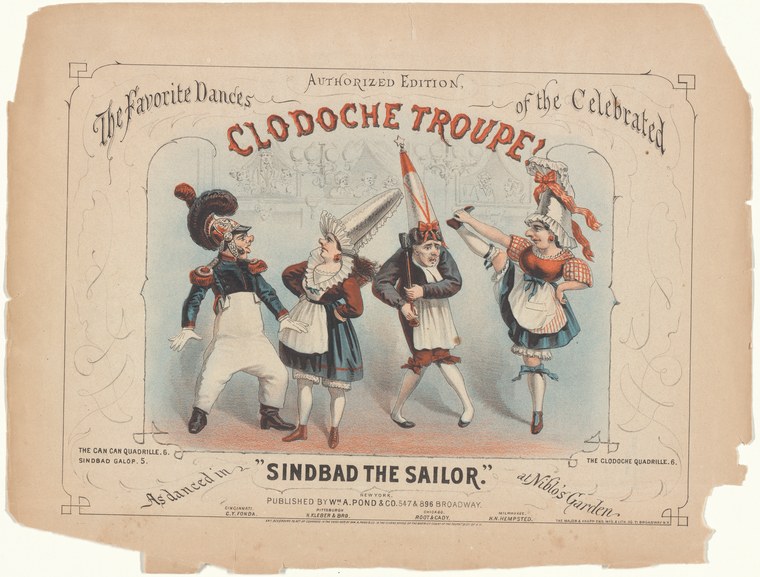
A colorful lithographic cover for sheet music titled "Clodoche Troupe" depicts four dancers in elaborate period costume arranged in a lively group composition. The scene shows energetic movement: figures strike exaggerated poses with limbs extended, some brandishing swords or other props. The dancer on the left wears a dark jacket with feathered hat; those in the center and right sport blue skirts, white aprons, and caps, along with brightly colored upper garments in red and orange. The figures are caught mid-leap or mid-turn, their bodies angled dynamically across the frame. The background is minimal, rendered in soft grays, allowing the costumed figures and their vivid color accents to dominate. The composition has the theatrical energy characteristic of mid-to-late 19th-century popular entertainment publicity.
The dancing
Four figures occupy the frame, none in formal ballroom hold. The bodies are loose and exuberant: legs kick or extend high, arms reach upward or outward, torsos twist. The leftmost dancer (in masculine dress) leans dramatically while brandishing a sword; the others gesture expansively or hold props. The weight appears to shift dynamically from foot to foot rather than held in a centered frame. The postures suggest social or popular dance rather than the controlled line of classical ballet.
The dance depicted
The title "Clodoche Troupe" indicates this advertises a performance ensemble rather than identifying a specific named dance form. The costumes—a mix of folk-inspired skirts, white aprons, and period jackets—and the exuberant, uncontrolled postures suggest this depicts a theatrical novelty or comedy act of the Gilded Age, the sort of spectacle acts that toured music halls and theaters in the late 19th century. The Clodoche Troupe appears to have been a real performing group, though the identities of individual dancers are not preserved. The image style and publisher information suggest this is publicity material meant to advertise their performances to theater-goers.
How it was made
This is a color lithograph, a printing technique that allowed rapid, cost-effective reproduction of vibrant theatrical publicity materials. Lithography made possible the bold, flat color areas and hand-drawn character visible here, and the technique's capacity for quick turnaround made it the standard medium for sheet music covers and theatrical advertisements throughout the 19th century. The presence of registration marks in the corners and publisher information at bottom confirms this was a commercial product made for distribution, not a unique work.
About this work
This is a sheet music cover from the late 19th or early 20th century (the exact date is not recorded in the catalogue) advertising performances by the Clodoche Troupe, a theatrical dance and comedy ensemble. The image captures the visual language of Gilded Age popular entertainment: vivid color, exaggerated gesture, and costume spectacle designed to draw audiences to theaters and music halls. It is neither classical ballet nor a preserved folk dance, but rather a record of the commercial theatrical landscape—the variety shows, novelty acts, and traveling troupes that dominated popular culture in this period.
What makes this image valuable to dance historians is precisely what makes it seem marginal: it documents the entertainment vernacular that existed alongside and outside the institutions of classical dance. Most dance history has focused on ballet companies and formal pedagogies; images like this reveal what ordinary audiences actually saw and paid for.
How to look at it
The artist has chosen a moment of maximum exuberance and spectacle—bodies stretched, limbs extended, movement in all directions at once. This is not documentary realism but promotional exaggeration: the poses are designed to arrest attention and convey energy and excitement on a theater lobby wall or in a window display. Notice the contrast between the rhythmic, controlled poses of formal dance and the anarchic, explosive energy of these four figures; this collision is exactly the point. The lithographic medium allows for saturated, eye-catching color and bold outlines that make the figures readable from a distance.
The period
This cover dates to the era of the music hall and traveling theatrical troupes, when variety entertainment—including dance acts, comic performances, and novelty numbers—dominated popular amusement. Sheet music was a major medium for publicity in this period, and cover illustrations competed vigorously for the attention of potential buyers. The visual style is consistent with commercial chromolithography of the 1880s–1910s. By this time, classical ballet had become increasingly institutionalized and associated with formal concert halls; the broader public experienced dance mainly through variety shows, circuses, operetta, and street entertainment like those the Clodoche Troupe appears to have performed.
Where it lives
This object is held in the New York Public Library's collection of prints depicting dance, a holding that includes theatrical publicity, dance instruction manuals, and performance documentation spanning centuries. It is catalogued as a music cover, indicating it either accompanied a musical score or advertised the availability of one. The publisher information (The Capon Quarville [?] on the printed sheet) and library cataloging marks suggest this was acquired as part of a broader collecting effort around theatrical and popular culture materials.
Dance in this work
Questions about this work
Who were the Clodoche Troupe?
Little biographical information survives, but they appear to have been a dance and performance ensemble active in the late 19th century, touring theaters and music halls. This cover was produced as publicity material to advertise their performances. They represent the many semi-professional and traveling entertainment troupes that were central to popular culture but rarely received the institutional documentation afforded to ballet companies.
What kind of dance is this?
It is not a formally named or canonical dance style. Based on the costumes (folk-inspired skirts and jackets), the dynamic, uncontrolled postures, and the theatrical context, this appears to be a novelty or comedy entertainment act—the kind of variety spectacle that filled music halls and theaters. It may incorporate elements of folk dance, comic pantomime, or acrobatics.
Why is this a sheet music cover?
In the 19th century, theatrical troupes often had signature musical pieces or songs associated with them. The cover would have advertised both the music and the performance group, allowing audiences who had enjoyed a show to purchase the music for home performance, and potentially drawing new audiences to live performances. Sheet music was a major medium for entertainment publicity.
What does the lithographic medium tell us?
Lithography was the dominant commercial printing technology of the late 19th century. It was fast, cheap, and allowed vivid color reproduction, making it ideal for mass-produced publicity materials. The presence of this image as a color lithograph tells us that the Clodoche Troupe was a profitable enough venture to warrant professional promotional printing, suggesting they had genuine commercial success.
More dance artwork





