49 works in this view — arrow keys or swipe to move between them.
Dance in Art
Lola Montez
Unknown artist
- Collection:
- Prints depicting dance
- Source:
- New York Public Library
- Rights:
- Public domain — free to use, share and adapt.
- Recorded as:
- Public Domain
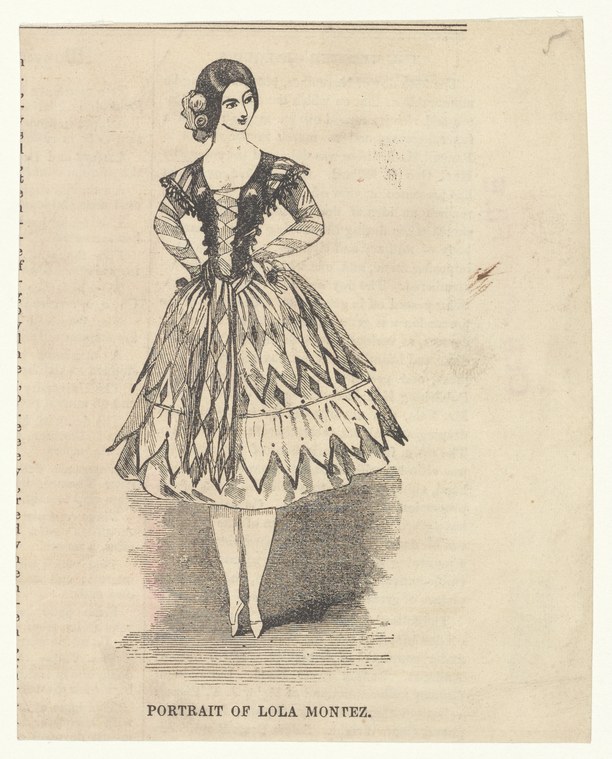
Lola Montez was a revolutionary figure in 19th-century dance, known for introducing sensual, dramatic movement to European and American stages and for rejecting the rigid conventions of classical ballet in favor of theatrical spectacle and personal presence. This image is crucial evidence of what dancers of her era wore, how they were marketed, and how performance identity was constructed and commodified through printed media. It shows the visual language used to represent female performance and sexuality in the mid-Victorian era.
What you are looking at
A single female figure stands center stage in a three-quarter pose, facing left, against a plain background rendered in soft tonal washes. She wears an elaborate mid-19th-century costume: a dark lace corsage or bodice with short puffed sleeves trimmed in lace, and a voluminous skirt composed of multiple tiers of scalloped or flame-like fabric panels that create a distinctive jagged silhouette. The skirt, rendered with fine parallel hatching lines, extends to mid-calf, revealing her legs in pale stockings and dark heeled shoes. Her dark hair is arranged in ringlets at the sides. The figure is balanced on one leg in a posed position, her body angled gracefully, her posture suggesting theatrical presentation rather than active movement. The engraving technique produces crisp outlines and fine linear detail, with areas of shadow created through cross-hatching and parallel lines.
The dancing
The dancer stands on one supporting leg with a slight bend, the other leg extended or relaxed beneath the skirt. Her torso is held upright, her shoulders squared, her arms positioned at her sides or slightly forward in a posed, presentational manner. Her head is turned to face left, gazing downward in a composed, demure expression. The pose reads as a formal moment of presentation or pause rather than mid-movement—the figure appears stable and poised for display, characteristic of theatrical portraiture where the dancer's most distinctive or recognizable costume is shown clearly.
The dance depicted
This is a portrait of the Spanish dancer Lola Montez, whose name appears in the inscription below the image. Montez was famous throughout Europe and America in the 1840s–1850s for her fiery dramatic and sensual dancing style, particularly her signature 'Spider Dance' performed in a similar costume. The scalloped skirt panels and overall silhouette are consistent with mid-19th-century theatrical costume, though the pose here emphasizes presentation over active dancing. The image documents both the performer and the iconic costume associated with her fame, functioning as a stage portrait or theatrical print that would have been distributed to theater audiences and collectors.
How it was made
This is an engraving or wood-engraved print, executed in black ink on paper, using fine linear hatching and cross-hatching to create tonal gradations and shadow. The technique allows for sharp detail in the costume ornament and clear outlines of form, ideal for reproductive circulation. The controlled, regular parallel lines and crisp edges indicate skilled engraving work, and the print quality suggests professional publication, likely for a theater audience, dance enthusiasts, or fans of the performer. Such prints were commonly distributed as affordable souvenirs of celebrated performers.
About this work
This is a stage portrait of Lola Montez, one of the most celebrated and notorious dancers of the 19th century, rendered as a professional engraving for public circulation. The image documents both the performer's likeness and the distinctive theatrical costume that defined her public identity, particularly the dramatic scalloped-panel skirt that became her signature silhouette. As a printed image of a living performer, it served multiple purposes: advertising, fan memorabilia, and documentation of a performance style and era. The engraving medium and formal presentation indicate this was an official or semi-official theatrical print, created to capitalize on Montez's celebrity and designed for wide distribution.
How to look at it
Notice the deliberate choices in the pose and costume presentation: the figure is arranged to display the costume's most striking feature—the scalloped, flame-like skirt panels—in full profile, while her face and body posture convey composed control and theatrical presence rather than explosive movement. The engraver has prioritized clarity and detail, allowing every element of the costume to be read clearly. Compare this formal presentation with documentary accounts of Montez's actual performances, which witnesses described as energetic, flirtatious, and scandalous; the print trades kinetic energy for iconic stillness and availability for viewing.
The artist
The engraver is not recorded in the catalogue. The print was likely created by a professional theater illustrator or commercial engraver working in the 1840s–1850s, when such stage portraits were standard theatrical merchandise. The style and execution suggest a London or European publishing house producing prints for theater-going audiences.
The period
Lola Montez performed during a transitional moment in dance history, when Romantic ballet was at its height but individual star performers and theatrical spectacle were increasingly driving box office appeal. The 1840s–1850s saw the rise of the 'danseuse' as celebrity and sex symbol, and Montez epitomized this shift away from classical narratives toward dramatic personality and sensual movement. Engraved theater prints were the primary means of circulating images of performers before photography became commonplace, making them essential tools for building and maintaining fan bases.
Where it lives
Held in the New York Public Library's collection of prints depicting dance. This is a commercial theatrical print, one of many similar reproductions created for public sale and theater distribution.
Dance in this work
Questions about this work
Who was Lola Montez and why was she famous?
Lola Montez (1818–1861) was a Spanish dancer and performer who became one of the most celebrated and controversial figures of the mid-19th century. She was known for her dramatic, sensual dancing style and her signature 'Spider Dance,' which combined theatrical narrative with suggestive movement. She performed throughout Europe and America, achieved celebrity status, and became infamous for her relationships with powerful men, including King Ludwig I of Bavaria, whose affair with her contributed to his political downfall.
What is the 'Spider Dance' that made Montez famous?
The Spider Dance was Montez's most famous act, performed in a costume similar to the one shown here. In the dance, she pretended to discover spiders in her skirts and flicked them away with increasingly frantic and sensual movements, creating a narrative of vulnerability and dramatic reaction. The dance was popular with audiences but also controversial; critics found it indecent, while audiences were captivated by her intensity and the costume's dramatic visual effect.
How were performers documented and promoted before photography?
Engraved and lithographed prints like this one were the primary means of circulating images of performers in the pre-photographic era. Theater managers and publishers commissioned prints of popular performers and sold them to audiences as souvenirs. These prints served as advertisements, fan merchandise, and visual documentation of costume and performance style. They were affordable, reproducible, and could be distributed widely, making them essential to building and maintaining a performer's fame.
What does this costume tell us about 1840s theatrical fashion?
The costume reflects mid-Victorian theatrical aesthetics: elaborate ornamentation, dramatic silhouette, and exaggerated feminine forms. The lace bodice and voluminous, scalloped skirt emphasize the body while maintaining formal propriety through coverage. The short puffed sleeves and the height of the skirt (mid-calf) were typical of mid-19th-century dance costumes. The ornamental detail and the costume's visual drama were central to the performer's appeal and to theater audiences' expectations of visual spectacle.
More dance artwork





