49 works in this view — arrow keys or swipe to move between them.
Dance in Art
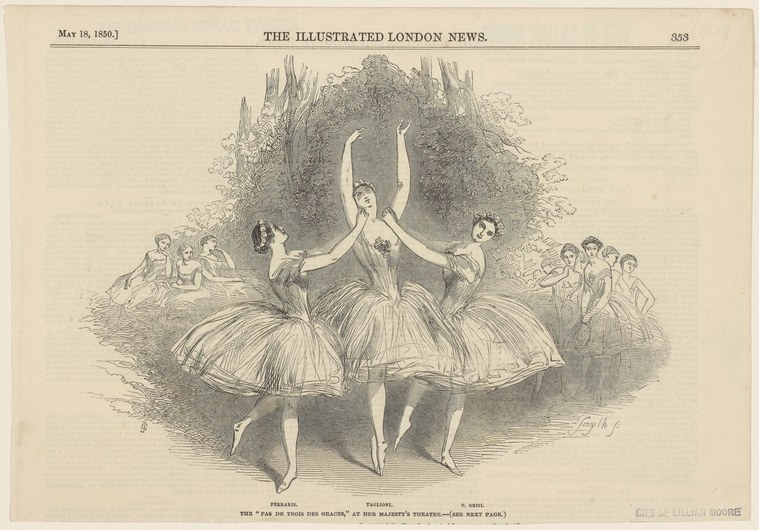
The Pas de trois des Graces, at Her Majesty's Theatre
Unknown artist
- Collection:
- Prints depicting dance
- Source:
- New York Public Library
- Rights:
- Public domain — free to use, share and adapt.
- Recorded as:
- Public Domain
This engraving is one of the few visual records of actual London ballet performance in the 1850s–1880s, a period often overshadowed by continental European ballet history. It demonstrates that classical ballet was an established and celebrated form in Victorian theaters, that the social prestige of the art permitted its reproduction in a leading national newspaper, and that the female dancer's body—poised, refined, and presented as an object of aesthetic contemplation—was central to the period's cultural imagination of dance.
What you are looking at
This engraving depicts a theatrical pas de trois staged at Her Majesty's Theatre, a major London playhouse. Three female dancers in classical tutus occupy the center, their voluminous skirts creating the characteristic silhouette of mid-nineteenth-century ballet. The central dancer raises both arms overhead in an attitude of elevation or celebratory gesture, while her two companions flank her with arms extended. The dancers stand en pointe or nearly so, their legs forming the elongated lines valued in classical ballet. The setting is a sylvan or theatrical backdrop with foliage and trees rendered in atmospheric perspective behind the dancers, creating depth. To either side and in the background, additional figures—likely musicians, attendants, or other performers—populate the scene, suggesting the full machinery of a theatrical production. The print's linear technique and careful tonal gradation create a sense of movement despite the frozen moment.
The dancing
Three principal dancers occupy the composition in what appears to be a unified group, though each maintains individual presence. The central figure's raised arms and upright carriage suggest either a moment of apotheosis or a pose struck for the audience's appreciation. The flanking dancers mirror each other in stance and arm position, their bodies angled toward the center figure, creating symmetry typical of classical ballet groupings. All three dancers appear to be on or near the points of their toes, their legs extended and refined. The tutus—short, bell-shaped skirts—dominate the visual composition and define the era's balletic vocabulary. The poses suggest a moment of relative stillness rather than rapid movement, consistent with the classical aesthetic of statuary-like beauty.
The dance depicted
This depicts a pas de trois, a classical ballet form in which three dancers (typically two female soloists and a male partnering dancer, though this engraving shows three female dancers) perform in coordinated sequence. The 'Pas de Trois des Graces' invokes the classical mythology of the three Graces (Aglaia, Euphrosyne, and Thalia), who embody beauty, charm, and elegance—qualities central to Romantic and classical ballet aesthetics. The stylized poses and emphasis on symmetry and ethereal beauty reflect the ballet vocabulary of the 1850s-1880s. The specific theatrical attribution to Her Majesty's Theatre suggests this was a well-known London production, though without additional documentation the identity of the original choreographer and principal dancers cannot be confirmed from the image alone. The medium—a wood engraving or steel engraving suitable for newspaper reproduction—indicates this was widely circulated imagery of a celebrated performance.
How it was made
This is a wood or steel engraving, recognizable from its fine linear hatching, tonal control through line density, and suitability for high-volume printing in illustrated newspapers and journals. The *Illustrated London News*, which published this image, was a pioneering weekly that combined news reporting with theatrical and cultural coverage, reaching a broad middle-class readership. The technique's precision allowed accurate rendering of costume detail—the tutu construction, the dancers' positioning, the architectural and botanical setting—making it a valuable document of actual theatrical practice. Engravings of this type were often drawn after eyewitness sketches made in the theater or from performers' models, then engraved for same-week publication, making this likely a reasonably faithful record of a specific London performance.
About this work
This engraving documents a mid-nineteenth-century ballet performance—specifically a pas de trois, a three-dancer ensemble piece performed at one of London's premier theaters. The work captures the classical ballet vocabulary, costume conventions, and theatrical aesthetics that dominated the stage during the transition from Romantic to late-Victorian ballet. The Graces, drawing on classical mythology, were a popular subject in ballet, and the three dancers' symmetrical arrangement and ethereal presentation reflect the period's idealization of beauty and grace as embodied in the female dancer. As a newspaper engraving, the work is both an artwork and a historical document, recording not only what the ballet looked like but also how theatrical dance was circulated and consumed by the Victorian public through the new medium of illustrated periodicals.
How to look at it
Pay attention to the frozen moment the engraver chose: the dancers are not in the midst of rapid movement but in a composed, almost sculptural pose that invites prolonged viewing. The central figure's raised arms and frontal orientation create a moment of display—a pause in which the audience can admire the line of the body, the grace of the arm, and the harmony of the group. The engraver's insistence on fine detail in the tutus, the dancers' positioning, and the theatrical setting conveys that this is a celebrated, well-attended performance worthy of careful documentation. Notice also the use of the background figures and architectural elements to situate the dancers within a professional theatrical space, not as an isolated aesthetic moment but as part of a larger social and institutional context.
The artist
The engraving is uncredited, consistent with the practice of *Illustrated London News*, where many contributors were staff artists or independent engravers whose names were rarely attached. The publication relied on a stable of skilled wood and steel engravers who could work at speed to meet weekly deadlines. These engravers worked from sketches, photographs, or live observation, translating them into the precise linear language of relief or intaglio printing. The anonymity of the engraver was standard practice; credit was typically given to the newspaper or to the original artist/photographer if known.
The period
The image dates to the heyday of Victorian theater and the mature phase of Romantic ballet's evolution. By the 1850s–1880s, the Romantic era's emphasis on supernatural and exotic subjects was giving way to a more conscious revival of classical subjects and virtuosity. The pas de trois as a form—standardized steps and positions, emphasis on symmetric beauty and technical display—became a staple of the ballet repertory during this period. Meanwhile, the *Illustrated London News* (founded 1842) was transforming British newspaper culture, making theatrical and cultural news accessible through images to a much larger audience than could attend performances. The engraving thus sits at the intersection of theatrical innovation and media revolution, documenting how Victorian society encountered and understood dance.
Where it lives
The image is held in the New York Public Library's collection of prints depicting dance, sourced from the *Illustrated London News*. The publication date of May 10, 1856, is printed at the top of the page. As a weekly illustrated newspaper, the *Illustrated London News* was mass-produced and distributed, making copies widely available to contemporary viewers and preserving multiple copies for research collections today.
Dance in this work
Questions about this work
What is a pas de trois?
A pas de trois is a classical ballet form in which three dancers perform together, typically in coordinated sequences. The term means 'step for three' and can involve various combinations and formations. This example features three female dancers, though the classical form often included one male dancer and two female soloists. The choreography emphasizes symmetry, coordination, and the display of technical skill.
What were the Graces in classical mythology, and why were they popular in ballet?
The three Graces—Aglaia (splendor), Euphrosyne (mirth), and Thalia (abundance)—embodied beauty, charm, and elegance in classical mythology. Ballet artists embraced classical and mythological subjects as a way to elevate dance to the status of high art, and the Graces' association with beauty and grace made them ideal subjects for Romantic and classical ballet. Their symmetry and complementary attributes made them natural candidates for ensemble choreography.
Why was this engraving published in the Illustrated London News?
The *Illustrated London News* was a weekly magazine that reported on major cultural, social, and theatrical events in London and beyond. A performance at Her Majesty's Theatre, one of London's leading stages, was considered news of sufficient importance and public interest to warrant illustration and publication. The magazine's readers—middle- and upper-class Londoners—were expected to be interested in theater, ballet, and the social world surrounding these institutions.
How accurate is this engraving as a document of the actual performance?
Wood and steel engravings were typically based on sketches made by trained artists, sometimes supplemented by photographs or eyewitness accounts. The engraver then translated these into the linear language of the medium. While individual poses and costume details are likely accurate, the composition as a whole may have been arranged or idealized for aesthetic effect. The engraving is reliable for documenting the ballet vocabulary, costume construction, and general appearance of the dancers, but should be treated as an artistic interpretation rather than a literal transcript.
More dance artwork





