49 works in this view — arrow keys or swipe to move between them.
Dance in Art
Auguste Taglioni
Unknown artist
- Collection:
- Prints depicting dance
- Source:
- New York Public Library
- Rights:
- Public domain — free to use, share and adapt.
- Recorded as:
- Public Domain
The Taglioni family—especially Marie Taglioni—revolutionized ballet by establishing pointe work and weightlessness as the aesthetic ideal of Romantic dance. This portrait of a member of that dynasty documents the celebrity apparatus around ballet in its most influential period. For historians of dance, it is evidence of how dancers were marketed, remembered, and mythologized in popular culture.
What you are looking at
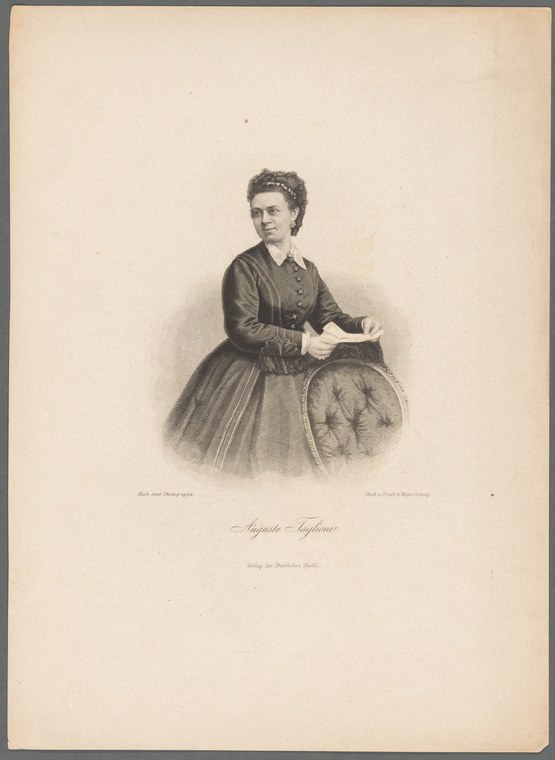
A half-length portrait of a woman seated and turned slightly toward the viewer, rendered in a soft mezzotint or similar tonal engraving technique. She wears a dark, long-sleeved dress with a fitted bodice and full skirt that extends below the frame, typical of mid-nineteenth-century fashion. Her dark hair is styled up and back, with curls arranged around the crown in the manner of the 1840s–1850s. She holds an open document or letter in her right hand, resting it against her skirt; her left hand rests on her lap. The background is plain and light, emphasizing the figure. The composition is formal and dignified, suggesting a named portrait—likely a commemorative print of a known performer.
The dancing
The subject is seated in a calm, composed posture with good postural alignment. Her shoulders are relaxed and level; her arms frame her body naturally. The open document in her hand suggests literacy, agency, or possibly the holding of a role or contract. There is no active dance movement visible, nor is the body positioned in a way that suggests motion. The sitter's gaze is direct and composed, meeting the viewer with the formality expected of mid-century theatrical portraiture.
The dance depicted
The title and holding collection identify this as a portrait of Auguste Taglioni, a member of the celebrated Taglioni family of dancers. The inscription indicates she was 'Prima Ballerina Assoluta'—the highest designation in the ballet hierarchy of the era. No movement is depicted; this is a portrait of the dancer rather than a representation of dance. However, the image documents a major figure in Romantic ballet during its flourishing in the 1840s–1850s, when the Taglioni name was synonymous with the ethereal, pointe-work-based aesthetic that defined the period.
How it was made
This is a mezzotint or stipple-engraved print, a reproductive technique favored for theatrical portraiture of the nineteenth century. The tonal subtlety—the soft gradations of light and shade across the face and dress—is characteristic of mezzotint, which allowed engravers to achieve photographic-like delicacy and reach a broad middle-class audience. The print was likely issued separately as a theatrical souvenir or as part of a collected series of opera and ballet celebrities, making it an ephemeral but widely distributed form of fan culture and artistic promotion.
About this work
This is a formal portrait print of Auguste Taglioni, a principal dancer of the Romantic ballet era, engraved and printed for circulation among theatre-goers in the mid-nineteenth century. It does not depict dance itself, but rather documents the celebrity of a dancer whose name was central to the development of ballet technique and aesthetics in Europe. The image belongs in a dance gallery not because it shows movement, but because it captures the fame, identity, and cultural status of a dancer who shaped theatrical dance history—and because portrait prints like this were the primary means by which audiences knew and remembered the performers of their time.
How to look at it
Attend to the formality of the pose and the markers of status: the fine dress, the composed bearing, the document held as a sign of literacy and professional standing. Notice the soft tonal technique of the engraving, which creates an impression of intimacy and presence despite the static composition. The portrait is designed not to show the dancer in motion, but to present her as a named individual of cultural importance—the convention of theatrical celebrity portraiture, where the face and bearing convey the identity and appeal that audiences came to the theatre to witness.
The artist
The artist is not recorded in the catalogue. The print is unsigned or the signature is not legible in this reproduction. The work belongs to the tradition of commercial theatrical portraiture and celebrity engraving that flourished in European cities, particularly London and Paris, throughout the nineteenth century. Prints of this type were typically issued by theatrical print sellers and music publishers, often in series, and were produced by specialist engravers rather than the painters who created the original designs.
The period
This portrait dates from the height of Romantic ballet, approximately 1840–1860, when the Taglioni family dominated European stages. Marie Taglioni's debut in *La Sylphide* (1832) had established the vocabulary of ethereal, pointe-based Romantic ballet, and her siblings and relatives capitalized on that fame. The engraving tradition allowed the images of celebrated dancers to circulate far beyond the theatre itself—to homes, salons, and shops—making them figures of broader cultural fascination. This democratization of celebrity through printmaking was a defining feature of nineteenth-century visual culture.
Where it lives
Held in the New York Public Library's collection of prints depicting dance. This is a commercially produced reproductive print, typical of nineteenth-century theatrical memorabilia, and represents the kind of ephemeral material through which dance history was disseminated and consumed by contemporary audiences.
Dance in this work
Questions about this work
Why is this a dance image if there is no dancing in it?
It documents a major figure in dance history and the cultural machinery around theatrical dance in the Romantic era. Portrait prints like this were how audiences knew, remembered, and collected images of the dancers they admired. For historians, they are evidence of celebrity, marketing, and the visual culture of performance.
Who was Auguste Taglioni?
A member of the celebrated Taglioni family of ballet dancers, who dominated European stages in the mid-nineteenth century. The family, led by Marie Taglioni, revolutionized ballet by establishing pointe work and the ethereal aesthetic that defined Romantic dance. Auguste held the title of Prima Ballerina Assoluta, the highest rank in ballet.
What is a mezzotint and why was it used for theatre portraits?
Mezzotint is an engraving technique that uses tiny dots or burrs to create subtle tonal gradations, allowing fine detail and a photographic quality. It was ideal for portraiture because it could render the human face with delicacy and likeness. For theatrical promotion, mezzotint prints could be produced in multiple copies and sold cheaply, making them perfect souvenirs for theatre-goers.
What does 'Prima Ballerina Assoluta' mean?
It is the highest designation in ballet hierarchy, designating a dancer of supreme technical mastery and artistic rank. The title was (and is) rarely bestowed. It signals that Auguste Taglioni held elite professional status in the ballet world of her era.
More dance artwork





