49 works in this view — arrow keys or swipe to move between them.
Dance in Art
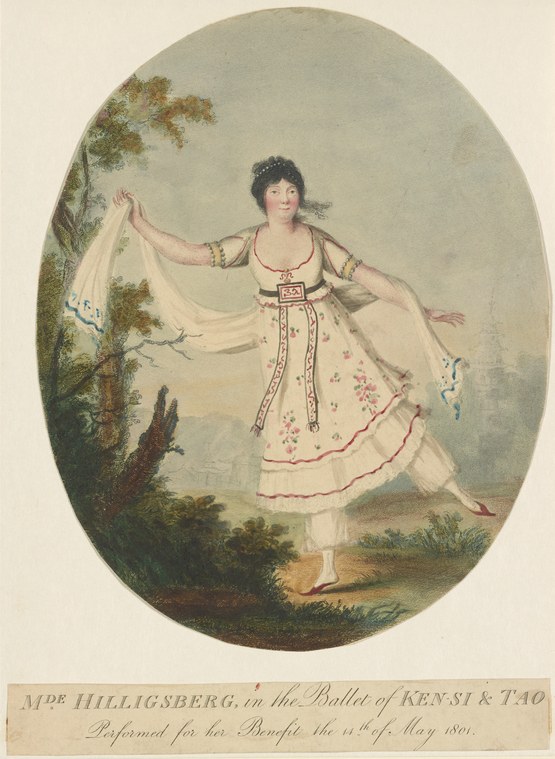
Mde. Hilligsberg in the ballet of Ken-si & Tao, performed for her Benefit the 14th of May 1801
Unknown artist
- Collection:
- Prints depicting dance
- Source:
- New York Public Library
- Rights:
- Public domain — free to use, share and adapt.
- Recorded as:
- Public Domain
This image is a rare named record of how a specific dancer embodied early Romantic ballet on the London stage, preserving not only the costume and pose but also the narrative context ('Ken-si & Tao') in which she performed. For students of early ballet history, it is evidence of the technical vocabulary, aesthetic ideals, and theatrical practices of the period—showing how the emerging Romantic ballet style was performed in London years before the great European triumphs of later decades. The veil, the muslin dress, the ethereal posture, and the pastoral setting are all markers of how ballet was beginning to shift toward a new vocabulary of feeling and fantasy.
What you are looking at
A young woman in Romantic-era theatrical costume stands alone in a sylvan setting, captured mid-gesture. She wears a short white muslin dress with a high waistline, decorated with embroidered or painted details in red and gold trim at the hem and down the front placket, and matching arm bands. Her dark hair is swept up in a Regency style. She holds a large translucent veil or scarf aloft in her right hand, the fabric billowing upward, while her left arm extends gracefully outward and downward. Her posture is light and buoyant, weight forward on her left leg, her right leg extended behind in a gentle attitude. The background is soft and atmospheric—trees and foliage rendered in muted greens and browns recede into pale sky—suggesting a pastoral or dream-like space rather than a stage. The composition is framed in an oval format, a convention of theatrical portraiture of the early 19th century. This is a portrait of a named performer, Mde. Hilligsberg, in a specific role or moment from a theatrical production.
The dancing
A single dancer, her weight placed lightly on her left leg with her right extended back in a supported attitude, suggesting elevation or weightlessness. Her upper body is upright but animated: her right arm is raised and extended, holding the veil aloft; her left arm curves away from her body in an open, expressive line. Her head tilts slightly, gazing toward the veil. The pose conveys grace and lightness—there is no weight in her carriage; she appears suspended in a moment of delicate movement. This is the vocabulary of early 19th-century ballet: soft turnout, elongated lines, an ethereal quality achieved through the illusion of effortlessness.
The dance depicted
This is theatrical ballet of the Romantic period, most likely early 19th-century pantomime-ballet. The title references 'Ken-si & Tao' (likely an Anglicized version of a Chinese or pseudo-Oriental tale), a type of exotic narrative ballet that was fashionable in London theatres around 1800–1815. The veil—a prominent prop—is central to the dance: it becomes an extension of the dancer's gesture and a vehicle for expressing emotion and character. The performer's elevated, ethereal bearing and the exposed legs visible beneath the short skirt suggest she is executing vocabulary from the emerging Romantic ballet vocabulary, including attitudes, arabesques, and port de bras, performed to create an illusion of flight or supernatural lightness. This was the technical vocabulary and aesthetic of dancers trained in the late 18th-century Italian school.
How it was made
This is a hand-coloured engraving or aquatint, a reproductive print technique that allowed theatrical portraiture to be circulated to a broad audience. The soft modeling of the background, the careful attention to the folds of the veil, and the precision of the costume details are characteristic of high-quality theatrical prints of the Regency era. The hand-colouring—executed after printing—allowed for subtle gradations in the dancer's flesh tones and the delicate rendering of the muslin dress and its embroidery. Such prints were sold at theatres and print shops as souvenirs and promotional images, making them widely accessible to theatre-goers and serving as a record of celebrated performances.
About this work
This is a hand-coloured engraved portrait of a named ballet dancer, Mde. Hilligsberg, captured in a specific role or moment from a London theatrical production performed on 14 May 1801. It documents the early Romantic ballet aesthetic: the short, high-waisted muslin dress; the ethereal, weightless carriage; and the emphasis on narrative and character expressed through gesture and props. The work is both a portrait of a celebrated performer and evidence of how early 19th-century ballet was conceived, performed, and circulated: as a form of theatrical storytelling in which a dancer's body, through technique and grace, inhabited exotic, fantastical, or emotional scenarios.
The oval format, the theatrical setting, and the hand-colouring place this squarely within the culture of English theatre portraiture of the Regency period. Such prints were consumed and collected by theatre audiences eager to preserve the memory of notable performances and to encounter celebrated dancers in their dressing rooms, figuratively if not literally. The image carries the authority of a named performer and a specific date, making it a primary document for the history of early ballet in Britain.
How to look at it
Notice the moment the artist has chosen to capture: not a leap or a dramatic turn, but a suspended moment of quiet grace—the veil held aloft, the body perfectly poised, the gaze soft. This is the Romantic aesthetic of ballet: an emphasis on stillness and poetry rather than display. Observe the bare leg beneath the short skirt and how the artist has rendered the foot in a soft point, suggesting turned-out position without exaggeration. The veil is not merely a prop but a continuation of the dancer's line and gesture—a technique that allows a choreographer to extend and elaborate movement in space. The oval frame and the pastoral setting work together to isolate the dancer and create an atmosphere of reverie, suggesting that this is not a theatrical 'dance' in the energetic sense, but a moment of character and emotion.
The period
This print dates to the early years of English theatrical ballet, a period when the art form was beginning to absorb influences from Continental pantomime and the emerging Romantic aesthetic. In 1801, ballet was not yet the dominant theatrical form it would become by mid-century, but London stages were already hosting producers and dancers who experimented with exotic narratives, emotional expression, and technical innovation. The vogue for 'Oriental' subjects—China, Turkey, the East Indies—reflected both imperial expansion and the Romantic taste for the picturesque and the foreign. Dancers of this era, many trained in the Italian school, were beginning to develop the technique and bearing that would define Romantic ballet: ethereal, weightless, expressive movement; pointed feet; the illusion of effortlessness concealing rigorous training. This performance sits at the threshold of that transformation.
Where it lives
The print is held in the New York Public Library's collection of prints depicting dance. It is a product of commercial theatrical culture—made for sale and distribution to theatre-goers—and represents one of the primary ways that celebrated performances were circulated and remembered in the pre-photographic era.
Dance in this work
Questions about this work
Who was Mde. Hilligsberg?
The catalogue does not supply biographical information beyond her name and the date and title of this performance. She was a named theatrical performer dancing on the London stage in May 1801, celebrated enough to warrant a portrait print. Further research into London theatre records and playbills from this period might yield more biographical detail.
What is Ken-si & Tao?
The title likely refers to a theatrical narrative (possibly adapted from or inspired by Chinese sources) popular on the London stage around 1800–1815. Such exotic stories were fashionable vehicles for dance and pantomime. The specific plot and other details of this production are not supplied here, but the title and the costume suggest a story involving an Oriental setting or character.
Is this ballet?
Yes, this is theatrical ballet of the Romantic period. However, early 19th-century ballet was often hybrid: part pantomime, part dance, part narrative theatre. The emphasis on gesture, the props, and the exotic setting show how ballet at this time was a form of theatrical storytelling, not yet the purely abstract or dramatically concentrated art form it would later become.
What is the veil for?
In Romantic ballet, the veil served both narrative and technical purposes. It was a costume element that could suggest character and emotion, and it was also a tool for extending the dancer's movement through space—allowing the choreographer to create designs and lines that the body alone could not achieve. The veil's billowing movement also enhanced the ethereal, weightless effect central to Romantic aesthetics.
More dance artwork





