49 works in this view — arrow keys or swipe to move between them.
Dance in Art
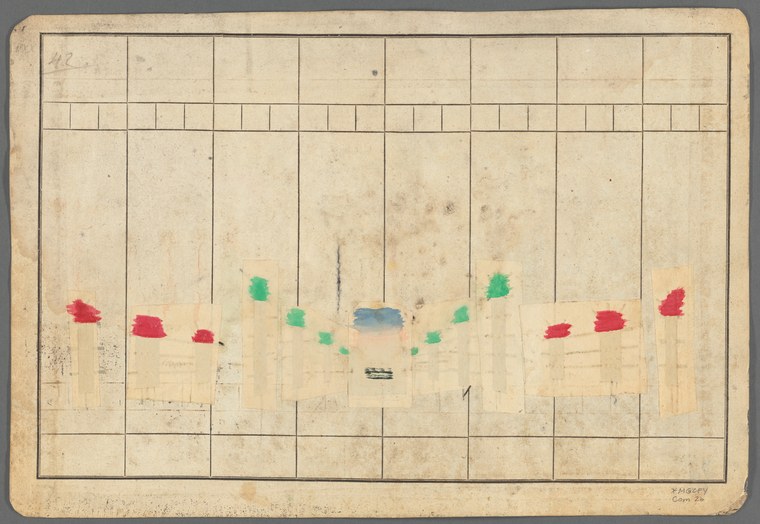
Interior with vaulted ceiling; in the foreground, a line of actors? including Harlequin
Unknown artist
- Collection:
- Prints depicting dance
- Source:
- New York Public Library
- Rights:
- Public domain — free to use, share and adapt.
- Recorded as:
- Public Domain
This is a rare surviving example of theatrical notation from before the era of systematic dance notation. For historians of commedia dell'arte and early modern performance, it offers direct evidence of how actors were positioned and costumed, and of how spatial arrangement structured the performance. For dance historians, it demonstrates that choreographic and performance concepts were documented in schematic, spatial terms long before Labanotation or Benesh notation existed.
What you are looking at
A theatrical stage scene rendered in ink on aged paper, divided by a regular grid of vertical lines suggesting stage divisions or a ground plan. Across the center runs a horizontal line of small colored figures—predominantly in red and green, with touches of blue—appearing to process or stand in formation across the stage floor. The figures are minimal, almost schematic, reduced to colored marks that suggest costumed actors rather than naturalistic bodies. The architecture above hints at a formal interior: a vaulted or coffered ceiling is suggested by the upper grid work. The overall composition reads as a notation or record of a stage arrangement rather than a finished theatrical image—the colored marks function as both costume indicator and spatial notation, allowing a viewer to read both the positions and the dress of the performers at a glance.
The dancing
The figures are too schematically rendered to assess detailed choreography or hold. They appear to be standing upright or moving horizontally across the stage in a line or shallow formation. The predominance of red and green—likely indicating different costumes or roles—suggests a binary division of performers. One figure appears slightly darker or more prominent near the center, possibly indicating a principal character. The regularity of spacing and the horizontal alignment suggest either a processional moment, a formal line dance, or a stage arrangement for ensemble work rather than intimate partnered movement.
The dance depicted
The catalogue description identifies Harlequin among the actors, indicating a work from the commedia dell'arte tradition. The horizontal line of costumed figures and the formal architectural setting support a theatrical scene, likely from a court ballet or intermezzo of the Renaissance or early Baroque period. The colored notation—red and green figures in deliberate arrangement—suggests this may be a performance record or ground plan rather than a finished artwork meant for exhibition. If this is commedia dell'arte, the dance content would involve the stock characters and physical comedy of that tradition, but the schematic rendering prevents identification of specific steps or styles.
How it was made
This appears to be a pen-and-ink drawing or possibly an engraving, with later hand coloring in watercolor or gouache. The grid structure and precise ruled lines suggest either a preparatory stage diagram or a professional theatrical notation. The aging and spotting of the paper, along with the quality of the hand-drawn grid, indicate an original work on paper rather than a printed impression. The technique—combining precise linear perspective with colored notation—is consistent with 16th- or 17th-century theatrical planning documents or prompt materials. The coloring in discrete washes rather than careful modeling supports the idea that this is a working document rather than a finished aesthetic object.
About this work
This is a theatrical ground plan or stage notation, most likely a record of a commedia dell'arte performance or court entertainment from the Renaissance or early Baroque period. The grid structure and colored figures constitute a practical stage diagram—a way of recording positions, entrances, and costume assignments for performance. The identification of Harlequin places it within the tradition of improvised comedy that dominated European court and popular theaters from the 16th century onward. Rather than depicting an individual moment of dance, it records the spatial and costume logic of an entire scene, making it valuable as evidence of how early modern theatrical movement was planned and transmitted.
How to look at it
Observe how the colored marks are distributed: the preponderance of red and green suggests two opposing groups or roles. Note the one figure that appears darker or more prominent—likely Harlequin himself, identified in the title. The regular horizontal spacing suggests either processional movement or a formal line-up for a scene. The grid overhead indicates not realistic perspective but rather a practical system for dividing the stage space and assigning positions. This is not a capture of a single moment of movement, but rather a map of an entire scene's spatial organization.
The period
The commedia dell'arte emerged in Italy in the 16th century and spread rapidly across Europe, becoming the dominant form of popular comedy by the 17th century. These performances were built on stock characters (Pantalone, Il Dottore, Arlechino, Colombina, and others), masked comedy, acrobatic movement, and improvisation within a loose plot structure. Court ballets and intermezzi of the same period—which often incorporated commedia characters and conventions—were more formally composed and documented. Theatrical notation as shown here served a practical function: these were working documents for actors and stage managers, not art objects for collectors. The grid suggests an influence from perspective drawing and architectural planning, disciplines that were undergoing rapid formalization and theoretical development in this same period.
Where it lives
The work is held in the New York Public Library's collection of prints depicting dance. It appears to be part of a broader assemblage of theatrical and dance documentation spanning centuries.
Dance in this work
Questions about this work
What is Harlequin doing in this image?
The image is too schematic to show specific action. Harlequin appears to be among a line of costumed actors on stage, likely as part of a formal scene arrangement or procession. The notation records his position and costume role rather than capturing a moment of individual movement.
Is this a dance?
It records a theatrical scene that may have included dance, but the primary focus is on stage positioning and costume. Commedia dell'arte performances were highly physical and often incorporated acrobatic movement, but this notation does not show steps or choreography—only the spatial and costume arrangement of actors.
Why is it drawn on a grid?
The grid is a practical theatrical tool, allowing stage managers and actors to record and repeat the spatial positions of performers. Each square or section corresponds to part of the stage floor, making it possible to indicate where each character should stand and how the stage picture should be composed.
What are the red and green marks?
These are colored notations indicating costume or character roles. In commedia dell'arte, characters were visually distinctive through their masks and dress, so using color to distinguish one group from another would have been a quick way to organize the stage picture and identify key roles at a glance.
More dance artwork





