49 works in this view — arrow keys or swipe to move between them.
Dance in Art
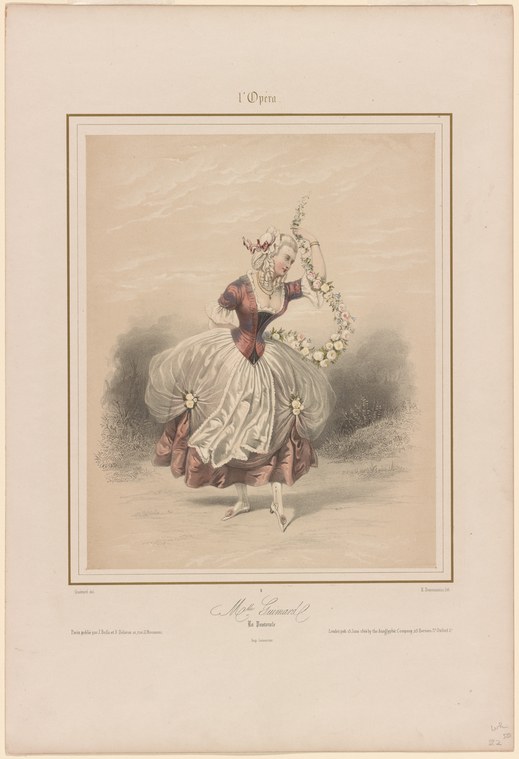
L'Opéra. Mlle Guimard. La pastorale
Unknown artist
- Collection:
- Prints depicting dance
- Source:
- New York Public Library
- Rights:
- Public domain — free to use, share and adapt.
- Recorded as:
- Public Domain
Mlle Guimard was a towering figure in late-18th-century ballet, celebrated for her technical skill and dramatic presence, and this image is one of the primary visual records of her performance aesthetic. The print preserves otherwise-lost choreography and stagecraft from a major theatrical tradition—the pastoral ballet—at a moment when dance was becoming a serious subject for artistic documentation and reproduction.
What you are looking at
A single female dancer occupies the center of the composition, posed in a moment of theatrical presentation. She wears a voluminous white skirt with a fitted bodice in deep burgundy or wine-red silk, with white stockings and heeled shoes. Her hair is elaborately dressed and adorned with what appears to be a wreath or garland of flowers. She holds aloft a large, delicate wreath or garland of white flowers—possibly orange blossoms or similar blooms—in both hands above her head, creating a vertical emphasis that draws the eye upward. The dancer's pose is frontal and formal, her body angled slightly in profile, with the skirt's voluminous folds creating strong diagonal movement across the lower half of the image. The background is softly rendered in gray tones, suggesting an interior theatrical space lit by warm, diffuse light that catches the highlights of the white fabric. The overall effect is one of refined elegance and careful artifice—a portrait of a performer at a moment of display.
The dancing
The dancer stands in a classical contrapposto stance with weight distributed evenly, one leg slightly advanced. Her arms are raised high and open, holding the floral garland at or above shoulder height, creating an expansive frame. The pose is static and posed rather than captured mid-movement; there is no suggestion of active motion through the limbs. Her torso is upright and formal, her head lifted. The raised arms and open gesture read as a presentation pose typical of ballet or court dance of the period—a moment of display rather than dynamic movement.
The dance depicted
This is most likely a theatrical dance from the 18th century, probably a pastoral or allegorical work. The inscription identifies the dancer as Mlle Guimard and refers to 'La pastorale' (The Pastoral)—suggesting a rustic or Arcadian theme. Marie-Madeleine Guimard was a celebrated French dancer of the late 18th century (1743–1816), known for her roles in ballet d'action and theatrical works at the Paris Opéra. The formal pose, the elaborate costume, and the floral iconography (garland, wreath) are consistent with pastoral ballet or ballet de cour of that era. The work likely depicts a moment from a specific theatrical production, frozen in an idealized presentation pose rather than showing active choreographic movement.
How it was made
This is a hand-colored engraving or aquatint, likely from the late 18th century. The delicate line work, the fine cross-hatching in the background, and the selective application of watercolor or gouache are typical of theatrical publicity engravings from this period. Such prints were produced to commemorate celebrated performances and distribute images of famous dancers to a wide audience. The technique allowed for relatively affordable reproduction and wide circulation among theaters, ballet enthusiasts, and collectors—making this a mass-market cultural artifact as much as a work of fine art.
About this work
This is a theatrical portrait engraving of Mlle Guimard, one of the most celebrated ballerinas of the late 18th century French stage, in a role from 'La Pastorale.' The work documents both the dancer and a specific moment in a now-lost production, preserving an image of late-18th-century ballet costume and presentation. It belongs to a rich tradition of engraved dance portraits that served as both souvenirs and publicity—visual records of famous performers that circulated among patrons and the theater-going public. The work is valuable not primarily as an artwork but as historical evidence: it shows us how a major dancer presented herself on stage, what costume and pose conveyed in that era's vocabulary of theatrical display, and what pastoral ballet looked like to contemporary eyes.
How to look at it
Note the stillness of the pose: this is not a moment of active choreography but a formal presentation, the equivalent of a curtsy or salute to the audience. The raised arms and the prominent floral wreath signal a pastoral or allegorical identity—flowers, crowns, and garlands were the visual language of such roles. Observe how the artist has used the voluminous skirt to create visual drama: the folds create strong diagonals and catch light, making the lower body read as a sculptural form rather than a platform for footwork. The face is idealized and refined, presented frontally to the viewer—the dancer as an object of admiration, not as an athlete in motion.
The artist
The artist is not recorded. This is characteristic of many theatrical engravings of the period, which were commercial products designed to serve the theater and its audience rather than to establish the artist's reputation. Such prints were often produced by atelier workshops in Paris and other European capitals, collaboratively and without attribution. The lack of a signed name does not diminish the technical skill required—the rendering of fabric, light, and human form is accomplished and shows intimate knowledge of theatrical costume and staging.
The period
This image dates to the late 18th century, when ballet was establishing itself as a major art form in European theaters. The 1760s–1780s saw the rise of ballet d'action—narrative ballets with coherent plots and developed characterization—pioneered by choreographers such as Jean-Georges Noverre. Pastoral and allegorical themes were enormously popular, drawing on literary and artistic traditions that valued nature, rusticity, and Arcadian fantasy as subjects. Mlle Guimard danced in this environment, and her fame rested on both technical prowess and the ability to embody character and emotion. The same period saw an explosion in the production and circulation of theatrical engravings—prints were collected, displayed, and traded much as photographs or posters would be in later centuries.
Where it lives
This print is held in the New York Public Library's collection of prints depicting dance, as part of the Library's broader holdings in theatrical and performing arts history. Such prints were typically published separately or collected in bound volumes, circulating as both theater merchandise and collector's items.
Dance in this work
Questions about this work
Who was Mlle Guimard?
Marie-Madeleine Guimard (1743–1816) was one of the most celebrated dancers of the late 18th-century Paris Opéra, famous for her technical skill, dramatic presence, and roles in ballet d'action. She was a major star of the period and a subject of intense public interest and numerous visual representations.
What is 'La Pastorale'?
Pastorale was a popular genre of theatrical dance in the 18th century, depicting idealized rural or Arcadian scenes with shepherds, nymphs, and other rustic characters. It allowed for elaborate costumes, romantic plots, and the display of the dancer's technique within a narrative framework.
Why is she holding a garland?
Floral garlands, wreaths, and crowns were conventional attributes of pastoral and allegorical characters in theater and dance. The garland signals that this is a nymph, shepherdess, or similar idealized rural character—not a realistic figure but a theatrical abstraction.
How were prints like this used?
Theatrical engravings were sold as souvenirs at the theater, distributed by fans and collectors, and used as promotional images. They served much the function that photographs and posters do today—allowing people to own an image of their favorite performer and to remember specific productions.
More dance artwork





