49 works in this view — arrow keys or swipe to move between them.
Dance in Art
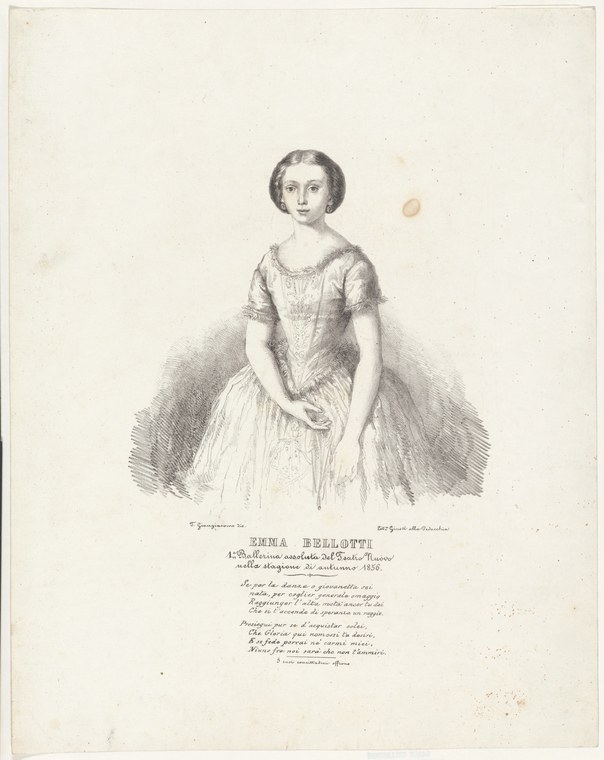
Emma Bellotti, [prima] ballerina assoluta del Teatro Nuovo nella stagione di autunno 1856 [followed by eight lines of poetry in Italian]
Unknown artist
- Collection:
- Prints depicting dance
- Source:
- New York Public Library
- Rights:
- Public domain — free to use, share and adapt.
- Recorded as:
- Public Domain
Bellotti's engagement at the Teatro Nuovo in 1856 is recorded nowhere else in accessible sources; this engraving is likely the only surviving visual documentation of her career. It is evidence of a thriving theatrical dance culture in nineteenth-century Italy beyond the major capitals, where celebrated dancers toured and were celebrated in print. The work demonstrates how engraving served as the primary medium for preserving the images of dancers before the advent of photography in theatrical contexts.
What you are looking at
A three-quarter-length portrait of a young woman identified as Emma Bellotti, prima ballerina assoluta of the Teatro Nuovo, presented in an engraved print from 1856. She stands in a composed, frontal pose wearing a light, translucent tulle skirt that falls to mid-calf, characteristic of mid-nineteenth-century romantic ballet costume. Her dress has short sleeves and a fitted bodice with delicate detailing; her dark hair is parted and smoothly drawn back. The figure is rendered with fine cross-hatching that gives volume and dimensionality to the skirt and a soft haze around the body. Below the portrait, eight lines of Italian verse in cursive script commemorate her autumn season performance. The composition is austere—a plain background with no scenery or supporting figures—placing all emphasis on the dancer's person and costume.
The dancing
Bellotti stands with her weight evenly distributed, her arms held at her sides in a natural, unforced manner. Her posture is upright and dignified rather than exuberant; her gaze is directed outward toward the viewer. There is no visible indication of movement—no extension of limbs, no turnout, no elevation. Her stance reads as a presentation portrait rather than a capture of movement in progress. The soft, voluminous skirt, gathered at the waist, would allow for the rapid legwork and balances essential to ballet but reveals nothing specific about technique or vocabulary.
The dance depicted
This is a portrait of a celebrated ballet dancer from the Romantic era, commissioned to commemorate a specific engagement. While Bellotti's costume—the tulle skirt, the relatively simple bodice, the lack of ornate decoration—aligns with the conventions of Romantic ballet as it was performed in Italy in the 1850s, the image itself does not depict an act of dancing. It is a formal commemorative engraving designed to honor the dancer as a public figure and star attraction. The Italian verses below may contain biographical or artistic detail, but the engraving itself serves as a document of celebrity and a record of her appearance at a particular theatre in a particular season.
How it was made
This is an engraving, identifiable by the uniform cross-hatching and parallel lines used to create tone, shadow, and the texture of fabric—particularly visible in the treatment of the skirt's diaphanous folds and the soft modeling of the face. The technique allows for fine detail and tonal subtlety while producing a linear, somewhat formal impression. The inscription is engraved in cursive script below the image. Such prints were relatively economical to produce in quantity, making them accessible to a broad theatre-going public; they circulated as souvenirs, advertisements, and records of celebrated performances and performers, similar to modern theatrical photographs or lobby cards.
About this work
This is a commemorative engraved portrait of Emma Bellotti, an Italian prima ballerina, produced to mark her engagement at the Teatro Nuovo in autumn 1856. It documents both her celebrity status and the visual conventions of Romantic-era ballet costume. The print belongs to a genre of theatrical portraiture that flourished in the nineteenth century—a form of celebrity circulation and archival record that valued the likeness and the occasion as much as the dance itself. For historians of ballet, such prints are primary sources for understanding how dancers were presented to the public, how costume evolved, and which performers achieved stardom in provincial Italian theatres during the mid-1800s.
How to look at it
The viewer should attend to the costume as historical evidence: the height of the skirt (just above the ankle), the simplicity of the bodice, the absence of a headdress or elaborate jewelry. These details situate Bellotti within the Romantic aesthetic and suggest what repertory she likely performed. The artist has chosen a moment of stillness and composure rather than action; the formality of the presentation—the frontal pose, the calm gaze, the uncluttered background—reflects conventions of portraiture that assert the dancer's status and dignity. This is how a celebrated performer wished to be remembered and presented to the public: as a composed, recognizable individual, not as a figure in a narrative or scene.
The artist
The engraver is not recorded in the catalogue. The inscription indicates publication by Fontanella and credits an artist signature (partially legible as 'G. Fontanella fec.' or similar), suggesting a professional theatrical print workshop. Italian theatres of this period employed skilled engravers to produce commemorative portraits and promotional material for touring and resident companies; such prints were often sold in theatre lobbies or through print sellers.
The period
In the 1850s, Italian ballet existed in a complex relationship with the dominant French and Russian traditions. Romantic ballet—with its emphasis on ethereal femininity, pantomime, and the primacy of the ballerina—had established itself as the international norm following the European success of works like La Sylphide and Giselle. Italian theatres, particularly in secondary cities, continued to mount Romantic ballets and to feature local and touring stars. The engraved portrait was the standard medium for celebrity and advertising; photographic technology existed but remained expensive and was not yet routinely used for theatrical portraiture. This print thus captures a moment when engraving was still the primary technology for mass-producing and circulating images of performers.
Where it lives
The print is held in the New York Public Library's collection of prints depicting dance, indicating it was preserved as a document of dance history and theatrical culture. It likely entered the collection as part of a broader acquisition of nineteenth-century theatrical prints or Italian materials. Such prints often survive in small numbers and in scattered collections; their presence in a library collection reflects the institution's interest in preserving ephemeral theatrical documentation.
Dance in this work
Questions about this work
Was Emma Bellotti a famous dancer?
She achieved sufficient prominence to have her likeness engraved and published by the Teatro Nuovo in Naples or a major Italian city. The title 'prima ballerina assoluta'—the highest rank in a theatre's ballet hierarchy—indicates she was the leading female dancer of the company. Beyond this engraving, however, little is recorded of her career in major historical sources, suggesting she was a star in her own time and place but did not achieve the international fame of her contemporaries in Paris or St. Petersburg.
Why does she look so still and formal?
This is a commemorative portrait, not an action scene. The artist's purpose was to create a recognizable likeness that could be sold to theatre-goers and preserved as a record of a celebrated performer. The conventions of portraiture—the frontal pose, the neutral background, the composed expression—were designed to convey status, dignity, and individuality. Romantic ballet imagery in other contexts (prints of scenes from ballets, drawings of dancers in performance) often showed much more dynamic movement and theatrical drama.
What do the verses say?
The eight lines of Italian text are engraved below the portrait but are not fully legible in this reproduction. They likely contain biographical information, a tribute to Bellotti's talent, or a poetic description of her performance. Such commemorative verses were standard in nineteenth-century theatrical prints and functioned as both advertisement and artistic homage. A transcription of the full text would clarify the specific occasion and the nature of the tribute.
Why is this engraved and not painted or photographed?
In 1856, engraving was the fastest and most economical way to produce multiple copies of an image for public sale. A portrait could be engraved from a drawing and then printed in editions of hundreds or thousands, making it affordable and accessible to theatre-goers. Photography existed but was cumbersome, expensive, and not yet widely used for theatrical portraiture. Engraving thus allowed theatres to capitalize on their stars' popularity through mass-produced souvenirs and publicity materials.
More dance artwork





