49 works in this view — arrow keys or swipe to move between them.
Dance in Art
Vertu médicale du boléro
Unknown artist
- Collection:
- Prints depicting dance
- Source:
- New York Public Library
- Rights:
- Public domain — free to use, share and adapt.
- Recorded as:
- Public Domain
The print documents the visual fantasy at the heart of Romantic ballet: the fetishization of the supernatural female dancer as weightless, winged, and benevolent. Understanding how such images circulated, shaped public expectation, and conflated ballet with otherworldly femininity is essential to reading the social and aesthetic history of nineteenth-century dance.
What you are looking at
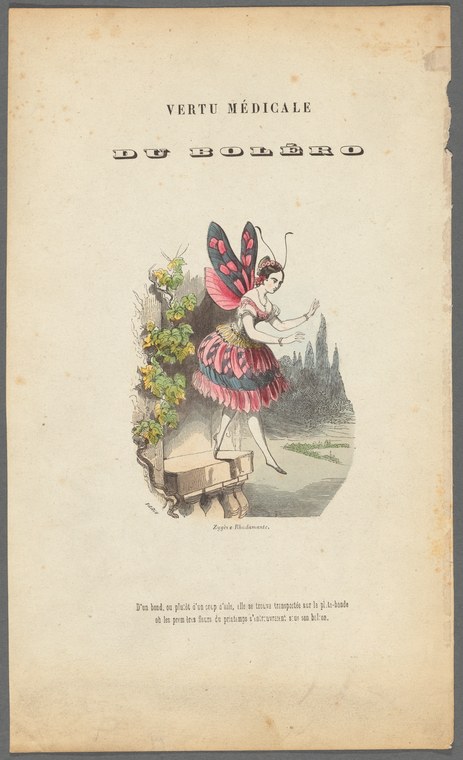
A winged fairy or sylph in a pink tulle skirt and white bodice stands in a garden setting, bending gracefully to tend flowering vines that climb a wooden trellis or support. The figure's wings are translucent and delicately colored in pink and iridescent tones. The background shows a misty landscape with tall evergreen trees, rendered in soft greens and grays. The foreground is illuminated with warm light that catches the dancer's form and the flowers, while the distant trees fade into atmospheric haze. The composition emphasizes the ethereal, supernatural quality of the subject—a being from another realm engaging in a naturalistic domestic task. Below the image runs a French text in italics, partially legible, that appears to be a poetic caption or verse.
The dancing
The dancer's posture is one of gentle, sustained flexion: the torso bends forward from the hips in a graceful arc, with the head inclined toward the flowers. The arms are extended downward and inward in a naturalistic gesture of tending or caressing, not in any formalized dance frame. The weight appears to rest on both legs, with the body elongated and softened rather than held in strict vertical alignment. This is an attitude of repose and intimate engagement rather than active movement or display.
The dance depicted
This image illustrates the Romantic ballet vocabulary—specifically the otherworldly sylph type that became central to nineteenth-century ballet through works like *La Sylphide* (1832). The winged figure, the ethereal tulle skirt, the garden setting, and the sustained, weightless quality of the pose all point to Romantic supernatural femininity. However, the image is not a scene of active dance but rather a poetic allegory: the winged dancer tends flowers as a metaphor for nature and grace. The title *Vertu médicale du bolero* (The Medicinal Virtue of the Bolero) introduces ambiguity—it pairs a Romantic image with a Spanish dance form, suggesting either a lost connection between the visual and the text, or a playful literary conceit.
How it was made
This is a hand-colored engraving or lithograph, likely from the 1830s–1850s based on the printing technique and the style of coloring. The delicate stippling and fine line work visible in the foliage and the fairy's wings suggest engraving; the soft blending of the background landscape suggests hand-coloring with watercolor or gouache. This technique was ideal for circulating images of theatrical scenes and ballet costumes to a broad middle-class audience through illustrated periodicals and books on dance and theater. The hand-coloring makes each impression unique and adds value as a souvenir or collectible.
About this work
This is a Romantic-era theatrical print depicting a supernatural dancer—a winged sylph in the idiom of early nineteenth-century ballet—in a moment of poetic repose rather than active performance. The image belongs to a tradition of hand-colored theatrical engravings that documented and idealized the emerging Romantic ballet aesthetic for a print-consuming public. It captures the visual vocabulary of otherworldliness that defined the era: diaphanous skirts, translucent wings, atmospheric landscape, and the dancer as a being of nature and grace rather than technical virtuosity. The discrepancy between title and image—the allusion to the bolero, a Spanish social dance, attached to a Romantic ballet figure—suggests either a complex textual layer now lost or a deliberate artistic irony.
How to look at it
Attend to the sustained, weightless quality of the pose: this is not a moment of active technical dancing, but a tableau of repose that implies the dancer's supernatural nature through posture and setting alone. Notice how the artist has rendered the wings—translucent, delicately tinted, integral to the figure's identity. The garden setting and the act of tending flowers are deliberate: they emphasize the dancer's affinity with nature and benevolence. The soft, atmospheric background and the warm light on the figure create depth and a sense of enchantment. The text below is key to interpretation; it anchors the image in a specific theatrical or literary tradition, even as its full meaning remains opaque.
The artist
The artist is not recorded. The style, technique, and subject matter are consistent with French theatrical print production of the 1830s–1850s, a period when Paris was the center of Romantic ballet and when illustrated periodicals and single-sheet prints celebrating famous dancers and roles were produced in high volume by publishing houses and print shops. Many such prints were unsigned or attributed only by studio or publisher name.
The period
This print dates from the height of Romantic ballet in Europe, when *La Sylphide* (1832) and *Giselle* (1841) had established the winged, ethereal female dancer as the dominant icon of the art form. The taste for theatrical prints and souvenirs was at its peak; illustrated journals like *L'Illustration* and *Le Magasin pittoresque* began circulation in the 1830s. Hand-colored engravings allowed theaters and dancers to reach middle-class homes and drawing rooms. The Romantic movement's investment in the supernatural, the natural, and the feminine converged in the image of the sylph—a figure that seemed to embody the era's aesthetic and spiritual preoccupations.
Where it lives
The work is held in the New York Public Library's collection of prints depicting dance. It is catalogued with minimal bibliographic information, suggesting it is one of many such theatrical prints acquired as a body or series rather than as an individually significant artwork.
Dance in this work
Questions about this work
Why does a Romantic ballet fairy have the title 'Vertu médicale du bolero'?
The title remains unclear. It may refer to a now-lost theatrical work or literary text that paired Romantic ballet imagery with Spanish dance; it may be a printer's error; or it may be an intentional irony or play on words. The image itself is unambiguously Romantic ballet in idiom, not bolero. Further research into French theatrical publications of the period would be needed to resolve the discrepancy.
Is this a record of an actual ballet performance?
Likely not, or not directly. Theatrical prints of this era often idealized costumes and poses beyond what was feasible in live performance. This image is a poetic fantasy—a meditation on the Romantic ballet aesthetic—rather than a documentary representation of a specific dancer or role in motion.
How do you know this is about Romantic ballet and not some other tradition?
The winged female figure, the diaphanous tulle skirt, the ethereal setting, and the supernatural subject matter are all iconographic hallmarks of Romantic ballet as it developed in Paris in the 1830s–1840s. No other dance tradition of the era used winged fairies in garden settings as a central motif.
More dance artwork





