49 works in this view — arrow keys or swipe to move between them.
Dance in Art
Dance on music covers
Unknown artist
- Collection:
- Prints depicting dance
- Source:
- New York Public Library
- Rights:
- Public domain — free to use, share and adapt.
- Recorded as:
- Public Domain
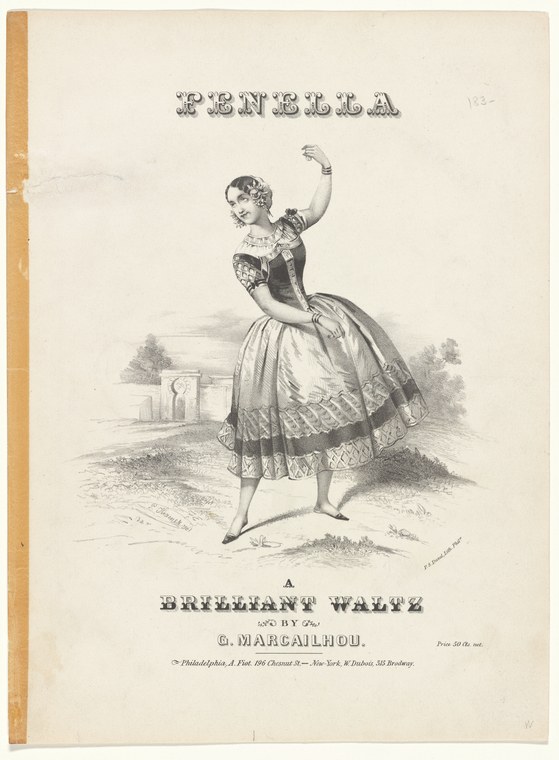
For dancers and historians, this engraving is a primary document of Romantic-era ballet aesthetics and technique. It shows how nineteenth-century ballet was marketed and understood by the public, and preserves the visual language—the costume, the posture, the spatial relationship between body and background—through which the period's obsession with weightlessness and transcendence was expressed. The print also raises questions about the economics and celebrity of nineteenth-century dance: who was Penella, and how did the circulation of her image in engravings contribute to her fame and the ballet's cultural reach?
What you are looking at
A young woman in mid-nineteenth-century dress stands alone in a landscape, captured in a moment of balletic poise. She wears a dark corseted bodice with short puffed sleeves and a voluminous skirt of pale fabric with dark horizontal bands or flounces at the hem—the silhouette characteristic of Romantic-era ballet costume. Her right arm is raised gracefully overhead, her left extends to the side, and her posture suggests the upright elegance and ethereal quality prized in the ballet of the 1840s–50s. The setting is minimal: a distant vista of trees and what appears to be a classical structure or temple in the background, rendered in fine stippling that gives the scene an almost dreamlike quality. The figure is poised en face, her gaze directed upward and inward, embodying the otherworldly, spiritual character of Romantic ballet heroines. The engraving's fine detail and the care taken in rendering fabric texture suggest this was a prestigious publication—a sheet music cover or promotional print for a celebrated dancer or ballet.
The dancing
The dancer stands in a nearly vertical alignment, her body elongated and weightless. Her raised right arm curves gracefully above her head; her left arm extends laterally at approximately shoulder height, fingers delicate. Her stance suggests she is on or near relevé—the elevated, ball-of-the-foot position fundamental to ballet technique. Her head is tilted back slightly, gaze lifted, creating the impression of effortless lift and transcendence. The composition is a single figure study, isolating the dancer against empty space to emphasize her form and the balletic silhouette.
The dance depicted
This is unmistakably Romantic-era ballet, likely from the 1840s or 1850s. The costume—short corseted bodice, multilayered skirt with horizontal flounces—is iconic of the period when dancers like Marie Taglioni and other European ballerinas performed in works such as *La Sylphide* and *Giselle*. The pose and ethereal quality suggest a solo moment, possibly a variation or a moment of spiritual transcendence characteristic of the supernatural and dreamlike narratives central to Romantic ballet. The title *Penella* (visible at the top of the print) may refer to a specific ballet or character, though this would require verification in theatrical records. The image documents not only the dance itself but the idealized body and aesthetic the period valued: weightless, elongated, and seemingly defying gravity.
How it was made
This is a fine engraving, executed with considerable skill and delicacy. The medium allowed for precise rendering of costume detail—the texture of the fabric, the layers of the skirt, the subtle shading of the bodice—and for the soft gradations in the background landscape achieved through careful stippling and cross-hatching. The quality of the work suggests it was produced as a commercial print, likely a sheet music cover or promotional image of a celebrated dancer. Engravings of this type circulated widely and served as both artistic documents and advertisements, making dancers and ballets known to the public beyond those who could attend performances. The NYPL attribution to this genre of print confirms its status as a mass-distributed cultural artifact.
About this work
This engraving documents the aesthetic and technique of mid-nineteenth-century Romantic ballet at a crucial moment in its history. The image captures both the physical vocabulary of the dance—the lifted posture, the arm positions, the ethereal quality of movement—and the costume that made Romantic ballet visually distinctive. Sheet-music covers and promotional engravings like this one were central to how ballet achieved its cultural authority in the nineteenth century: they circulated beyond the theater, reaching middle-class homes and creating a visual standard for what ballet should look like. This print preserves not only a moment of performance but a vision of femininity, grace, and otherworldliness that defined an era.
How to look at it
Attend to the dancer's weightlessness: notice how the engraver has rendered her poised on the ball of the foot, her body elongated and seemingly suspended. The raised arm and tilted head are not merely decorative gestures but conventions of Romantic ballet vocabulary, signaling transcendence and otherworldliness. The minimal, ethereal setting—the distant landscape, the empty space surrounding the figure—is also deliberate: it isolates the dancer and emphasizes her as the sole focus, the ideal form. The horizontal bands on the skirt, rendered with careful cross-hatching, are not merely decorative; they show the construction of the Romantic tutu and hint at how the skirt would move and float in performance. Finally, observe the care taken in the face: the upturned gaze and delicate features are part of the visual vocabulary of Romantic femininity that ballet embodied and promoted.
The artist
The artist is unrecorded in the catalogue. The quality of the engraving suggests a trained hand, likely working in a commercial printshop producing sheet music and theatrical promotion materials. Such prints were often unsigned or signed only with a monogram, reflecting the collaborative, workshop-based nature of mid-nineteenth-century print production. The engraver was not necessarily the composer or the dancer; they were a technician translating performance into a portable, repeatable image.
The period
This print dates to the height of Romantic ballet, a period (c. 1830–1860) when ballet became a dominant form of theatrical entertainment and cultural aspiration, particularly among urban, educated, middle-class audiences. Ballet in this era was understood as an art of illusion—dancers should appear weightless, ethereal, almost supernatural. Female dancers were the primary stars, and the short tutu (as seen here) became the visual emblem of the art form. Simultaneously, the rise of lithography and wood engraving made theatrical imagery accessible to those who could not attend performances; sheet music covers became a primary way the public encountered and remembered dancers and ballets. This print belongs to that moment when ballet was becoming a mass cultural phenomenon, circulated and consumed through prints as much as through live performance.
Where it lives
The print is held by the New York Public Library in its Prints collection, catalogued under 'Prints depicting dance.' It is a sheet music or theatrical promotion cover, likely printed in the mid-nineteenth century by a commercial printshop in New York or possibly imported from Europe. Such prints were ephemeral objects, produced in quantity and distributed to advertise performances and dancers; their survival in library collections reflects both their cultural importance and their fragility as paper artifacts.
Dance in this work
Questions about this work
Who was Penella?
The catalogue does not identify Penella definitively. The name may refer to a dancer, a ballet, or a character; it was not uncommon for sheet music covers and promotional prints to highlight a celebrated performer. To identify Penella with certainty, one would need to consult nineteenth-century theater records, dance histories, or the NYPL's archival documentation for this print.
Is this from a famous ballet?
The costume and style are consistent with Romantic-era ballets of the 1840s–1850s, such as *La Sylphide* or *Giselle*, but without further documentation, it cannot be attributed to a specific ballet. The title *Penella* alone does not appear to be the name of a major canonical work, though regional or lesser-known ballets with that title may have existed.
Why is the skirt so short?
The short tutu was the costume standard of Romantic ballet by the mid-nineteenth century. It allowed for visible footwork and created the visual impression of weightlessness and ethereality that the period's aesthetics demanded. The length also reflected practical performance considerations: dancers needed mobility and visibility for their technique.
How was this image made?
This is a hand-engraved print, likely made by transferring a drawing onto a copper plate and using fine lines and stippling to build tone and detail. The technique was labor-intensive but allowed for multiple impressions, making it ideal for commercial circulation as a sheet music cover or promotional material.
More dance artwork





