49 works in this view — arrow keys or swipe to move between them.
Dance in Art
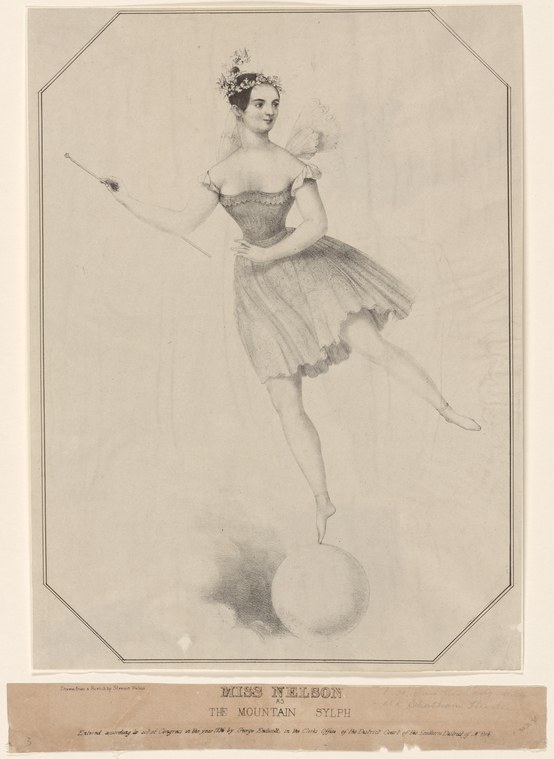
Miss Nelson as The mountain sylph
Unknown artist
- Collection:
- Prints depicting dance
- Source:
- New York Public Library
- Rights:
- Public domain — free to use, share and adapt.
- Recorded as:
- Public Domain
This image is essential evidence of how Romantic ballet was performed and what it looked like in the theatre. It preserves both the technical achievement (the illusion of flight via the suspended pose) and the aesthetic ideology (the supernatural, weightless, feminine ideal) that defined the genre. For dancers and historians, it shows the specific costume, the body carriage, the relationship between the dancer and the imagined aerial space—details that illuminate how the Romantic sylph was actually staged and performed.
What you are looking at
A young woman in theatrical dress is suspended in mid-leap against a plain background, her body arched in a graceful aerial pose. She wears a corseted bodice in a dotted or patterned fabric with short puffed sleeves, and a diaphanous skirt of gathered tulle or muslin that extends to mid-calf. Her hair is styled up and adorned with what appears to be a wreath or ornamental headdress. She holds a delicate wand or switch in her raised right hand. Beneath her, rendered in soft shadow, is a large spherical form—possibly representing a cloud or mystical element. The composition is spare: the figure dominates a light, neutral ground with only a simple rectangular border framing the image. The print shows the fine gradations of pencil or engraving work, with careful attention to the fall of fabric and the modeling of the dancer's limbs.
The dancing
The dancer is captured in a single, suspended moment—one leg appears to extend behind or beneath her in a line suggesting elevation, while the other bends beneath. Her torso is upright, the shoulders held back, her gaze directed upward and to the side. The raised arm holding the wand creates an open, expansive upper frame. The pose suggests weightlessness and control, with the body suggesting both strength and ethereal delicacy. There is only one figure, and no partner or supporting dancers are present.
The dance depicted
This is almost certainly a Romantic-era ballet, and the title 'The Mountain Sylph' combined with the costume, the supernatural cloudlike form below, the wand, and the overall aesthetic strongly suggest a work from the 1830s–1850s tradition exemplified by works like *La Sylphide* (1832). The sylph—a supernatural spirit of the air—was a defining figure of Romantic ballet, and the iconography here (the ethereal tutu, the flight pose, the magical wand, the wreath) is canonical. The image captures the moment of aerial ascension or suspension, which became the defining technical and poetic achievement of Romantic ballet, requiring the development of pointe work and the use of mechanical aids to create the illusion of weightlessness.
How it was made
This is a lithograph or fine engraving on paper, executed with considerable skill in the rendering of light and shadow. The technique allows for the fine, delicate linework visible in the dancer's features, the texture of the fabric, and the subtle modeling of the body. The use of a plain white ground and minimal setting is typical of theatrical portraiture from this period, where the focus is entirely on the dancer and her costume. The bordered rectangular frame is characteristic of mid-nineteenth-century theatrical prints, which were produced for circulation as souvenirs and promotional materials.
About this work
This is a theatrical print documenting a Romantic ballet performance by Miss Nelson in the role of the Mountain Sylph, likely from the 1830s or 1840s. The work belongs to the tradition of Romantic ballet portraiture—prints that celebrated the new technical and aesthetic achievements of the era, particularly the illusion of weightless, supernatural flight. The sylph role was central to Romantic ballet's cultural prestige, and images like this one circulated widely among theatregoers and dance enthusiasts, serving both as a memento of a specific performance and as a visual record of the period's choreographic innovations. The print demonstrates how nineteenth-century audiences understood and valued the ethereal, otherworldly qualities that ballet aspired to embody.
How to look at it
Attend to the moment the artist has chosen: not a moment of grounded dancing, but the instant of suspension or ascent, with the body in an open, elongated line that suggests effortlessness. Notice how the artist has used the spherical form beneath the dancer to anchor the sense of height and flight. The pose itself is anatomically demanding—it requires the strength and flexibility of a trained dancer—but it is rendered as weightless and serene. The delicate linework in the tulle, the fineness of the facial features, and the careful modeling of the extended leg all contribute to an aesthetic of refinement and otherworldliness that was central to Romantic ballet's cultural ideal.
The artist
The artist is not recorded in the catalogue. The print is unsigned and undated. Theatrical prints of this type were often created by engravers or lithographers working from life sketches or from memory of specific performances, sometimes without formal credit. The quality of execution suggests a professional practitioner working within the established conventions of theatrical portraiture.
The period
This print dates almost certainly to the Romantic era of ballet (c. 1830–1850s), a period of radical innovation in dance aesthetics and technology. The sylph became the defining figure of the age following the premiere of *La Sylphide* in Paris in 1832, a work that crystallized the period's fascination with the supernatural, the ethereal, and the transcendent. The development of pointe work (dancing on the tips of the toes), the refinement of the tutu into the short, layered form visible here, and the use of gas lighting all contributed to creating the visual and kinetic illusion of weightlessness. Theatrical prints like this one were mass-produced as lithographs for urban middle-class audiences, creating a vigorous market for images of celebrated dancers and roles. The print reflects both the technical achievements and the cultural anxieties of the period—the Romantic era's simultaneous idealization and objectification of the female dancer.
Where it lives
This print is part of the New York Public Library's collection of prints depicting dance, held in the performing arts collection. It is a lithograph or engraving, a format typical of theatrical ephemera produced in the nineteenth century for circulation and sale to theatregoers.
Dance in this work
Questions about this work
What is a sylph?
In Romantic ballet, a sylph is a supernatural spirit of the air or forest, typically a beautiful, ethereal young woman. The sylph became the iconic Romantic heroine after the premiere of *La Sylphide* in 1832. The role required dancers to create the illusion of weightlessness and to move with an ethereal, dreamlike quality, and it became the vehicle for demonstrating the technical and aesthetic innovations of the era.
How did dancers create the illusion of flight?
Romantic ballet dancers used a combination of techniques and technologies. They developed pointe work—dancing on the tips of the toes—which created the visual line of elongation and weightlessness. Choreographers designed movements that emphasized upward lines and sustained balances. Stage machinery and lighting also contributed: gas lighting created dramatic shadows and highlights, and mechanical devices could be used to assist the dancer in achieving or maintaining suspension in the air. The poses themselves, like the one shown here, were designed to suggest flight through their elegant, extended lines.
Who was Miss Nelson?
The catalogue record does not identify Miss Nelson beyond the title. She was clearly a professional dancer performing in the 1830s–1850s, celebrated enough to have a print made of her in the popular sylph role. Theatrical prints of the era often identified performers only by surname and role, and detailed biographical information about many dancers of the period is now lost.
Why were theatrical prints so popular?
Theatrical prints served as souvenirs for audiences, promotional materials for theatres and dancers, and visual documentation of celebrated performances. They were affordable, could be framed and displayed at home, and allowed theatregoers to remember and share the experience of seeing a particular performer. For dancers, they were crucial to building and maintaining a public reputation and career.
More dance artwork





