49 works in this view — arrow keys or swipe to move between them.
Dance in Art
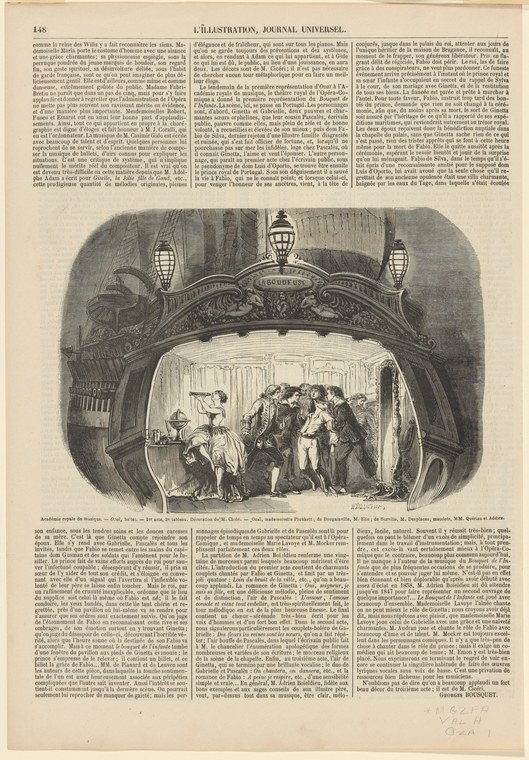
Académie royale de musique, Ozaï, ballet, 1er acte, 2e tableau
Unknown artist
- Collection:
- Prints depicting dance
- Source:
- New York Public Library
- Rights:
- Public domain — free to use, share and adapt.
- Recorded as:
- Public Domain
This engraving documents a specific, named production at a major dance institution, providing rare visual evidence of how French opera-ballet was staged and what it looked like in performance. For historians and dancers studying the transition from court ballet to theatrical narrative dance, it is a crucial primary source that shows the costuming, stage design, and dramatic context in which dance took place.
What you are looking at
A richly detailed engraving depicting a theatrical scene from the opera-ballet *Ozaï*, Act 1, Scene 2. The stage is framed by an ornate proscenium arch with classical decoration, elaborate side panels, and hanging lamps. Within this arch, a curtain parts to reveal an interior setting—a grand room or palace chamber with draped fabrics. The scene is crowded with figures in 18th-century costume: men in breeches, coats, and hats; women in full skirts and elaborate dress. The composition suggests a moment of social interaction or dramatic assembly rather than formal dance formation, with figures clustered in conversation, gesturing toward one another. The engraving's fine cross-hatching renders depth and atmosphere, with darker tones in the architectural surround concentrating light on the stage action. The theatrical machinery and elaborate framing emphasize the spectacle of the Royal Academy of Music's production.
The dancing
The dancers and actors are dressed in contemporary 18th-century fashion, with no visible pointe work or classical ballet positions. The bodies are in conversational or dramatic postures—upright, gestural, oriented toward each other rather than in the line or geometric formations typical of formal ballet. Several figures appear to be in mid-gesture or movement, but the overall composition reads as a theatrical tableau or dramatic moment rather than a choreographed dance passage. The density of figures and the crowded stage suggest an ensemble or chorus scene rather than a featured dance.
The dance depicted
This engraving documents a scene from *Ozaï*, an opera-ballet presented at the Académie Royale de Musique (the Paris Opera) in the 18th century. The title identifies it as Act 1, Scene 2, suggesting this is a moment from the narrative rather than a distinct dance number. The scene appears to depict a social or dramatic gathering—possibly a court scene, celebration, or dramatic encounter—rather than a formal dance. Without additional documentation, it is difficult to determine whether a specific dance form was choreographed for this moment, though the theatrical setting and costuming are consistent with the mixed dance-drama productions typical of French baroque and rococo opera-ballet. The work was designed to be viewed as theatrical spectacle.
How it was made
This is an engraving, executed in the detailed linear style characteristic of 18th-century theatrical illustration. The technique uses fine cross-hatching and parallel lines to build tone and create illusionistic depth, particularly in the rendering of the architectural frame and the fall of fabric. Engravings of this type were printed in relatively large quantities for circulation among the theater-going public and collectors of theatrical prints, making them important documentary evidence of how specific productions were designed and staged. The quality of the engraving and the expense of its production suggest this was a record of a significant production at a prestigious institution.
About this work
This is a documentary engraving of a scene from *Ozaï*, an opera-ballet produced at the Académie Royale de Musique in Paris. It captures the visual spectacle and theatrical design of 18th-century French dance-theater at a major institutional venue. The work is valuable as a record of how dramatic moments were staged and costumed during the period when ballet was evolving from pure dance spectacle toward narrative drama. The engraving preserves not only the choreographic moment but also the architectural and sartorial context in which it was presented, offering insight into the integration of dance, music, costume, and decor in baroque and rococo theatrical practice.
How to look at it
Attend to the framing: the ornate proscenium arch is as much a subject of the engraving as the scene within it, emphasizing that this is a designed and manufactured spectacle. Notice how the architectural surround and theatrical machinery dominate the composition, with the dancers and actors occupying the brightly lit stage area. The engraver chose to show a narrative or social moment rather than a formal dance line, suggesting this was a scene of dramatic interaction. The detailed rendering of costume and the density of figures conveys the richness of production values and the importance of visual spectacle to the art form.
The period
This engraving dates to the era of French baroque and rococo opera-ballet, when the Académie Royale de Musique (Paris Opera) was the premier venue for dance in France. During the 18th century, ballet was transitioning from pure geometric spectacle toward more narrative and dramatic forms, with greater integration of mime, gesture, and theatrical design. Theatrical prints like this one were important means of documenting and circulating knowledge of major productions beyond those who had attended performances. The engraving's style and the production design it depicts reflect the period's taste for elaborate scenic machinery, rich costuming, and the integration of dance into a broader theatrical spectacle of music, spoken drama, and visual design.
Where it lives
This print is part of the New York Public Library's collection of prints depicting dance. It is likely one of a series of engravings documenting the production of *Ozaï* at the Paris Opera, and may have been created for sale to the theater-going public or to collectors of theatrical imagery.
Dance in this work
Questions about this work
What is Ozaï and when was it performed?
*Ozaï* is an opera-ballet that was performed at the Académie Royale de Musique (Paris Opera). The specific dates and creators are not documented in the catalogue record, but the style of the engraving and the costume design suggest an 18th-century production, likely in the baroque or rococo period when such mixed theatrical spectacles were popular in France.
Can you identify the choreography or the dancers?
No. The engraving documents the scene and setting but does not identify individual dancers or provide detailed notation of movement. It is a record of theatrical spectacle—the framing, costuming, and dramatic moment—rather than a dance-specific documentation.
Why is this scene important to ballet history?
This engraving documents how dance was integrated into French opera-ballet at a major institutional venue. It shows that ballet of this era was not purely abstract or geometric, but was embedded in narrative and dramatic contexts, with elaborate staging and costuming. It is evidence of the theatrical world in which dance took place.
More dance artwork





