49 works in this view — arrow keys or swipe to move between them.
Dance in Art
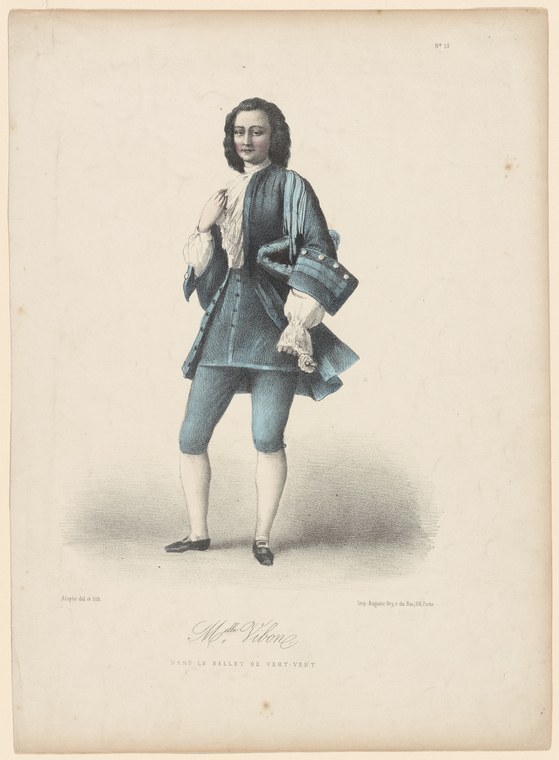
Melle. Vibon, dans le ballet de Vert-Vert
Unknown artist
- Collection:
- Prints depicting dance
- Source:
- New York Public Library
- Rights:
- Public domain — free to use, share and adapt.
- Recorded as:
- Public Domain
This print documents a specific professional dancer and a specific theatrical production, placing the work in the lived history of French theater rather than in an imagined or literary vision of dance. It is also a primary source for the actual costume, carriage, and physical ideals of male theatrical dancers in this period—information that is invaluable to historians of dance and costume. The formal presentation convention on display here—the isolated figure in characteristic pose—became a standard template for theatrical celebrity in the 18th and 19th centuries.
What you are looking at
A young male dancer stands alone against a plain ground, posed in an attitude of elegant restraint. He wears a blue-grey justaucorps (a close-fitting coat) with white fur trim at the cuffs and collar, knee breeches of the same blue-grey fabric, and white stockings with dark heeled shoes. His hair is shoulder-length and dark, styled in the fashion of the early 18th century. He holds one arm extended to the side at about shoulder height with a slight curve, while the other rests near his body, and his weight appears centered. His posture is upright and dignified, with the slight forward tilt of the torso characteristic of the period. The figure occupies the center of the composition, isolated and formally presented as if for theatrical documentation or costume record.
The dancing
A single male dancer is shown in a standing position, neither in motion nor in an extreme position but rather in a formal presentational stance. His arms are moderately raised and curved in the graceful manner codified in baroque dance manuals—the working arm extended gently to the side, the supporting arm held to the body with equal elegance. His weight distribution suggests balance and control rather than any particular step or movement. The body is upright, the head held level, the expression composed. This is the language of the dancing master's demonstration or the theatrical male dancer of the early 18th century court and stage.
The dance depicted
This is a theatrical or ballroom dancer from the period of French baroque dance, most likely from a professional theatrical context given the costume and presentation. The title identifies him as Melle. Vibon in the ballet 'Vert-Vert', a work known from the early 18th century. The pose itself is not a moment of action but rather a formal presentation of the dancer's bearing and costume—a convention of the period in which dancers were documented in characteristic positions that demonstrated good form, alignment, and the elegant carriage essential to ballet and courtly dance. The style and dress suggest the vocabulary of minuet, gavotte, or other haute danse forms popular in this era.
How it was made
This is a hand-colored engraving or etching, executed with fine line work and finished with subtle color washes in blue-grey, white, and flesh tones. The technique allows precise rendering of the costume and its details—the fur trim, the button work, the stocking seams—while the soft shading of the figure against the plain ground creates an effect of theatrical lighting and presence. This was a common format for documenting dancers, particularly in France, where engraved theatrical portraits could be produced relatively inexpensively and circulated among the dance community and curious public. The style and method of printing suggest publication from a commercial print house, likely in Paris.
About this work
This is a formal theatrical portrait of a male dancer named Vibon, costumed and posed to exemplify the refined carriage and dress of early 18th-century stage dancing. The work belongs to a large tradition of printed theatrical documentation—costume and pose records that served both as souvenirs for patrons and as reference material for dance professionals. It captures not a moment of narrative drama but rather the essential presentation of the dancer's art: the body held in a state of noble alignment, the movement potential gathered but not discharged, the costume indicating both role and social status. The image is evidence of how dancers were marketed and remembered, and of the formal aesthetic principles that governed theatrical dance in the baroque period.
How to look at it
Attend to the posture and carriage: note how the body is held in a state of poised readiness rather than repose or exertion. The alignment of the head and spine, the careful placement of the arms, and the precision of the stance reveal the physical discipline and aesthetic principles of the form. Look at the costume: the close fit and fine detail of the justaucorps and breeches would have shown every line of the body beneath, so the dancer's physique was on display as part of his art. Consider also the expression and gaze: composed, directed outward, presenting rather than narrating. This is a formal genre portrait translated into the register of dance.
The artist
The print is attributed to an unnamed engraver working from a drawing (the inscription 'Gravé par le S. [signature]' or similar is not fully legible in the image). It appears to be a commercial theatrical print of the type produced in Paris during the early 18th century, likely issued by a print publisher who specialized in theatrical costume and celebrity documentation. The style and execution are competent but not exceptional, suggesting a working print shop rather than a named master engraver.
The period
The early 18th century was the age of the professional dancer in the European court and theater. The reign of Louis XIV had elevated dance to a formal art with its own vocabulary, and the legacy of his academies and the court ballets lived on in the professional theatrical ballet and in the opera-ballet form. Male dancers occupied a significant place in this world—as virtuosos, as partners, and as bearers of the serious, dignified movement that was the mark of haute danse. The costume worn by Vibon reflects the fashion of the period and the practical requirements of stage movement. Prints like this were a new form of celebrity marketing, allowing the faces and bodies of famous performers to circulate beyond those who could attend performances.
Where it lives
This engraving is held in the New York Public Library's collection of prints depicting dance. The title is inscribed in French beneath the figure. The work is undated in the record but the style, costume, and typography suggest publication in the early 18th century, likely in Paris.
Dance in this work
Questions about this work
Who was Melle. Vibon?
The catalogue does not provide biographical information. The title identifies her as a performer in the ballet 'Vert-Vert', a comedy-ballet from the early 18th century with music by Michel Pignolet de Montéclair. She was evidently a professional dancer in Paris, significant enough to be documented in a published print portrait. Beyond this, little is known from the print itself.
What is 'Vert-Vert'?
Vert-Vert was a ballet-pantomime first performed in Paris in 1735, with a libretto based on a satirical poem by Jean-François de Saint-Lambert. The story concerns a parrot (vert-vert) who escapes from a convent and has adventures in the outside world. It was a light, comic work popular in its time, and a vehicle for the display of comic and character dancing as well as serious ballet.
How do we know this is an engraving and not a painting or drawing?
The fine parallel lines (hatching and cross-hatching) visible in the shadows and modeling of the fabric, the precision of the line work, and the method of hand coloring are all characteristic of intaglio engraving. The technique allowed for fine detail and for multiple impressions to be taken from a single plate, making theatrical prints like this one economically viable for distribution.
What does the pose tell us about the dance?
The pose is not a step or movement but rather a formal presentation of the dancer's carriage and alignment. It shows us that male theatrical dancers of this period were expected to hold the body in an upright, noble posture with arms held in curved, graceful positions. The ideal was of dignity, control, and elegant repose—quite different from the explosive, virtuosic vocabulary that would develop later in the 19th century.
More dance artwork





