49 works in this view — arrow keys or swipe to move between them.
Dance in Art
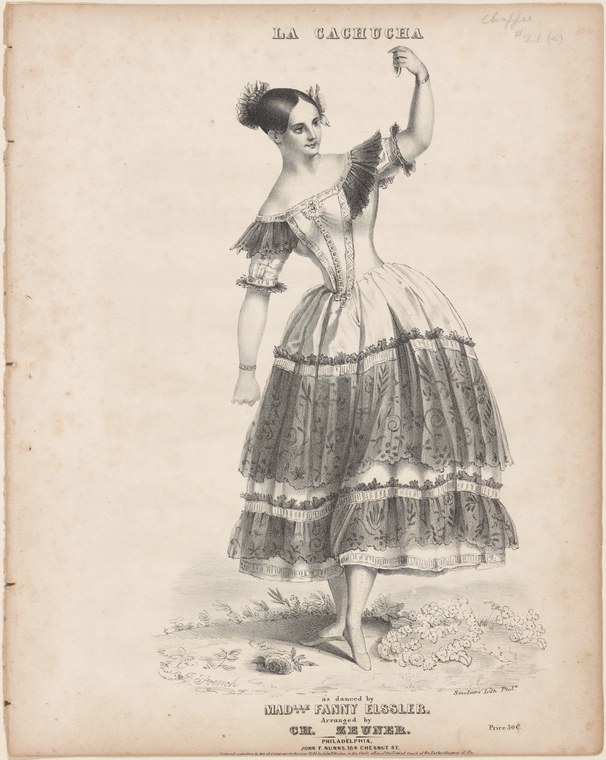
La cachucha as danced by Madlle. Fanny Elssler
Unknown artist
- Collection:
- Prints depicting dance
- Source:
- New York Public Library
- Rights:
- Public domain — free to use, share and adapt.
- Recorded as:
- Public Domain
Fanny Elssler was one of the two or three most celebrated dancers of the romantic period, and *La Cachuça* was her most famous role—the dance that secured her reputation across the Atlantic and defined her as a dancer of character and national colour as much as classical line. This engraving is an artifact of how romantic-era dancers were documented, advertised, and made iconic: not as action photographs capturing the peak of a jump, but as composed portraits in which the dancer holds a moment of elegant control. It reveals how mid-19th-century audiences understood and consumed ballet celebrity.
What you are looking at
A single female dancer is shown in a moment of performance, occupying most of the composition against a plain background. She wears a mid-19th-century performance costume: a white off-shoulder blouse with short puffed sleeves and decorative trim, and a full skirt in white with multiple horizontal bands of dark patterned fabric and lace—characteristic of romantic-era ballet dress. Her dark hair is styled up and back. Her pose is one of controlled elegance: she stands with one leg supporting her weight while the other extends behind or to the side, her upper body held upright, her arms positioned expressively with the nearer arm raised. The distant ground line is indicated by minimal sketching suggesting a stage or performance floor. The whole composition emphasizes the dancer's form and the architecture of her costume.
The dancing
A single dancer in a turned-out stance with one leg supporting and the other extended in a controlled line. Her arms are positioned in a lifted, open frame—the nearer arm raised and extended, suggesting a moment of balance or transition within a phrase. Her posture is upright and dignified, with the ribcage held high and the weight clearly engaged through the supporting leg. The costume, with its full gathered skirt, suggests a dancer trained in the vocabulary of early romantic ballet, and the control visible in her frame indicates a performer of technical accomplishment.
The dance depicted
This is *La Cachuça* as performed by Fanny Elssler, one of the most famous dances of the romantic ballet era. The cachuça was originally a Spanish folk dance (related to the bolero and fandango families), and Elssler's version—choreographed for her by Joseph Mazilier—became a sensation across Europe and America in the 1830s–40s. The image captures the pose mid-performance, but the costume and the formal engraved presentation suggest this is a record of the theatrical *adaptation* of the Spanish dance, not the vernacular original. The controlled turnout, the lifted port de bras, and the theatrical tutu place this firmly in the romantic ballet tradition, even though the dance was understood as an exotic, 'national' or character piece within that tradition.
How it was made
This is a wood or steel engraving, likely a commercial print produced for mass circulation among ballet audiences. The fine parallel line-work typical of engraving allows for the precise rendering of costume detail—the pattern on the skirt, the texture of the lace, the folds of fabric. Engravings of celebrated dancers were common merchandise in the 19th century, sold as souvenirs or illustrations in theatrical magazines and periodicals. This printing technique meant the image could be reproduced widely and cheaply, making Elssler's fame and this particular iconic pose available to audiences far beyond those who saw her perform live.
About this work
A mid-19th-century engraving of Fanny Elssler performing *La Cachuça*, the Spanish-influenced character dance that became one of her signature roles and a defining work of romantic-era ballet. The print captures a single moment of poised, controlled performance—one leg supporting, the other extended, arms lifted in an open frame—and renders the elaborate theatrical costume in fine detail. This is both a document of romantic ballet practice and a piece of celebrity merchandise, circulated widely to capitalize on Elssler's international fame. The work sits at a fascinating crossroads: it celebrates a dancer known for her dramatic power and technical precision, yet it captures her in a moment of stillness—the engraver's choice of a balanced, sustainable pose rather than a moment of virtuosic extremity.
How to look at it
Attend to the precision of the costume rendering—the engraver has taken care to show the pattern and layering of the skirt, the delicate trim, the texture of the fabrics—because this detail was part of what made the image legible as a souvenir of a specific, celebrated performance. Notice the dancer's posture: the supporting leg is turned out and engaged, the free leg is extended in a clear line, and the upper body is held upright and open. This is not a moment of maximum extension or height, but rather a moment of poise and balance—a position a dancer could sustain and that reads clearly from a distance, making it an ideal choice for a theatrical print. The compositional choice to show the dancer alone, full-length, against a blank ground is itself part of the romantic aesthetic: the emphasis is on the individual performer as an autonomous figure of beauty and skill, not on narrative or ensemble.
The period
This print dates from the height of the romantic ballet era (roughly 1830–1850), when ballet was undergoing a profound shift toward themes of the exotic, the melancholic, and the supernatural, and when dancers became international celebrities whose images were mass-produced and circulated like modern stars. Fanny Elssler rose to prominence partly in reaction against the dominance of Marie Taglioni and the ethereal, pointe-work-focused style of the Romantic ideal; Elssler was known for her dramatic attack, her use of the flat of the foot, and her incorporation of character and folk-dance material into ballet. *La Cachuça*, drawn from Spanish folk tradition, exemplified this approach and was part of a broader 19th-century fascination with 'national' or 'character' dances as materials for theatrical ballet. The engraving itself is a product of the period's mechanisms for turning live performance into portable, collectible cultural product.
Where it lives
The work is held in the Library of Congress Prints collection (nypl indicates a New York Public Library source, which often includes LC materials in cross-indexed digital collections). It is a commercial theatre print, designed for circulation and sale to audiences and ballet enthusiasts of the period.
Dance in this work
Questions about this work
Who was Fanny Elssler?
Fanny Elssler (1810–1884) was an Austrian dancer and one of the two greatest stars of the romantic ballet era, celebrated for her dramatic power, technical precision, and incorporation of folk-dance material into classical ballet. She was the leading rival and counterweight to Marie Taglioni, and her career took her across Europe, North America, and Russia. *La Cachuça* became her signature role.
What is the cachuça?
The cachuça is a Spanish folk dance in triple metre, related to the bolero and fandango. Elssler's theatrical version, choreographed for her around 1835, was adapted from Spanish tradition into a romantic-era character piece: it retained rhythmic and gestural elements of the original but reshaped them through the vocabulary of ballet. The theatrical cachuça became world-famous through Elssler's performances.
Why was this engraving made?
Celebrity dance prints were a standard form of merchandise and publicity in the 19th century. They advertised performers, documented celebrated roles, and allowed audiences who could not attend performances to own an image of their favourite dancers. This engraving capitalized on Elssler's fame and made *La Cachuça* visually iconic.
How does the pose reflect the dance?
The pose captures a moment of control and balance within the choreography—the extended leg and lifted frame suggest the combination of Spanish folk vocabulary (which often used the extended leg and open carriage) with the turned-out, upright posture of classical ballet. It is a sustainable moment rather than a peak of virtuosity, making it a clear and legible image of the dancer's technique and character.
More dance artwork





