49 works in this view — arrow keys or swipe to move between them.
Dance in Art
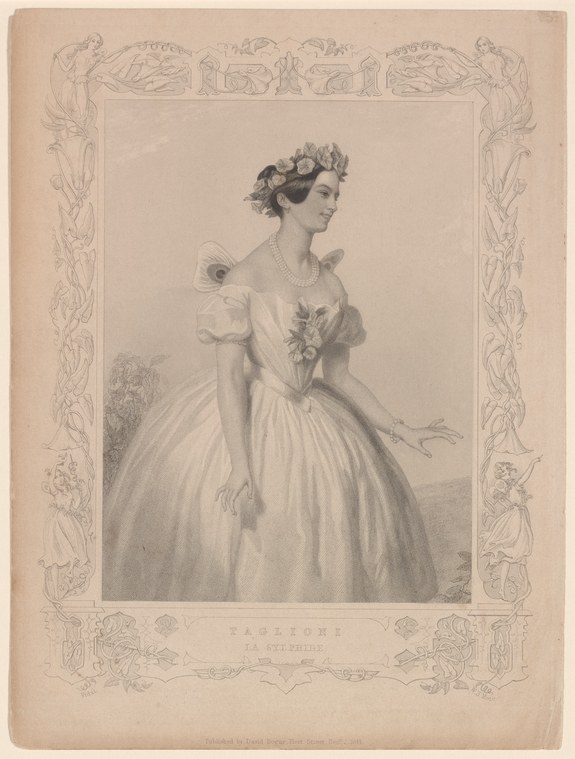
Taglioni, La sylphide
Unknown artist
- Collection:
- Prints depicting dance
- Source:
- New York Public Library
- Rights:
- Public domain — free to use, share and adapt.
- Recorded as:
- Public Domain
Maria Taglioni was the first great international ballet star and *La Sylphide* the first canonical Romantic ballet. This image is proof of how print culture made her famous across Europe and how the ethereal, pointe-shod silhouette became inseparable from ballet's identity. For historians of dance and theater, it shows how theatrical image-making operated before photography—as a deliberate, stylized, and highly portable medium of star promotion.
What you are looking at
A single female dancer dominates the composition, shown in three-quarter profile facing left. She wears a romantic-era pointe shoes and a white tulle skirt of mid-calf length, with puffed sleeves and a fitted bodice. Her dark hair is arranged in an elaborate upswept style with what appears to be a decorative crown or tiara. She holds a small bouquet of flowers in one hand and gestures gracefully with the other, her body aligned in a classically trained ballet posture. The figure is set against a plain background and framed by an ornate decorative border composed of intertwining botanical and figural motifs in a neoclassical style. The engraving captures a moment of poised elegance, the dancer appearing suspended in a movement that balances stillness with the suggestion of motion.
The dancing
The dancer's weight appears to be held in the lifted, elongated frame characteristic of ballet training. Her arms are positioned with soft curves, one holding flowers and the other extended in a classical port de bras. The head is held with the proud carriage of a trained ballerina, gaze directed into the middle distance. Her legs, visible through the translucent skirt, are aligned in a turned-out position typical of ballet's first position or a preparation stance. The overall bearing conveys the trained elegance and ethereal quality that defined the Romantic ballet aesthetic.
The dance depicted
This is a portrait of Maria Taglioni in the role of the Sylphide, from the 1832 ballet *La Sylphide*, the defining work of Romantic ballet. The costume—white tulle skirt, pointe shoes, fitted bodice, and floral crown—is iconic of Taglioni's most famous role and became the template for the Romantic ballerina ideal. The image captures not a moment of narrative action but rather a portrait of the dancer-as-character, a form of theatrical promotion common in the 19th century. Taglioni's introduction of sustained dancing en pointe (on the tips of the toes) transformed ballet technique and made this silhouette immediately recognizable to contemporary audiences.
How it was made
This is an engraving, a line-based reproductive technique suited to mass circulation. The fine parallel lines (hatching and cross-hatching) build shadow and volume, most visible in the skirt's folds and the figure's features. The ornate border—a hallmark of theatrical prints and fashion plates of the period—was engraved as part of the composition and suggests this was designed for framing or collection in a portfolio. Engravings were the primary medium for theatrical portraiture before photography, allowing multiple impressions to be sold to audiences as souvenirs and to art collectors, making Taglioni's image widely distributed across Europe.
About this work
This is a portrait engraving of the Romantic-era ballerina Maria Taglioni in her most celebrated role, the Sylphide. It documents both a pivotal moment in ballet history—the emergence of pointe work as a technical requirement—and the 19th-century practice of printing and selling theatrical portraits as fan ephemera and collectibles. The engraving is one of many such images produced in the 1830s–1840s to capitalize on Taglioni's international fame; her image became almost as famous as her dancing. The ornate neoclassical border frames the figure as a precious object, elevating the dancer to the status of high art while the engraving process ensured the image reached a wide paying public. This work is essential to understanding how 19th-century dancers built celebrity and how ballet's visual identity was shaped for mass consumption.
How to look at it
Attend to the pose: the dancer is shown not mid-movement but in a moment of poised stillness, a common convention in theatrical portraiture intended to display the figure's beauty and the costume's elegance rather than to document an actual step. Notice the pointe shoes and turned-out legs—technical markers that would have been immediately legible to an audience familiar with ballet. The ornate border, with its neoclassical caryatids and botanical motifs, was a standard framing device that elevated theatrical subjects to high-art status and marked the print as a luxury object worthy of collection and display.
The artist
The artist is not recorded. The engraving style and neoclassical border are consistent with Parisian theatrical print production of the 1830s–1840s, when such portraits were typically commissioned by print dealers or theater management and sold in series. The quality of the line work and the composition suggest a skilled reproductive engraver working from a painted original, a standard practice in theatrical portraiture of the period.
The period
This engraving was made during the height of Romanticism in the visual and performing arts (c. 1830–1850). In ballet, the premiere of *La Sylphide* in 1832 marks the official beginning of the Romantic ballet era, characterized by supernatural narratives, ethereal female dancers in white tutus, and the aesthetic of the unattainable sylph or spirit. Taglioni's technical innovation—sustained dancing en pointe—coincided with and enabled this aesthetic shift. In printmaking, the neoclassical ornamental border and the fine engraving technique reflect the taste of a bourgeois audience that collected theatrical ephemera, fashion plates, and prints of celebrities. The engraving was one of dozens of Taglioni portraits produced during the 1830s–1840s and widely distributed across Europe, making her the first globally recognized ballet superstar.
Where it lives
The work is held in the New York Public Library's Prints collection, one of the major repositories of 19th-century theatrical prints and popular imagery. It is catalogued as a portrait engraving without attribution to a specific artist, consistent with the anonymity of many reproductive prints from this period.
Dance in this work
Questions about this work
Who was Maria Taglioni and why is she important?
Maria Taglioni (1804–1884) was an Italian-Swedish ballerina who became the first international ballet superstar. She created the role of the Sylphide in 1832 and pioneered sustained dancing en pointe, transforming ballet technique and aesthetics. Her fame was unprecedented for a dancer—she was as celebrated in Russia, London, and Paris as she was in Milan, and her image was reproduced and sold by the thousands.
What is *La Sylphide* and why does it matter?
*La Sylphide* (1832) is the first canonical Romantic ballet, based on a narrative about a mortal man who falls in love with an unattainable air spirit (sylph). The ballet defined the visual language of Romantic ballet: the ethereal white tutu, pointe shoes, supernatural subject, and the male gaze entranced by an otherworldly female figure. It is still performed today and remains central to ballet repertory.
Why are the pointe shoes important?
Pointe work—dancing on the tips of the toes—was not invented by Taglioni, but she was the first dancer to sustain it throughout a role, making it a technical requirement rather than a occasional effect. This innovation allowed dancers to appear lighter, more ethereal, and less earthbound—essential to the Romantic ballet's aesthetic of the supernatural. Pointe work remains the defining technical marker of classical ballet.
How did 19th-century dancers become famous without photography or mass media?
Through prints. Theatrical portraits like this one were sold to audiences as souvenirs and collectibles, distributed by print dealers in major cities across Europe. Taglioni's image was engraved and reprinted hundreds of times, circulating her fame far beyond those who could attend a performance. These prints were framed, pasted into albums, and traded, making her a celebrity in the modern sense long before photography was commercially viable.
More dance artwork





