49 works in this view — arrow keys or swipe to move between them.
Dance in Art
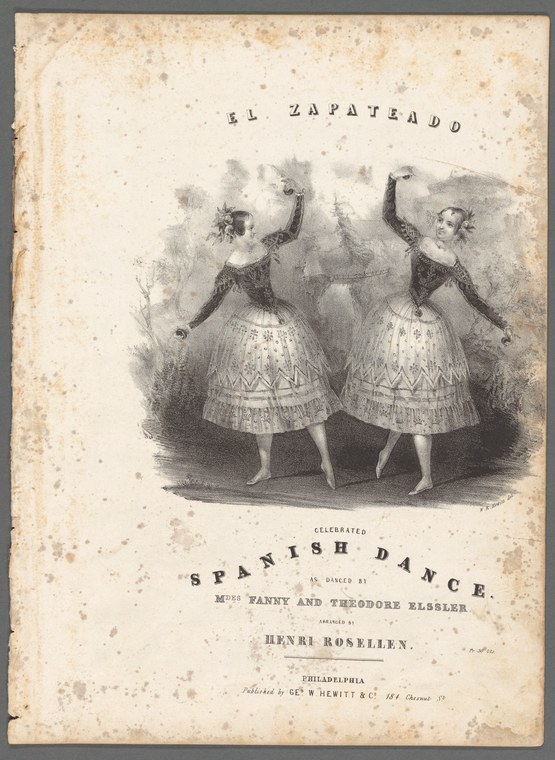
El zapateado, celebrated Spanish dance, as danced by Mdes. Fanny and Theodore [i.e., Thérèse] Elssler, arranged by Henri Rosellen
Unknown artist
- Collection:
- Prints depicting dance
- Source:
- New York Public Library
- Rights:
- Public domain — free to use, share and adapt.
- Recorded as:
- Public Domain
This print documents how European professional dancers encountered and performed Spanish dance traditions during the 1840s, and shows the visual conventions used to represent the zapateado to a theatrical audience. It is evidence of the specific performance style, costuming, and staging of one of the era's most celebrated dances, performed by internationally renowned artists whose interpretations shaped European taste.
What you are looking at
This is a sheet music cover for a Spanish dance composition, rendered as a lithograph or engraving. Two women in identical poses dominate the composition, positioned side by side in a symmetrical arrangement. Both wear dark corseted bodices and voluminous white skirts decorated with geometric patterns and what appears to be lace or embroidered detailing at the hem. Their arms are raised at shoulder height, elbows bent, with one arm extended forward and the other back in a mirror image—a posture characteristic of Spanish folk dance. Their heads are tilted, with dark hair styled in the fashion of the mid-19th century. The background is plain, typical of theatrical prints of the era, allowing the figures and their costumes to command full attention. The image is presented as a title page, with text at top and bottom indicating this is a Spanish dance arranged for performance.
The dancing
The two figures are identically posed in what appears to be a characteristic moment of zapateado or Spanish folk dance: arms held at medium height with a bent-elbow frame, suggesting rhythmic arm movements accompanying footwork. The weight appears distributed evenly, the bodies upright and formal rather than dramatically tilted. The posture suggests preparedness for rapid footwork rather than a mid-leap moment. The mirror-image positioning indicates a duet or ensemble formation, though whether these are meant to represent simultaneous or sequential movement is unclear from the static image.
The dance depicted
This is a print documenting a Spanish dance, specifically zapateado (Spanish footwork dance), as performed by the Elssler sisters—Fanny and Thérèse (Theodore)—who were major European ballet stars of the 1830s–1840s. Zapateado is characterized by rapid, intricate footwork and rhythmic heel-and-toe percussion against the floor, accompanied by arm gestures. The composition was arranged by Henri Rosellen, a prolific composer of dance music and ballet arrangements of the period. The image shows the dance as performed by professional theatrical dancers of the Romantic era, not as a folk form—the costumes are theatrical rather than vernacular, and the poses are formal and composed for public performance.
How it was made
This is a lithographic print, likely from the 1840s, produced as sheet music cover art. The fine detail and tonal gradation visible in the fabric, faces, and background shading indicate a well-executed lithograph, a medium that allowed rapid reproduction and distribution to a broad musical public. Such prints served as advertisements for compositions and as records of celebrated performances. The technique allowed for both artistic refinement and commercial circulation, making this object evidence of how theatrical dance was promoted and remembered in the pre-photographic era.
About this work
This sheet music cover documents a Spanish dance performance by two of Europe's most celebrated dancers during the Romantic ballet era. It captures the theatrical interpretation of Spanish folk dance by professional ballet artists, preserving a moment of the mid-19th-century fascination with national and ethnic dance styles within the European theatrical tradition. The work belongs to a large body of Romantic-era prints that immortalized specific dancers and choreographic moments, serving as both commercial products and historical records of performance practice.
How to look at it
Pay attention to the arm and hand position: the bent-elbow frame and the forward-and-back alternation of the arms indicate the rhythmic arm work that accompanies Spanish footwork. The rigid uprightness of the torso and the formal positioning of the feet suggest that what is shown is a posed moment rather than a captured mid-step instant—the figure is ready to dance or pausing mid-phrase, not mid-leap. The symmetrical arrangement of the two identical figures suggests this was a duet or a double image meant to showcase both performers or to emphasize the standardized formal beauty of the pose.
The artist
The artist of the lithograph is not recorded. Henri Rosellen (1811–1876) was a French composer, pianist, and arranger known for orchestrating popular dances and ballet music, including works for famous dancers of the era. He was not the printmaker but rather the musical arranger credited on the title. The Elssler sisters—Fanny (1810–1884) and Thérèse, known as Thérèse or Theodore (1808–1878)—were Austrian-born dancers who achieved international fame in European and American theaters, performing in both ballet and character dances including Spanish and national styles.
The period
The 1830s–1840s were the height of the Romantic ballet era, a period marked by intense European fascination with national, folk, and exotic dance forms. While classical ballet dominated the stage, celebrated dancers frequently performed 'character' or 'national' dances—including Spanish, Italian, Scottish, and Oriental styles—as entertainment within or between acts. These dances were often arranged by composers like Rosellen to suit theatrical convention and the technical abilities of star performers. Sheet music covers with dance imagery were major commercial products, creating demand for high-quality lithographs that publicized both the music and the celebrated dancers.
Where it lives
This object is held in the New York Public Library's Prints collection as part of their holdings of dance-related prints and theatrical ephemera. It is a sheet music cover, typical of the commercial print culture surrounding theatrical performance and published dance music in the mid-19th century.
Dance in this work
Questions about this work
Who were Fanny and Thérèse Elssler?
The Elssler sisters were among the most celebrated dancers of the Romantic era. Fanny Elssler (1810–1884) was an international star known for her technical brilliance and performances in both classical ballet and character dances. Thérèse (1808–1878) had a successful performing career as well. Both were Austrian-born but performed across Europe and America and became iconic figures of their time.
What is zapateado?
Zapateado is a Spanish dance form defined by rapid, intricate rhythmic footwork—the name derives from 'zapato' (shoe). The feet strike the floor in complex patterns while the upper body remains relatively still and the arms perform accompanying gestures. Professional theatrical versions, like the one documented here, refined and stylized the folk form for stage performance.
Why was Spanish dance popular in European theaters?
The Romantic era (1830s–1850s) saw European fascination with national, folk, and 'exotic' dance forms. Spanish dance appealed to Romantic tastes for passion, color, and difference from the formal classical ballet tradition. Star dancers performed character dances to vary their programs and display their versatility, and composers created arrangements to support these performances.
How was this image used?
This was a sheet music cover, printed and distributed to advertise both the composition and the celebrated dancers who performed it. Such prints served as souvenirs, advertisements, and visual records of famous performances. The lithographic print allowed affordable reproduction and circulation to a broad musical and theatrical public.
More dance artwork





