49 works in this view — arrow keys or swipe to move between them.
Dance in Art
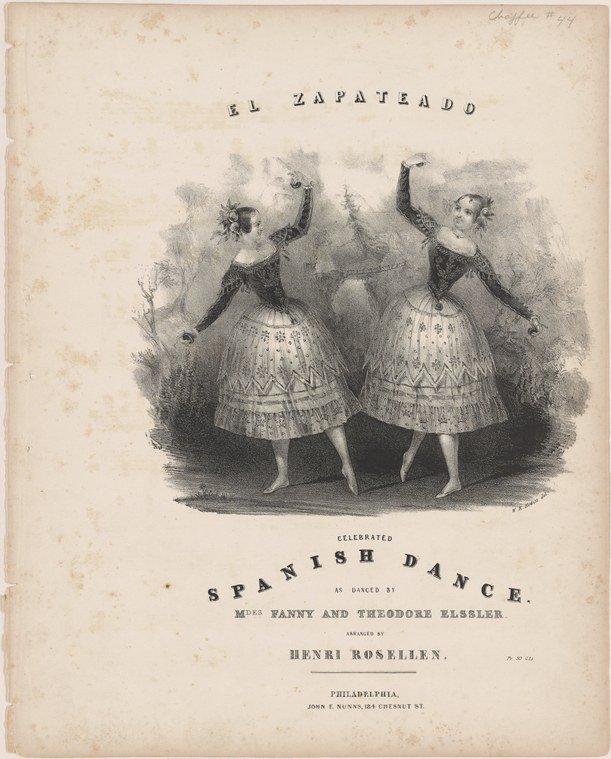
El zapateado, celebrated Spanish dance. As danced by Mdes Fanny and Theodore Elssler.: Arranged by Henri Rosellen
Unknown artist
- Collection:
- Prints depicting dance
- Source:
- New York Public Library
- Rights:
- Public domain — free to use, share and adapt.
- Recorded as:
- Public Domain
The Elssler sisters were among the most celebrated dancers of the Romantic ballet era, and this print documents their engagement with Spanish dance—a form that would influence European theatrical dance throughout the 19th century. For historians of Romantic ballet and Spanish dance in America, this is direct visual evidence of how folk forms were staged, choreographed, and marketed to paying audiences in the 1830s–1840s.
What you are looking at
This is a lithographic sheet music cover depicting two young female dancers in a moment of energetic performance. Both women wear nearly identical white bell-shaped skirts with decorative geometric patterning at the hem, dark fitted bodices, and have their hair styled up. They are positioned side by side, both with their arms raised overhead in symmetrical poses, leaning slightly backward with energy and momentum. The pose captures them mid-movement, bodies arched. The background is rendered in soft gray tones with atmospheric shading that suggests depth without defining a specific interior or stage space. The title "El Zapateado" appears in ornamental lettering at the top; below the image is printed "Celebrated Spanish Dance. As danced by Mdes Fanny and Theodore Elssler. Arranged by Henri Rosellen." with a Philadelphia publisher's mark. The composition is centered and formally balanced, emphasizing the parallel geometry of the two dancers.
The dancing
Both dancers stand in nearly identical positions with arms raised symmetrically overhead, bodies leaning backward with apparent momentum. The pose suggests a moment of vertical lift and dynamic energy rather than a grounded step. Their legs are straight and extended, with weight distributed to support the backward lean. The choreographic synchronization—both women executing identical gestures simultaneously—emphasizes unison and spectacle. The fit of their costume allows visibility of leg line and foot position, though the resolution does not permit detailed reading of specific footwork.
The dance depicted
This is a representation of El Zapateado, a Spanish folk dance style characterized by rhythmic footwork and percussive stamping (zapateado means "tapping" or "stamping" in Spanish). The Elssler sisters—Fanny and Théodore (also known as Thérèse)—were famous European dancers of the Romantic era who performed Spanish dances as part of their repertory. The raised-arm pose and arched-back lean visible here are consistent with Spanish and Andalusian dance vocabulary of the period. The print documents a specific performance piece choreographed or arranged by Henri Rosellen, suggesting this was a deliberate theatrical construction of Spanish dance for European audiences rather than folk practice itself.
How it was made
This is a lithograph, identifiable from the soft tonal modeling, the grayscale palette, and the characteristic printing qualities visible in the image. The technique allowed rapid reproduction and wide circulation of sheet music covers, making it an accessible format for documenting popular theatrical dances of the period. The composition and printing quality suggest professional production for commercial distribution by a Philadelphia music publisher (John F. Nunns). Lithography's tonal range enabled the atmospheric background and the subtle modeling of the dancers' forms, conveying movement and dimensionality.
About this work
This lithographic sheet music cover documents a celebrated performance of El Zapateado, a Spanish dance, by the renowned Romantic-era dancers Fanny and Théodore Elssler. The image preserves a moment of exuberant movement—both dancers captured with raised arms and arched backs in perfect unison. The work belongs to a tradition of theatrical dance prints that brought European stage spectacle into domestic music rooms and parlors. It represents a specific moment when Spanish folk dances were being absorbed into the Romantic ballet repertory and presented as exotic entertainment for cosmopolitan audiences. The print is significant both as a document of Romantic-era performance and as evidence of how Spanish dance vocabulary was adapted, formalized, and circulated through transatlantic theatrical networks.
How to look at it
Notice the perfect symmetry of the two dancers and the moment chosen: not a grounded step or footwork phrase, but a dynamic rising movement with the body arched backward and arms lifted—capturing energy and lift rather than the percussive, stamping footwork that the dance's name suggests. This is a Romantic-era convention: the printed dance image often privileges vertical momentum and expressive gesture over the specific technical vocabulary of the dance form itself. The raised-arm pose and the backward lean are theatrical signatures of Spanish dance in the European imagination, instantly legible to viewers as marking "Spanishness."
The artist
The lithograph is attributed to an unnamed artist, likely a commercial illustrator working for the Philadelphia publisher John F. Nunns. The arrangement is credited to Henri Rosellen, a composer and conductor known for theatrical music. The image is a product of collaborative theatrical and music-publishing enterprises typical of the period, where composers, dancers, and lithographers worked together to document and promote popular stage works.
The period
This print dates to the height of the Romantic ballet era (circa 1830s–1840s), when European dancers regularly incorporated exotic and national dances into their performances. The Elssler sisters, particularly Fanny Elssler, were famous for performing Spanish, Neapolitan, and other folk-derived dances as solo specialties within the broader Romantic ballet canon. Spanish dance was marketed as sensual, earthy, and authentically national—a contrast to the ethereal, otherworldly aesthetic of Romantic ballet proper. This sheet music cover testifies to the commercial success of such performances: the dance was popular enough to warrant publication as printed music for piano arrangement, suggesting it was performed in theaters across America and played in homes by amateur musicians.
Where it lives
This print is held in the New York Public Library's collection of dance-related prints. It is a sheet music cover produced by John F. Nunns, a music publisher based in Philadelphia, and represents a common form of theatrical documentation in the 19th century: the illustrated cover to a musical arrangement that allowed domestic audiences to re-create or recall theatrical spectacles at home.
Dance in this work
Questions about this work
Who were Fanny and Théodore Elssler?
Fanny Elssler (1810–1884) and her sister Théodore (also known as Thérèse) were Austrian dancers famous throughout Europe and America during the Romantic ballet era. Fanny Elssler was particularly renowned for her performance of character dances, including Spanish, Neapolitan, and other folk-derived forms, which she incorporated into her theatrical repertory. She danced across Europe and made a celebrated tour of the United States (1840–1842), where she was received as a major international star.
What is Zapateado?
Zapateado is a Spanish dance form characterized by rapid, rhythmic footwork and percussive stamping (from the Spanish word zapato, meaning shoe). It is part of the broader tradition of Andalusian and flamenco dance. In the Romantic era, European dancers like Fanny Elssler performed choreographed versions of Zapateado as theatrical spectacles, which formalized and adapted the folk tradition for concert and operatic contexts.
Why would this be published as sheet music?
In the 19th century, successful stage dances were often arranged for piano and published as sheet music so that middle-class households could own and perform simplified versions at home. The illustrated cover served as both a commercial advertisement for the printed music and a souvenir connecting domestic music-making to celebrated stage performances. This democratized access to theatrical novelties and extended the commercial life of popular dances.
What do the dancers' poses tell us about how the dance was performed?
The raised arms and backward arch suggest a Romantic-era theatrical vocabulary emphasizing verticality, lift, and expressive line. The synchronization of the two dancers emphasizes spectacle and visual harmony rather than the intricate, individual footwork that defines Zapateado in folk practice. This reflects the adaptation of folk forms to European concert-dance conventions.
More dance artwork





