49 works in this view — arrow keys or swipe to move between them.
Dance in Art
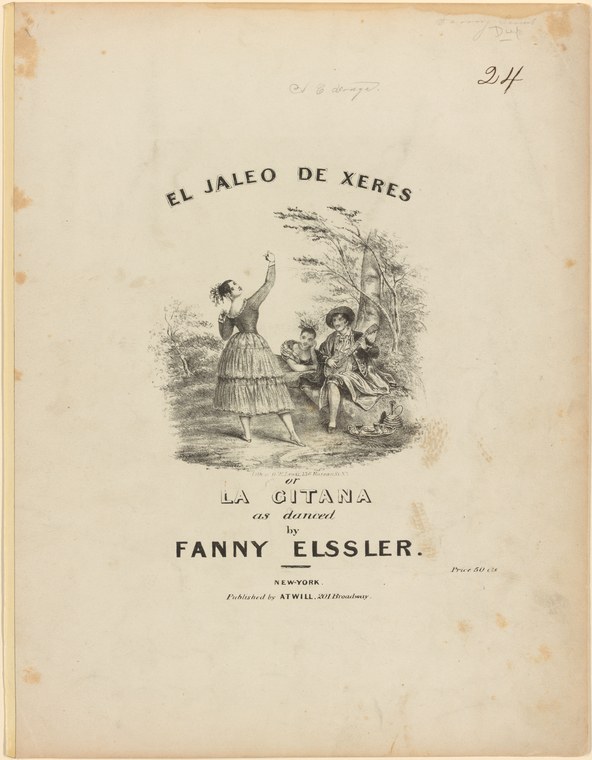
El jaleo de Xeres or La gitana as danced by Fanny Elssler
Unknown artist
- Collection:
- Prints depicting dance
- Source:
- New York Public Library
- Rights:
- Public domain — free to use, share and adapt.
- Recorded as:
- Public Domain
Fanny Elssler was one of the two dominant ballerinas of the Romantic era, and her interpretations of character dances like the jaleo were as celebrated as her classical roles. This image documents the fusion of ballet stardom with ethnographic performance—a practice that shaped 19th-century dance and raised questions about authenticity, exoticism, and the female performer's body that remain relevant to dance history today.
What you are looking at
A lithograph title page for a theatrical dance work features an engraved scene of three figures in a landscape setting. At center left stands a woman in a full-skirted Romantic-era dress with a fitted bodice, her arm raised expressively upward in a gesture of emotion or exultation. To her right, two figures in male dress—one seated or crouching low, the other standing—interact with her dynamically. The seated figure appears to be playing a stringed instrument, possibly a guitar. The setting is sketched with loose foliage and trees, suggesting an outdoor or garden scene. The composition captures a moment of narrative drama: the woman's raised arm and the body language of all three figures suggest heightened emotion, conflict, or passionate interaction rather than formal choreography. The figures' positioning creates a diagonal line of energy across the frame, with the woman's gesture dominating the upper half.
The dancing
The principal figure—a woman in a long trained skirt—dominates through her raised arm and upright carriage. Her gesture is one of theatrical expression rather than technical dance vocabulary: the arm extends upward with palm open, a Romantic-era convention for expressing longing, distress, or ecstatic emotion. The two male figures below her are smaller in scale and less formally posed; one kneels or crouches, the other stands. Neither displays the formal frame or turnout of academic dance. The composition suggests dramatic interaction—perhaps a scene of seduction, betrayal, or passion—rather than a demonstration of technical virtuosity.
The dance depicted
The image illustrates *El jaleo de Xeres* (or *La gitana*) as performed by the celebrated Romantic ballerina Fanny Elssler. The jaleo was a characteristic Spanish dance form incorporating rhythmic hand-clapping, stamping, and passionate bodily expression—a genre that allowed Romantic-era ballerinas to perform ethnographic or character dances outside the vocabulary of classical ballet. Elssler was known for her naturalistic acting and her ability to perform national dances with dramatic intensity. This image suggests a narrative moment rather than pure dance spectacle: the raised arm and emotional intensity indicate the dramatic character of Elssler's interpretation. The presence of a guitar-player and the loose, expressive poses suggest the street or folk context from which the jaleo derived, even as Elssler's costuming and bearing mark it as a theatrical performance.
How it was made
This is a lithograph—a planographic printing process that allows for softer, more fluid lines than wood or copper engraving. The title text is lithographed; the central scene appears to be an engraved vignette, possibly originally drawn for a different purpose and incorporated as illustration. The combination of crisp lettering and softer figural work is typical of mid-19th-century theatrical ephemera. As a title page, it was produced for commercial circulation—likely as a souvenir of Elssler's performance or as frontmatter for a published score or scenario. The NYPL holding suggests this was part of a broader archive of dance and theatrical documentation.
About this work
This is a title page for a theatrical dance work featuring Fanny Elssler in a Spanish character dance, *El jaleo de Xeres*, dating to the Romantic era of ballet (circa 1830s–1840s). The image captures a moment of dramatic intensity rather than technical display: a woman with raised arm interacts with two male figures in a landscape setting, suggesting narrative theater rather than pure dance. The work belongs in a dance archive because it documents both the star performer and the emerging genre of character dance—a category that allowed Romantic ballerinas to perform outside the strict conventions of classical ballet. Elssler's interpretation of Spanish national dance was historically significant, influencing how European audiences understood and consumed non-European dance forms.
How to look at it
The viewer should attend to the woman's raised arm—a gesture of Romantic-era acting conventions that signals emotional intensity rather than balletic display. Note how the composition places her above and apart from the two male figures, emphasizing her status as the principal performer. The loose, gestural quality of the drawing and the inclusion of the guitar-player ground the scene in a folk or street context, even as the woman's costuming marks her as a theatrical performer. This is a work about how a European balllerina interpreted and performed a Spanish dance form, not about the dance form itself—a distinction crucial to understanding Romantic-era character dance and the politics of exoticism that attended it.
The artist
The print is unmarked; no artist is attributed in the catalogue record. The engraved vignette may be the work of a theatrical illustrator or a dance-focused printmaker of the 1830s–1840s. The lithography and publication by A. Wivell, 323 Broadway, New York, places it within the commercial theatrical print trade of antebellum America, where imported European performers were heavily marketed to audiences through prints, playbills, and souvenir publications.
The period
The Romantic era (c. 1820–1860) saw the rise of the ballerina as star performer and the development of character dance as a category distinct from classical ballet. National dances—Spanish, Hungarian, Italian—became fashionable in European and American theaters, performed by European dancers in costume and framed as ethnographic display. Fanny Elssler's tours of Europe and America (1834–1842) made her a major celebrity, and her interpretations of character roles were as celebrated as her classical technique. The jaleo in particular became associated with Elssler and was performed by other dancers seeking to capitalize on her success. This theatrical moment coincided with the rise of lithography as a medium for celebrity marketing and with the development of dance notation and choreographic publishing.
Where it lives
This title page is held by the New York Public Library in a collection designated "Prints depicting dance." It survives as a souvenir of Elssler's American performances or as part of a published score or scenario, reflecting the commercial theatrical print trade of 1830s–1840s New York.
Dance in this work
Questions about this work
Who was Fanny Elssler?
Fanny Elssler (1810–1884) was an Austrian dancer and one of the two most celebrated ballerinas of the Romantic era, rivaling Marie Taglioni. Unlike Taglioni, who was known for ethereal, aerial technique, Elssler excelled at dramatic acting and character dances. She performed extensively in Europe and America, and her interpretations of national dances like the jaleo made her a major celebrity in the 1830s–1840s.
What is the jaleo?
The jaleo is a Spanish dance characterized by rhythmic hand-clapping, foot-stamping, and passionate bodily expression. It originated as a street or folk dance and became fashionable in European theaters during the Romantic era, when ballerinas began performing national dances as character pieces. Elssler's version was titled *El jaleo de Xeres* (the jaleo of Jerez), referencing the Spanish city.
What is a lithograph?
Lithography is a printing technique based on the principle that oil and water do not mix. An image is drawn on a stone or metal plate, treated with chemicals to accept or repel ink, and then printed. Lithographs allowed for softer, more fluid lines than engraving and were cheaper to produce, making them ideal for theatrical prints and celebrity marketing in the 19th century.
Why does this matter to dance history?
This image documents a key moment in the development of character dance—a category that allowed ballerinas to perform outside the strict vocabulary of classical ballet. It also shows how European audiences consumed and understood non-European dance forms through the bodies and interpretations of famous performers, raising questions about authenticity and exoticism that remain central to dance studies.
More dance artwork





