49 works in this view — arrow keys or swipe to move between them.
Dance in Art
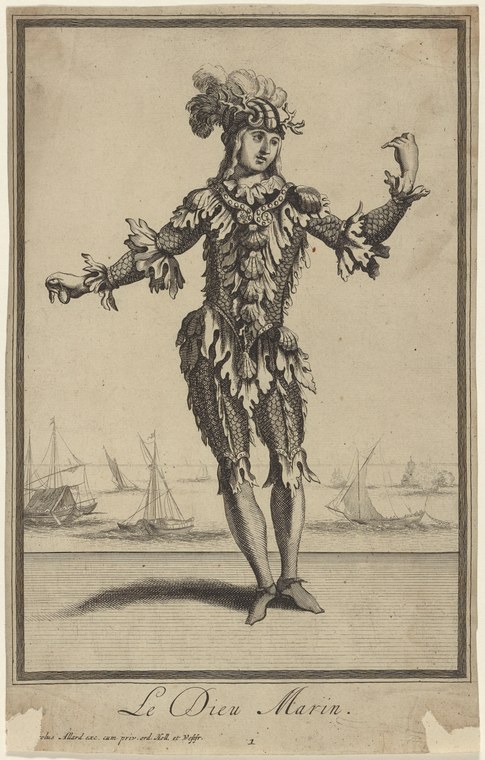
Le dieu marin
Unknown artist
- Collection:
- Prints depicting dance
- Source:
- New York Public Library
- Rights:
- Public domain — free to use, share and adapt.
- Recorded as:
- Public Domain
This work captures the visual and gestural vocabulary of allegorical court spectacle before ballet codified into an abstract, movement-centered art form. It shows how dance figures in this period communicated meaning through costume, pose, and emblematic stillness rather than footwork—essential context for understanding the transition from court theatre to modern dance.
What you are looking at
A single androgynous figure stands alone against a seascape scattered with sailing vessels. The dancer wears an elaborate costume of feathered or leaf-like elements layered across the torso and limbs, creating a wild, nature-inspired silhouette. The headdress is equally ornate, with feathered or curled plumes rising from the crown. The figure strikes a pose with both arms extended outward at shoulder height, palms facing forward in a gesture of display or invocation. The legs are bare and planted firmly, with the weight centered. The shallow foreground platform grounds the figure before a vista of calm water dotted with ships in sail—a setting suggesting either a seaside performance space or an allegorical marine realm. The print is rendered in fine engraved lines on a cream ground, with careful cross-hatching to model form and volume.
The dancing
A single standing figure with weight balanced evenly on both feet, arms raised to shoulder height and extended laterally with open palms—a pose suggesting display, welcome, or supernatural power rather than steps or partnered motion. The torso is upright and frontal; the gaze is directed forward and outward toward the viewer. The elaborate costume—feathered or foliate elements covering the body—suggests a non-naturalistic, possibly allegorical or theatrical character rather than a ballroom or folk dancer.
The dance depicted
This appears to depict a theatrical or court character rather than a social dance. The French title 'Le Dieu Marin' (The Sea God) and the marine setting indicate this is likely a personification or allegorical figure from court ballet or commedia dell'arte tradition. The pose and costume suggest a character revelation or apotheosis rather than narrative dance action. The figure may represent a deus ex machina or a supernatural being, consistent with early modern court spectacles where gods, spirits, and mythological figures appeared in stylized, emblematic poses rather than virtuosic movement.
How it was made
An engraving executed in the fine-line classical manner, likely 17th or 18th century. The meticulous cross-hatching, linear precision, and shallow picture plane are characteristic of northern European court-ballet documentation. The medium—reproducible and portable—suggests this was made for circulation among the educated elite as a record of a court spectacle or as a model for choreographers and costume designers. The print's clarity and finish indicate professional workshop production.
About this work
This engraving documents or designs a theatrical sea-god character from the court-ballet tradition. The elaborate feathered costume and apotheotic pose suggest a being of supernatural status, presented not in motion through narrative space but in a stationary, frontal display—the visual language of emblematic court theatre. The marine setting, indicated both by the title and the ships beyond, anchors the figure in a specific allegory. As a print, it served both as a record of actual spectacle and as a design guide for future productions, functioning within the network of court entertainment documentation that shaped early modern theatrical dance.
How to look at it
Observe the stillness and frontality of the pose—this is not a captured moment of motion but a revelation or apotheosis, in which the figure presents itself to the viewer. The extended arms and open palms are a language of display and claim, not steps or partnered interaction. Notice how the elaborate costume—every element patterned and rhythmic—is as much the 'dance' as the body; in court theatre, costume and gesture formed a unified, emblematic whole. The ships in the background are not mere decoration but a semantic anchor, establishing the figure as a inhabitant of the sea realm.
The artist
The artist is not recorded. The work comes from the NYPL collection of prints depicting dance, and the engraving style and subject matter place it within the tradition of northern European court-ballet documentation, possibly Dutch or German, from the 17th or 18th century. Such prints were often produced by workshop engravers and circulated as records of court spectacles or design templates.
The period
This print belongs to the era of court ballet (ballet de cour) in northern Europe, when dance spectacles were integral to court ceremony and entertainment. These were multimedia events combining poetry, music, costume, and choreography, often performed by courtiers and court dancers rather than professionals. Allegorical and mythological characters—gods, nymphs, sea creatures—were stock figures, presented in elaborate costume and static or slow-moving poses that emphasized their otherworldly status. By the 17th century, such spectacles were documented in prints and descriptions to extend their prestige and reach beyond the court itself.
Where it lives
The work is held in the NYPL's collection of prints depicting dance. It is catalogued with minimal metadata: artist unknown, date unknown, medium and technique unrecorded in the catalogue. The engraving style and subject matter allow a provisional dating to the 17th or 18th century and localization to northern Europe.
Dance in this work
Questions about this work
Is this a real dance or an imaginary one?
It documents a character type from court ballet rather than a named choreography. The figure is a personification—the Sea God—rendered in the emblematic, non-narrative style of court spectacle. Whether it was ever performed or exists only as a design proposal cannot be determined from the print alone.
Why is the figure so still, and why are the arms just held out?
In court ballet, allegorical characters were often presented in static, heraldic poses that emphasized their symbolic status rather than their physical virtuosity. The extended arms and forward gaze are a visual language of power, invitation, or revelation—the figure is presenting itself as a divine being, not dancing in the sense of executing steps.
What does the costume tell us?
The feathered or foliate costume marks this figure as a supernatural being—neither human nor animal, but a personification of natural or divine force. Such costumes were expensive and labor-intensive, indicating this was a high-status court production. The layering and surface patterning create visual richness and movement even in a static pose.
Who would have seen this in the original?
A court-ballet spectacle would have been witnessed by the court circle—nobility, dignitaries, and sometimes invited guests. The print, however, circulated more widely among the educated classes and served as a record of the court's sophistication and artistic investment. Choreographers and costume makers would have consulted such prints as design references.
More dance artwork





