49 works in this view — arrow keys or swipe to move between them.
Dance in Art
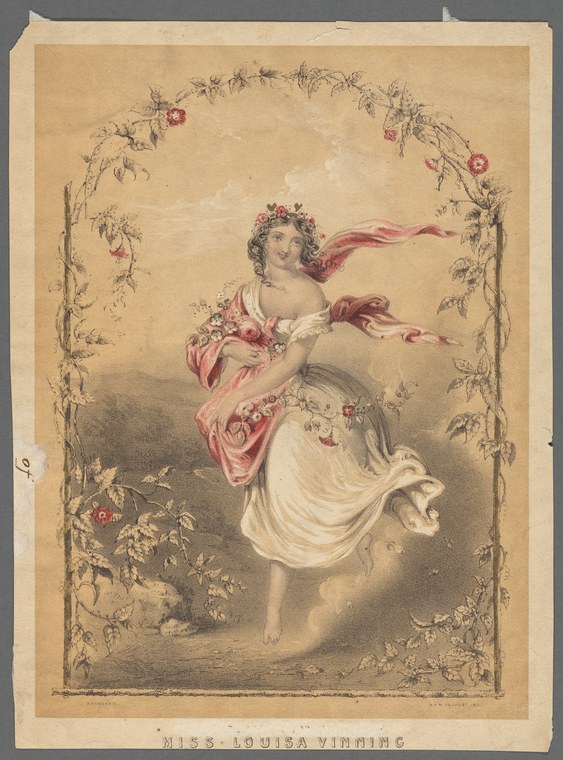
Miss Louisa Vinning
Unknown artist
- Collection:
- Prints depicting dance
- Source:
- New York Public Library
- Rights:
- Public domain — free to use, share and adapt.
- Recorded as:
- Public Domain
This image is one of the few surviving visual records of an individual Romantic-era dancer in an actual performance pose, making it invaluable evidence of technique, costuming, and the visual mythology of mid-19th-century ballet. It documents the birth of the pointe-work aesthetic and the Romantic obsession with the female body as weightless and supernatural—foundational ideas that shaped all ballet that followed.
What you are looking at
A young woman in elaborate Romantic-era costume floats upward through a delicate garden of climbing vines and roses, her body weightless and her drapery billowing around her. She wears a fitted pink corset and a white skirt that swirls in impossible curves, and pink ribbons stream from her hair and shoulders. Her pose is one of extreme, sustained elevation—her body arched, her legs in an extended position that defies gravity. The setting is framed by a simple border of flowering vines that forms an ornamental cartouche; the background is soft and atmospheric, rendered in pale earth tones and grays that suggest either stage lighting or an ethereal, otherworldly space. The figure's upward trajectory and the dreamlike quality of the composition suggest a moment of supernatural or fantastical transformation, common to the Romantic ballet of the mid-19th century.
The dancing
A single figure, identified as Miss Louisa Vinning, is captured in an attitude of extreme vertical extension. Her torso is deeply arched backward, her legs split in a near-vertical position, and her arms are raised and extended. The pose demonstrates the aesthetic of the Romantic period—elongation, ethereality, and the illusion of weightlessness achieved through extreme arabesque or attitude positions. The body position is technically demanding and suggests either a trained dancer or an idealized artistic representation of one. There is no partner or supporting figure; the woman appears to be self-supported in this impossible elevation.
The dance depicted
This image depicts theatrical Romantic ballet, most likely from the 1840s–1850s, when such ethereal, weightless imagery became the visual language of the genre. The pose—a highly extended arabesque or attitude with the torso arched and legs split vertically—is the hallmark of Romantic ballet technique. Miss Louisa Vinning was a known dancer of this period, and the print may commemorate a specific role or famous moment from her performances, possibly from a work such as *Giselle* or *La Sylphide*, which featured precisely these kinds of supernatural aerial moments. The print celebrates the dancer as a celestial or otherworldly being, a convention fundamental to Romantic ballet's fascination with sylphs, spirits, and the supernatural.
How it was made
This is a hand-colored lithograph or engraving—likely a lithograph based on the soft tonal gradations and the characteristic handling of the drapery. The technique allowed for wide circulation as an affordable theatrical memento, and the delicate coloring (pale pinks, whites, and earth tones) would have been added by hand after printing, a common practice for theatrical prints of this era. The ornamental floral border suggests this was a presentation print, possibly a souvenir of a particular performance or role. The softness of the medium and the emphasis on atmospheric effect over anatomical precision are typical of mid-19th-century theatrical portraiture intended to capture the ephemeral, dreamlike quality of a stage moment.
About this work
This is a mid-19th-century hand-colored print commemorating Miss Louisa Vinning, a dancer of the Romantic ballet era, captured in an iconic moment of weightless, supernatural elevation. The image distills the visual aesthetic that defined Romantic ballet: the female dancer as ethereal being, her body elongated and arched in an impossible attitude that seems to defy gravity. The print is both a portrait of an individual performer and a record of the technique and ideals of Romantic ballet as they were understood and marketed to the public.
The work belongs in a dance history collection as evidence of how theatrical dance was visualized and celebrated during the Romantic period. It shows us not only what dancers could do—the extraordinary extensions and arched positions demanded by the style—but also how the culture around dance positioned the female dancer as otherworldly and ephemeral. The print's circulation as a souvenir tells us about the celebrity of individual performers and the commercial apparatus that surrounded theatre.
How to look at it
Notice first the extreme arching of the torso and the vertical split of the legs—this is the defining physical achievement of Romantic ballet technique, often called 'attitude' or 'arabesque,' and it appears throughout mid-19th-century dance imagery. Observe how the artist has positioned the body not as a portrait of repose, but as a frozen moment of ascent; the drapery spirals upward and the ribbons stream, emphasizing the upward trajectory. The ornamental floral frame creates a stage-within-a-frame, and the soft, atmospheric background suggests theatrical lighting or a liminal space between the real and the supernatural. The print asks us to see the dancer not as a human performer, but as a celestial being—the central fantasy of Romantic ballet.
The artist
The artist is not recorded, which is typical of mid-19th-century theatrical prints. These were often created by commercial print workshops in major theatrical centers (London, Paris, New York) for rapid circulation and sale to audiences. The unsigned status reflects the print's function as a product of theatrical commerce rather than fine art; many such prints were based on sketches by actors, dancers, or witnesses at performances, then worked up into finished compositions by professional engravers and colorists.
The period
This print dates to the height of Romantic ballet, when works like *La Sylphide* (1832) and *Giselle* (1841) had established the female dancer as the center of the art form. The 1840s–1850s saw an explosion of theatrical portraiture—both as lithographs and engravings—that made famous dancers household names and created a market for images of performers in costume. This was the era in which the pointe shoe became standard, and the elevated, weightless aesthetic visible in this image was becoming the signature vocabulary of ballet technique. The soft, ethereal rendering of the figure reflects both the technical possibilities of lithography and the Romantic era's visual fascination with the supernatural and the otherworldly.
Where it lives
The work is held in the New York Public Library's collection of prints depicting dance, part of their broader theater and performing arts holdings. It is identified as a theatrical souvenir print, likely sold at or near the theatre where Miss Louisa Vinning performed, making it a document both of individual celebrity and of 19th-century theatrical commerce.
Dance in this work
Questions about this work
Who was Miss Louisa Vinning?
Louisa Vinning was an active performer in the mid-19th-century Romantic ballet era, though detailed records of her career are sparse. Like many dancers of her time, she is now known primarily through theatrical prints and reviews. The fact that a print was commissioned in her likeness indicates she was a performer of some prominence, likely known for roles in the supernatural ballets that dominated the period.
What is the pose in this image?
The pose is an extreme arabesque or attitude—the foundational positions of Romantic and classical ballet. The dancer's torso is arched backward while the working leg is lifted high and extended behind, the supporting leg straightened, and the arms raised in a balletic frame. This specific, nearly impossible extension suggests either an extraordinary dancer or an idealized artistic representation of the Romantic ballet aesthetic.
How was this print made?
This is a hand-colored lithograph or engraving from the mid-19th century. The print was made by mechanical means (lithography or engraving), then colored by hand—a common and affordable way to create theatrical mementos. The soft rendering of the drapery and the atmospheric background are characteristic of lithography, a medium that allowed for subtle tonal gradations and was ideal for theatrical portraiture.
Why was she depicted floating?
The weightlessness of the pose reflects the central aesthetic fantasy of Romantic ballet: the dancer as supernatural being—a sylph, spirit, or otherworldly creature. This imagery was so dominant in the 1840s–1850s that dancers were typically portrayed in these elevated, arched, impossible-seeming positions, whether or not they were performing an explicitly supernatural role.
More dance artwork





