49 works in this view — arrow keys or swipe to move between them.
Dance in Art
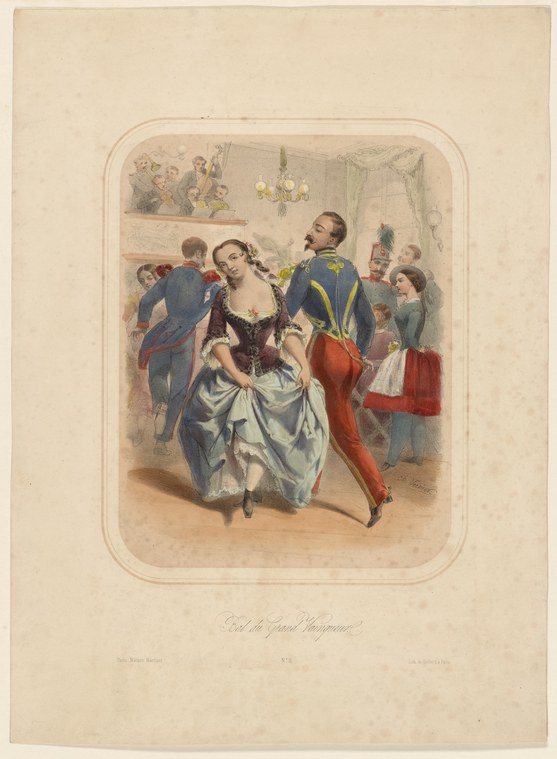
Bal du grand vainqueur
Unknown artist
- Collection:
- Prints depicting dance
- Source:
- New York Public Library
- Rights:
- Public domain — free to use, share and adapt.
- Recorded as:
- Public Domain
The image reveals how ballroom dance functioned not as athletic display but as social theater, embedded in hierarchies of honor and spectatorship. For historians of dance and fashion, it is evidence of the posture, costume, and choreographic restraint that defined elite ballroom practice in the 1840s–1850s.
What you are looking at
A fashionable interior ballroom scene, rendered in hand-colored engraving or lithograph. A woman in an elaborate ball gown—white silk skirt with dark velvet corsage, her blonde hair dressed high—stands at the center, attended by a gentleman in dark coat with gold braid at her left. The couple is framed by a throng of formally dressed onlookers in a paneled salon lit by a chandelier. The shallow stage space and crowded composition emphasize the social spectacle of the moment rather than the physical exertion of dance. The woman's posture is upright and composed; her skirt billows slightly, caught in motion. The background figures are sketched more loosely, their faces barely defined, pushing the central pair forward. The overall tone is one of refined elegance and social theater.
The dancing
The woman stands nearly vertical, her weight evenly distributed, her torso held in the formal, corseted posture required by 1840s–50s fashion. Her arms are at her sides or held at a modest angle, consistent with the restrained frame of ballroom dancing of the period. The man beside her is similarly upright, his posture protective and deferential. There is no visible contact between the dancers' hands, which is unusual for a couple dance of this era and may indicate the moment just before or after a figure, or a posed presentation rather than an active step. The composition presents two primary dancers and numerous secondary figures, all stationary or barely animated.
The dance depicted
This appears to be a ballroom scene from the Romantic era, most likely depicting a waltz or quadrille at a grand ball. The dress, setting, and social formality point to the 1840s–1850s, when the waltz was becoming the dominant couple dance in European salons. The title 'Bal du grand vainqueur' (Ball of the Great Victor) suggests a commemorative or celebratory event, possibly honoring a military or political figure—a context common in printed popular engravings of the period. The image prioritizes social status and spectacle over choreographic detail; the dancer's elevated position and admiring crowd suggest a moment of presentation or honor rather than active technical execution.
How it was made
This is a hand-colored engraving or lithograph, evidenced by the fine linear work, the delicate tonal modeling, and the careful application of color over a printed base. The technique allowed for rapid, affordable reproduction and wide circulation among the middle and upper classes. The precision of the line work and the softness of the tinted backgrounds are characteristic of commercial theatrical or society prints of the mid-nineteenth century. Such works were often sold individually or in series and served as both souvenirs of events and windows into fashionable social life.
About this work
This is a commemorative ballroom engraving of the mid-nineteenth century, depicting a moment of social honor at a grand ball. The work captures the aesthetic of Romantic-era ballroom dancing—formal, restrained, and intensely social. It belongs in a gallery of dance in art as a document of how the waltz and quadrille were staged, celebrated, and consumed as symbols of refinement and status during the height of European court and salon culture.
How to look at it
Attend to the woman's vertical posture and the absence of a firm hand-hold between the dancers: this is not mid-step but a moment of presentation or greeting. The crowd of onlookers, sketched with far less detail than the central pair, reveals the priority of social display over choreographic interest. The woman's slightly billowed skirt and the slight turn of her head suggest a moment of turning or responding to her partner, rather than a static pose. The composition's shallow depth and lateral arrangement emphasize the ballroom as a social arena where dancers are seen and judged by society, not as a space for movement.
The period
This print belongs to the golden age of the lithographed and engraved ballroom scene, a genre that flourished between 1830 and 1870 across Europe. The Romantic era valorized the waltz as the emblem of modern elegance and passion (though constrained by rigid corseting and etiquette), while the quadrille dominated structured group dancing. Commemorative prints of balls held in honor of royalty, military victories, or diplomatic events were common commercial products, circulating among the urban elite. The title's reference to a 'victor' suggests this may document a specific historical occasion, though the generalized setting and idealized figures indicate it may also be a generic salon scene with a celebratory title.
Where it lives
This work is held in the New York Public Library's Prints collection, part of a broader assemblage of ephemeral dance and theater prints from the nineteenth century. It is a commercial popular print, likely produced in France or Germany, intended for distribution among an educated, affluent audience.
Dance in this work
Questions about this work
What is 'Bal du grand vainqueur'?
The title translates as 'Ball of the Great Victor.' Without additional documentation, it is unclear whether this commemorates a specific historical event—a military victory, diplomatic triumph, or coronation—or whether it is a generic celebratory title applied to an idealized ballroom scene. Such prints were often sold with evocative titles to appeal to a broad market.
Why aren't the dancers touching hands?
In mid-nineteenth-century formal ballroom dance, hand contact could be quite light or intermittent depending on the figure being executed. However, the composition here suggests a moment of presentation or greeting rather than active dancing. The woman and man may be posed at a social moment—an introduction or acknowledgment—rather than mid-step.
What dance is being depicted?
The formal posture, indoor salon setting, and elegant dress suggest either a waltz or a quadrille. The vertical, restrained posture and the presence of multiple onlookers are consistent with either form. Without more specific choreographic detail—footwork, hand positions, or floor patterns—a precise identification is not possible from the image alone.
Who is the artist?
The artist is not recorded in the catalog record. The technique and style are consistent with mid-nineteenth-century European ballroom prints, but attribution would require examination of the original print, signatures, or publishing marks not visible in this reproduction.
More dance artwork





