49 works in this view — arrow keys or swipe to move between them.
Dance in Art
Sylphide
Unknown artist
- Collection:
- Prints depicting dance
- Source:
- New York Public Library
- Rights:
- Public domain — free to use, share and adapt.
- Recorded as:
- Public Domain
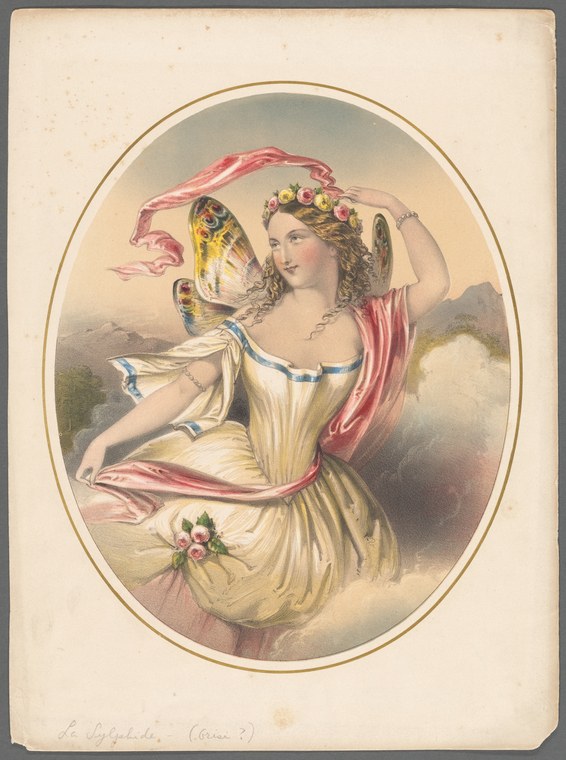
This image is one of the iconic visual records of *La Sylphide* and the birth of Romantic ballet. It shows how the new aesthetic—weightlessness, the sylph as a character-type, the fusion of dance and nature—was packaged and sold to the public through theatrical prints. For a historian or dancer, it is evidence of how deeply the Sylph captured the imagination of the age, and how prints like this one created and reinforced the visual identity of the Romantic ballet era.
What you are looking at
A winged female figure in Romantic-era dress floats against a soft, clouded background in an oval composition. She wears a pale yellow or cream muslin dress with a low neckline and delicate blue trim, her shoulders bare, her hair crowned with flowers. A pink silk scarf streams behind her head and shoulders. Her pose is weightless and ethereal: she reclines at an angle, one arm raised and extended to display a large butterfly she holds aloft, the other arm curving gracefully at her side. The butterfly—rendered in jewel tones of blue, gold, and black—is the focal point of her gaze and gesture. Her body seems to defy gravity, suspended in the soft light that models her form and the drapery. The setting is entirely dreamlike: mountains or landscape forms dissolve into mist at the edges, and the whole image is suffused with a pale blue-grey atmospheric haze that creates the effect of being suspended in air or cloud. This is the ethereal, supernatural world of the Romantic ballet.
The dancing
A single female figure is the entire composition. Her weight appears to float unsupported; there is no ground plane. Her frame is open and extended, with the upper body arched backward slightly in a languid curve, the chest lifted. Her head is tilted back in wonder, gazing upward at the butterfly. One arm reaches upward and outward in a gesture of delight or enchantment, while the other rests more quietly along her body. The pose suggests the turned-out, elongated line preferred in Romantic ballet, though the figure is not in a recognizable dance position or hold—this is a moment of suspended reverie rather than active steps.
The dance depicted
This is almost certainly a representation of the Sylph from *La Sylphide*, the foundational work of Romantic ballet, first performed in Paris in 1832. The figure's costume—muslin dress, bare shoulders, floral crown, the impossibly weightless suspension—and her encounter with a butterfly are the iconography of the Sylph character and that ballet's dreamlike, supernatural world. The image captures not a moment of dancing in the technical sense but the spirit or essence of the Sylph: ethereal, otherworldly, and associated with nature (the butterfly). The posture and floating quality align with Romantic ballet's aesthetic of weightlessness and enchantment, achieved through the new technique of dancing on the tips of the toes (pointe work, though shoes are not clearly visible here). This appears to be a popular print produced for a mass audience, likely circulated in the years following the ballet's tremendous success.
How it was made
This is a hand-coloured engraving or lithograph, rendered with the refined technique typical of mid-19th-century theatrical prints. The soft modelling of flesh tones, the delicate gradations of colour in the drapery and sky, and the fine linear work in the composition suggest engraving or lithography with careful hand-application of watercolour or gouache. The oval vignette format—with soft edges fading into the cream paper—was conventional for portrait and theatrical prints of this period and allowed for mass circulation. The hand-colouring and the precision of line indicate this was a luxury print, more refined than a simple woodcut, yet affordable enough to be collected by middle-class theatre-goers. The technique allowed the printer to capture the ethereal quality that was essential to marketing the Romantic ballet to its public.
About this work
This is a Romantic-era theatrical print, most likely from the 1830s–1840s, depicting the Sylph—the supernatural, ethereal protagonist of *La Sylphide*, the most influential ballet of the early 19th century. The figure floats in a dreamlike, weightless pose, her costume and demeanour embodying the aesthetic of Romantic ballet: beauty, mystery, nature, and the impossible grace of pointe work. The hand-coloured engraving or lithograph was a standard format for circulating images of celebrated performers and ballets to a middle-class audience hungry for theatrical imagery.
This work belongs in a gallery of dance in art because it captures not choreography or a moment of technique but rather the Romantic ballet's entire worldview—its aesthetics, its mythology, and its visual language. The Sylph became the template for the Romantic ballerina: ethereal, tragic, associated with the supernatural and nature. Prints like this one shaped how audiences imagined and remembered the dance they had seen.
How to look at it
Note the artist's choice to freeze the figure not in a recognizable step but in a moment of suspended wonder and communion with nature. The butterfly is not incidental—it is the entire point of the gesture, the object of the Sylph's enchantment and the viewer's eye. Observe how the figure's weight seems to float entirely unsupported, defying gravity in a way that evokes the miraculous effect of pointe work: the audience's sense that the dancer is weightless, unearthly, almost not quite human. The Romantic-era convention at work here is the 'portrait of the character'—not the performer, but the character as imagined: the Sylph as an ideal, a spirit, a creature of nature and magic. The soft vignetting and pale, dreamlike colour heighten this sense of otherworldliness.
The period
This print was created during the dominance of the Romantic movement in European theatre and art (c. 1830–1850). *La Sylphide* premiered in Paris on 12 March 1832, choreographed by Filippo Taglioni for his daughter Marie Taglioni, and became the defining work of Romantic ballet. Its plot—a mortal man enchanted by a supernatural sylph who vanishes, leaving him bereft—embodied Romantic obsessions with the otherworldly, the impossible desire, and the fusion of human and natural worlds. Marie Taglioni's revolutionary technique on pointe, and the ballet's use of the now-standard romantic tutu (a knee-length muslin skirt), created a visual and kinetic language that dominated European ballet for decades. Theatrical prints and lithographs were a major industry in this period, circulating images of celebrated performers and scenes to a rapidly expanding theatre-going public. This image is likely from the 1830s–1840s, during the height of Taglioni's fame and the worldwide export of the Sylphide phenomenon.
Where it lives
This hand-coloured print is held in the New York Public Library's collection of prints depicting dance. It is an example of the mass-produced theatrical imagery that circulated widely in the 19th century, sold to theatre-goers and collectors as a memento of performances and celebrated dancers.
Dance in this work
Questions about this work
What is a sylph, and why did it matter so much to Romantic ballet?
A sylph is a delicate spirit or fairy of the air, drawn from Romantic literature and folklore. In *La Sylphide*, the sylph represents the impossible, the otherworldly, the beautiful thing that cannot be possessed. The character let Romantic dancers and audiences explore themes of desire, loss, and the supernatural—central to Romanticism. The sylph costume (a soft, knee-length white muslin skirt and bare shoulders) and the weightless quality of pointe technique created a visual and kinetic language for this world that became the template for Romantic ballet itself.
Is the figure on pointe? Can you tell from the image?
The image does not show the feet clearly enough to be certain, but the floating, weightless quality of the pose and the context (*La Sylphide* made Marie Taglioni's pointe technique famous) suggest the artist was evoking that effect. Pointe work was revolutionary and central to the Romantic aesthetic of weightlessness and impossibility. Whether or not the Sylph is literally on pointe in this moment, the image celebrates the sense of supernatural lightness that pointe work created.
Who would have bought this print?
Middle-class theatre-goers, especially women, who attended *La Sylphide* or wanted to own an image of the ballet and its famous dancers. These prints were affordable, mass-produced, and collected much like theatre programmes or celebrity photographs are today. They were also sold as evidence of one's taste and refinement, and as mementos of a beloved performance.
Does this image show an actual performance, or is it an idealized portrait?
It is an idealized portrait of the character, not a documentary image of a stage moment. The figure is suspended impossibly in air with no stage visible; the setting is a dreamscape. The artist's goal was to capture the essence and spirit of the Sylph—the character as imagined—rather than to document a specific performance or dancer.
More dance artwork





