49 works in this view — arrow keys or swipe to move between them.
Dance in Art
The harvest dance of the Viennoise children
Unknown artist
- Collection:
- Prints depicting dance
- Source:
- New York Public Library
- Rights:
- Public domain — free to use, share and adapt.
- Recorded as:
- Public Domain
This print is rare documentation of child performance in early 19th-century balletic theater, showing how professional technique and theatrical spectacle were applied to popular, accessible themes. It captures the aesthetic and commercial conventions of theatrical dance prints during the Romantic era, revealing what performances were considered noteworthy enough to publish and circulate among American audiences in New York.
What you are looking at
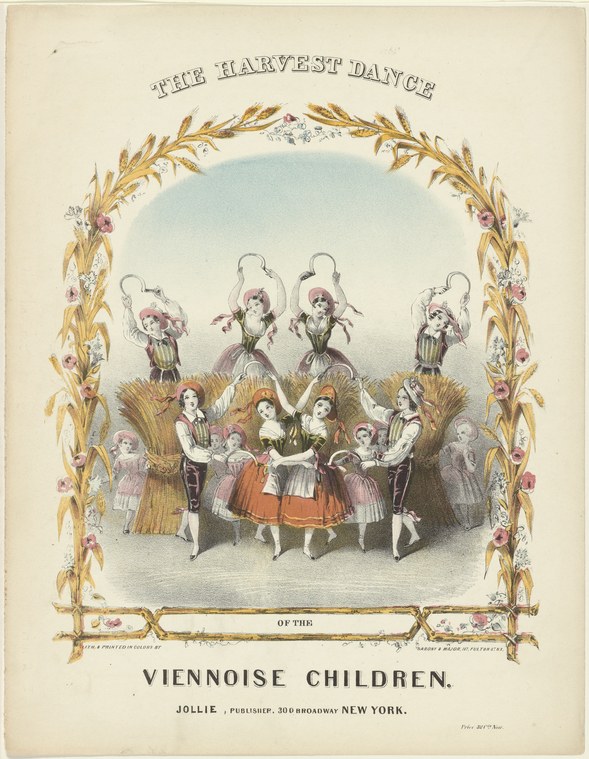
A hand-colored engraving depicts children performing a harvest dance in a theatrical or ballroom setting. The composition is framed by a decorative border of wheat sheaves tied with ribbons and small flowers, reinforcing the harvest theme. Eight children in the center are arranged in two groups: four stand elevated on what appears to be a platform or stage, holding curved implements (possibly scythes or harvest tools rendered as props) and wearing identical striped or patterned dresses; four younger children sit or stand at ground level in front, dressed in contrasting fabrics with white aprons and bonnets. The standing children lean inward with their bodies in graceful, synchronized poses. The entire scene is rendered in soft tones of blue, ochre, and rose, with delicate shading that suggests a refined, precious entertainment rather than authentic agricultural labor. The border and title treatment suggest this is a published theatrical print or souvenir.
The dancing
The upper group of four children maintains a coordinated, balletic posture with bodies angled toward the center, arms curved and lifted, suggesting a choreographed ensemble rather than naturalistic movement. The lower group sits in a more relaxed formation, creating a hierarchical visual composition. The implements they hold appear decorative rather than functional. The children's bodies show a light, upward quality consistent with early 19th-century theatrical dance training—no heavy weight-bearing or grounded stances are visible. The symmetry and precision of the arrangement suggests trained performers, likely children from a dance academy rather than peasant harvesters.
The dance depicted
This appears to be a theatrical character dance or ballet divertissement styled as a harvest scene, likely performed in Vienna or Central Europe in the early 19th century. The 'Viennoise' in the title indicates either Viennese dancers or a work created in Vienna. The inclusion of children suggests this was part of a larger production—possibly a ballet pantomime or spectacular entertainment featuring child performers. The aesthetic aligns with the Romantic-era taste for picturesque folk themes combined with refined balletic technique. Without access to theatrical records, the specific ballet or performance cannot be identified, but the composition and presentation indicate this was a noteworthy enough production to be published as a commercial print for audiences and collectors.
How it was made
This is a hand-colored engraving or aquatint, evident from the fine linear work in the decorative border and figures, combined with carefully applied watercolor washes. The technique allowed for detailed costume rendering and atmospheric depth while remaining reproducible and affordable for a middle-class audience. The decorative border and published information (Jollie publisher, New York, Broadway) indicate this was a commercial theatrical print, likely sold to patrons after performances or through music and print shops. The quality of execution and the care in coloring suggest this was not a cheap broadside but a more substantial theatrical souvenir aimed at collectors interested in dance, fashion, and entertainment culture.
About this work
This print documents a specific theatrical performance—likely a Viennese ballet or divertissement featuring child dancers—cast as a harvest celebration. The work sits at the intersection of early 19th-century balletic refinement and romantic nationalism: an urban, professionally trained ensemble performing a stylized version of rural labor, dressed in decorative costumes and arranged in symmetrical, balletic poses. It exemplifies how Romantic-era theaters used folk themes and child performers to create novelty entertainment. The image survives as a rare artifact of how such performances were marketed and memorialized—not as documentation but as fashionable theatrical souvenir.
How to look at it
Attend to the formal arrangement and symmetry: the artist has composed the scene as a carefully balanced theatrical tableau rather than a naturalistic moment. Notice how the children are differentiated by height and position but unified by posture and costume coordination, suggesting this is not a documentary image but a representation of aesthetic refinement. The decorative wheat border frames the scene as precious and self-conscious—the opposite of authentic harvest labor. The soft, delicate coloring and the printed border treatment emphasize that this is a souvenir of a theatrical illusion, not a window onto actual practice.
The period
This work dates to the early-to-mid 19th century (likely 1830s–1850s based on costume silhouettes and printing technique), a period when theatrical prints were among the most widely circulated images of dance in America and Europe. Vienna was a major center for balletic innovation and performance, and Viennese dance companies and dancers were celebrated internationally. Child performers in elaborate spectacles were fashionable entertainment; theaters produced seasonal novelties and divertissements designed partly for their saleability as prints and souvenirs. The Romantic movement's interest in folk culture and pastoral themes was translated into theatrical entertainment, often featuring professionally trained dancers in costumes and settings that implied rustic authenticity while maintaining refined technique.
Where it lives
This print comes from the New York Public Library's collection of prints depicting dance. It was published by Jollie of New York (Broadway address), indicating circulation in the American theatrical market, likely sold in the theater lobby or through print sellers in New York.
Dance in this work
Questions about this work
Were these real Viennese children or an American company?
The title and costume suggest the dancers were trained in the Viennese balletic tradition, but the print was published in New York and may represent either a visiting Viennese company or American dancers trained in that style. Without archival records, the specific company and performers cannot be identified from the image alone.
What are they holding?
The curved implements appear to be stylized harvesting tools (scythes or sickles) rendered as decorative props. They are not meant to be functional but rather costume pieces that establish the harvest theme while the children perform balletic movements.
Is this a real harvest dance or theatrical fiction?
This is theatrical fiction—a refined, choreographed entertainment that borrows the aesthetic and theme of harvest celebration without presenting actual folk dance. It exemplifies the Romantic-era fashion for picturesque themes combined with professional balletic training.
What does the wheat border mean?
The decorative border reinforces the harvest theme and frames the scene as precious and theatrical. It is a common device in 19th-century theatrical prints, signaling to the viewer that they are looking at a curated, artistic representation rather than documentary evidence.
More dance artwork





