49 works in this view — arrow keys or swipe to move between them.
Dance in Art
Female dancer in a landscape
Unknown artist
- Collection:
- Prints depicting dance
- Source:
- New York Public Library
- Rights:
- Public domain — free to use, share and adapt.
- Recorded as:
- Public Domain
This image is valuable evidence of how Romantic ballet was visualized and marketed to its audience. The choice to show a moment of stillness rather than virtuosic movement reveals what Romantic aesthetics valued—transcendence, interiority, and the illusion of the supernatural rather than technical display. For historians and dancers, it documents the silhouette, carriage, and visual conventions of a foundational era in ballet history.
What you are looking at
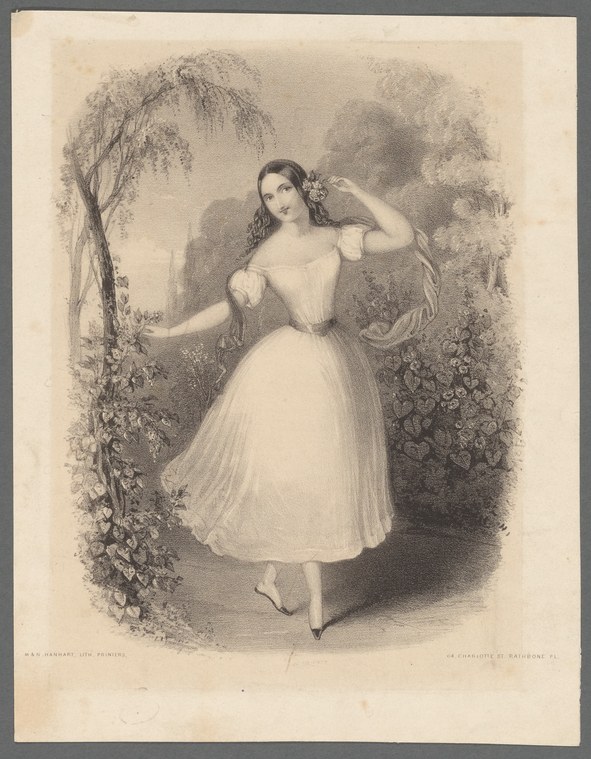
A young woman stands alone in a wooded garden setting, posed in a moment of graceful repose. She wears a white tulle skirt of mid-calf length over a fitted bodice, with her shoulders bared and her hair adorned with flowers or ribbons. Her left arm curves upward to touch her hair while her right arm extends gently outward; her body weight appears settled on her right leg, the left leg relaxed. The background is rendered in soft, atmospheric tones with verdant foliage—willows and flowering bushes—creating an idyllic Romantic landscape. The composition is intimate and introspective rather than dramatic, suggesting a moment of private reverie. The print itself shows considerable finish in the modeling of light and shadow, with the figure emerging luminously from the darker background.
The dancing
A solitary figure with an upright but unhurried carriage. Her frame is open, neither held in a formal ballroom position nor engaged in active locomotion; instead, her pose suggests a pause between movements or a moment of contemplative stillness. The upward reach of the left arm and the gentle extension of the right create a sense of elongation and openness. Her weight is clearly placed, the stance stable but not rigid—this is not a pose of tension or exertion but of lyrical suspension. The bare shoulders and unencumbered arms allow the full line of the upper body to be read.
The dance depicted
This appears to depict a Romantic-era theatrical ballet, most likely from the mid-19th century. The white tulle skirt, bare shoulders, flower crown, and idyllic garden setting are hallmarks of the Romantic ballet aesthetic. The pose and dress are consistent with the soloists (typically sylphs, sprites, or otherworldly heroines) who were central to ballets such as *La Sylphide* (1832) or *Giselle* (1841). The figure is not caught mid-movement but rather in a moment of poetic stillness—characteristic of how Romantic ballet often represented the ephemeral, dreamlike quality of supernatural or transcendent figures. The artist has prioritized grace and atmospheric reverie over technical virtuosity.
How it was made
This is an engraving or lithographic print, executed with considerable skill in the rendering of tone and texture through fine hatching and tonal gradation. The technique allows for broad distribution—this is a print made for a wide audience, not a one-off artwork. The soft modeling of light, the atmospheric background, and the careful attention to fabric texture (especially the gauzy tulle) suggest a sophisticated reproductive process, likely a tonal lithograph or steel engraving. The signature line at the bottom (partially legible) indicates this is a published print, probably from a series documenting theatrical or fashionable subjects.
About this work
This is a print depicting a Romantic-era theatrical ballet dancer, identifiable by her costume and aesthetic but not yet attributed to a specific ballet or artist. It belongs to the 19th-century tradition of theatrical prints—images made to circulate among the ballet-going public, capturing iconic moments or celebrated dancers in famous roles. The work exemplifies the visual culture of Romantic ballet, which valued ethereal beauty, poetic subject matter, and the illusion of weightlessness. Such prints were distributed as fashion plates, theatrical souvenirs, and art objects, making them key documents of how ballet was imagined and consumed in the mid-1800s.
How to look at it
Note the deliberate placement of the figure—not in motion but suspended in a moment of reflection, as if between phrases of movement. The upward reach suggests both vulnerability and aspiration. Observe how the artist has rendered the tulle with a specific translucency that conveys its weightlessness, a technical achievement that emphasizes the Romantic ideal of the ethereal dancer. The garden setting is not incidental; it places the figure in an idealized natural world, a Romantic trope that elevated the ballet dancer to the status of a creature of nature or of dream rather than a mere performer.
The period
This print was made during the height of Romantic ballet in Europe, roughly 1830–1860, when ballets centered on supernatural heroines (sylphs, spirits, ghosts) and exotic locales dominated the stage. The aesthetic emerged partly as a reaction against the virtuosic, earthbound technique of earlier ballet and partly from Romanticism's broader interest in the otherworldly and irrational. Ballet dancers—especially women—became symbols of transcendence and unattainability. Prints of celebrated dancers in famous roles became a form of popular visual culture, similar to modern celebrity photography. The image reflects both the technical possibilities of mid-19th-century printmaking and the appetite for theatrical imagery among educated, middle-class viewers.
Where it lives
This print is held in the New York Public Library's collection of dance-related prints. The collection documents the visual record of dance from multiple periods and cultures, with particular strength in 18th- and 19th-century theatrical prints. Such objects represent an important layer of theatrical history—not the performance itself, but the dissemination and memorialization of it.
Dance in this work
Questions about this work
Is this a real dancer or an imaginary figure?
It is almost certainly a representation of a real dancer—likely a celebrated performer of the 1830s–1850s—in a famous role. Romantic-era ballet prints typically documented celebrated performers as much as specific ballets. The artist may have drawn from life or from memory, capturing the dancer's likeness and her characteristic style of moving and dressing for the role.
What ballet is this from?
Without a visible title, artist attribution, or other identifying marks, it is not certain. However, the costume and aesthetic—especially the white tulle, flower crown, and garden setting—are strongly consistent with the soloists of *La Sylphide* or *Giselle*, the two most famous Romantic ballets of the era.
Why is she standing still rather than dancing?
This reflects a deliberate artistic choice about how to represent ballet. Rather than capture a spectacular jump or turn, the artist chose a moment of poetic stillness. This is consistent with Romantic aesthetics, which valued interiority, grace, and the illusion of weightlessness over visible technical effort. The figure's poise—open, elongated, seemingly at rest—conveys the Romantic ideal of the dancer as a creature of dream or nature.
How was this print made?
Based on the technique visible in the image, this is likely a tonal lithograph or steel engraving from the mid-19th century. Both techniques allowed for the soft gradations of light and shadow visible here. The print was made for wide circulation—sold to theatergoers, collected by enthusiasts, and used as a fashion reference.
More dance artwork





