49 works in this view — arrow keys or swipe to move between them.
Dance in Art
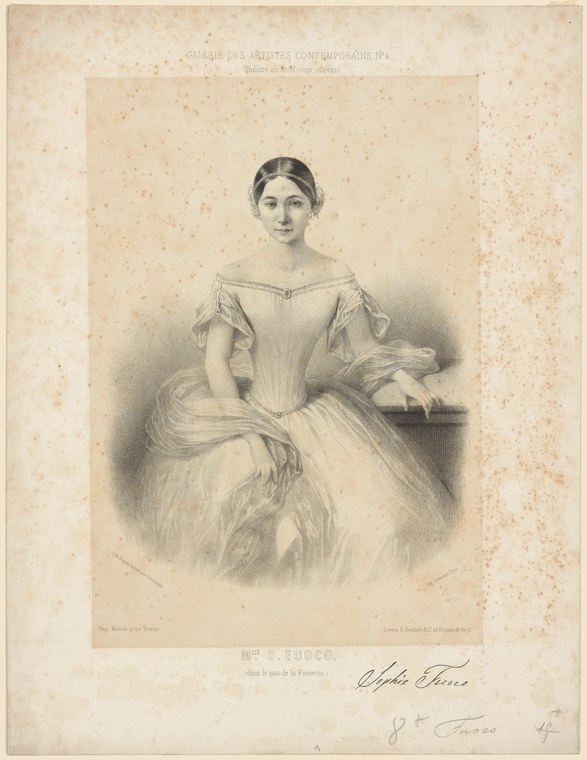
Mlle. S. Fuoco dans le pas de La favorite, Théâtre de la Nation Opéra
Unknown artist
- Collection:
- Prints depicting dance
- Source:
- New York Public Library
- Rights:
- Public domain — free to use, share and adapt.
- Recorded as:
- Public Domain
This lithograph documents a now-forgotten dancer and performance, yet it is precisely such prints that allow us to reconstruct the bodies, costumes, and casting practices of Romantic opera-ballet. Fuoco's career and the *pas de la Favorite* have largely disappeared from dance history; this portrait is one of the few surviving images of her. The work also exemplifies the mass production and circulation of dancer portraiture—a major visual economy of the period that shaped how dancers were seen and remembered.
What you are looking at
A three-quarter-length portrait of a young woman in Romantic-era theatrical dress, depicted in a soft lithographic style. She wears a white off-shoulder corseted bodice with short puffed sleeves, and a voluminous white tulle skirt gathered at the waist—the silhouette characteristic of 1840s ballet costume. Her dark hair is parted centrally and pulled back smoothly. She sits or reclines slightly, resting her right arm on a surface beside her, turning to address the viewer with a composed, direct gaze. The pose suggests theatrical portraiture rather than a captured moment of dancing; the skirt falls in deep folds and settles around her, showing the weight and architecture of the tulle rather than mid-movement suspension. The background is plain and warm-toned, with no setting or scenery indicated. The inscription at bottom reads 'Mlle. S. Fuoco dans le pas de La Favorite' and includes a signature and date notation.
The dancing
A single standing or semi-reclining female figure dominates the composition, viewed frontally with a slight turn of the torso. The right arm rests passively on a surface, the left hangs at her side; neither arm shows the raised port de bras typical of active dance positions. The weight appears settled and static rather than in motion. The pose is that of a posed sitting for a portrait artist rather than a dancer captured mid-performance: shoulders relaxed, spine upright but not in the pulled-up alignment of classical ballet positions.
The dance depicted
The inscription identifies this as Mademoiselle S. Fuoco performing 'the dance from La Favorite'—almost certainly referring to the opera *La Favorite* (1840), composed by Gaetano Donizetti. Fuoco was an Italian-French dancer of the Romantic era who performed at the Opéra Garnier in Paris and was known for roles in contemporary ballet and opera-ballet. The 'pas' referenced would have been a solo or featured dance number within the opera's score. However, this image is a formal portrait rather than a representation of actual choreography or movement: it commemorates Fuoco in her role and costume rather than documenting a specific step, phrase, or moment of dance.
How it was made
The work is a lithograph, executed in black ink on paper with skillful use of tonal gradation to model the figure's form and the texture of fabric. The technique allowed rapid reproduction and wide circulation; such portrait lithographs of celebrated dancers were a standard product of the 1840s theatrical print market, distributed to audiences and collectors as mementos of performances. The soft, almost photographic tonal range suggests a stone drawn with fine control, likely produced in Paris where both the opera and the lithographic print trade were centered. This is a commercial theatrical document, not a unique artistic object.
About this work
This is a commemorative lithographic portrait of Mademoiselle Fuoco, a notable Romantic-era dancer, shown in costume from the opera *La Favorite* (1840). The work belongs to the 19th-century tradition of theatrical portraiture—prints that circulated among audiences to preserve the memory of celebrated performers and roles. While it does not depict dancing in progress, it is material evidence of how dancers were marketed, remembered, and valued during the Romantic ballet period. The costume, setting, and inscribed identification make it a historical record of performance practice and celebrity culture in 1840s Paris opera.
How to look at it
Observe the costume first: the off-shoulder corseted bodice and gathered white tulle skirt are the visual signature of 1840s Romantic ballet, instantly recognizable to a contemporary viewer. Note that the pose is portraiture, not dance—the figure is not in motion, not in a ballet position, not performing. The artist has chosen a composed, frontal presentation that shows off the costume's structure and the dancer's face equally. This is a commercial image designed to sell: it makes the dancer a face and a name, not a body in motion. The gentle modeling and soft focus serve to idealize the subject, much like a photograph touched with a soft-focus lens.
The artist
The artist is not recorded in the catalogue. The lithograph was published commercially in Paris, likely by one of the major print houses specializing in theatrical portraiture. The signature and date notation at the base suggest a named artist and specific publication date, but these are not legible or recorded in the source record. Such prints were often rapid commercial commissions by journeyman lithographers working from daguerreotypes or quick sketches; individual artistic identity was subordinated to the market demand for fresh portraits of current performers.
The period
The 1840s were the height of the Romantic ballet era in Paris, when the Opéra Garnier was the center of European dance. Romantic ballet emphasized weightless, ethereal female bodies in white tulle skirts performing supernatural or exotic roles; Mademoiselle Fuoco's costume here exemplifies that aesthetic perfectly. At the same time, lithographic technology and improved printing methods had made theatrical portraiture a mass medium—theaters and print sellers supplied audiences with portraits of their favorite performers, feeding a celebrity culture not unlike today's. Fuoco's image would have been sold in theater lobbies and print shops, creating a visual archive of performance that was often ephemeral.
Where it lives
The work is held in the Prints depicting dance collection at the New York Public Library. It is catalogued from NYPL's records with minimal metadata: artist unknown, date uncertain (inscription possibly indicates 1840s but is not confirmed), medium not formally recorded (determined from image to be lithograph). This reflects the status of such prints in institutional practice—they were often acquired in bulk as theatrical ephemera and catalogued minimally.
Dance in this work
Questions about this work
Who was Mademoiselle S. Fuoco?
Fuoco was a Romantic-era dancer active in Paris opera-ballet, likely in the 1840s. She is now largely forgotten and appears in few historical records; this portrait is one of the primary surviving images of her. Like many dancers of the period, she would have performed in both ballet and the dancing sequences within operas, particularly in works by Donizetti and other contemporary composers.
What is 'the pas de la Favorite'?
A 'pas' is a dance number or solo. This one was featured in Donizetti's opera *La Favorite* (1840), one of the most frequently performed operas of the 19th century. The *pas* would have been a set piece for a dancer or dancers within the larger opera, likely performed on a stage with orchestral accompaniment and in costume as shown here.
Is this a drawing from life or a portrait after a photograph?
Almost certainly the latter. By the 1840s, lithographers regularly worked from daguerreotypes (early photographs), which allowed them to capture likenesses quickly and then translate them into the more commercially viable medium of lithographic print. The pose and the soft modeling suggest a photographic source, though this cannot be confirmed without the original stone or additional documentation.
How was this image used and circulated?
Theatrical portrait lithographs were sold commercially in print shops and theater lobbies, often at relatively low cost. Audiences bought them as souvenirs of performances, to collect likenesses of favorite dancers and stars. They also served as advertisement for future performances. Such prints were produced in editions of hundreds or thousands and were consumed quickly and often discarded, which is why few survive.
More dance artwork





