49 works in this view — arrow keys or swipe to move between them.
Dance in Art
Melle. Taglioni
Unknown artist
- Collection:
- Prints depicting dance
- Source:
- New York Public Library
- Rights:
- Public domain — free to use, share and adapt.
- Recorded as:
- Public Domain
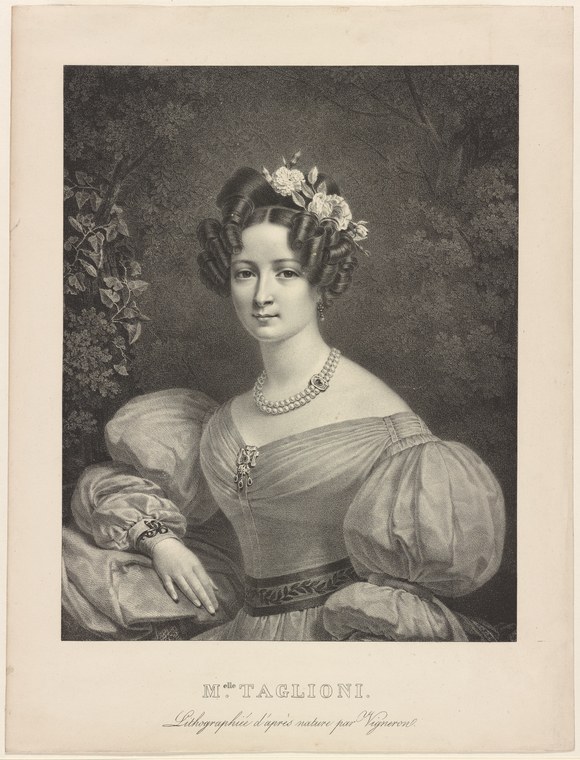
Marie Taglioni was the first great prima ballerina of the modern era and the dancer most closely identified with the invention of pointe technique and the Romantic sylph aesthetic. This portrait, though not a performance image, is a primary visual document of how she presented herself and was presented to her admirers—a celebrity portrait in the medium that made such likenesses available to the masses. It stands as evidence of the dancer as celebrity and the role of reproductive prints in creating and circulating the visual identity of stage stars.
What you are looking at
A young woman in Romantic-era dress stands three-quarter length against a dark, textured background enlivened by climbing foliage at left. She wears a white or pale silk off-shoulder ball gown with voluminous puffed sleeves and a fitted bodice cinched at the waist; the skirt falls in soft, gathered folds to the floor. Her dark hair is arranged in the fashionable ringlets of the 1830s–40s and crowned with white flowers. A pearl choker encircles her neck, and she wears a delicate brooch at her breast. Her left hand rests lightly on her skirt; her right arm hangs naturally at her side with a small fan or handkerchief visible in her grasp. Her posture is upright and poised, her gaze directed softly outward. The whole figure radiates the elegance and ethereal quality associated with the Romantic ballet aesthetic of the period.
The dancing
A single standing female figure in formal portrait pose, not mid-movement. The body is relaxed and symmetrical, weight evenly distributed, arms and hands arranged with studied grace. The figure wears the costume associated with Romantic-era stage dress but is presented as a formal portrait subject rather than caught in the act of dancing. There is no evidence of active choreographic position or balletic frame.
The dance depicted
This is a portrait of Mlle. Taglioni, likely the celebrated Italian-Swedish ballerina Marie Taglioni (1804–1884), whose name appears in the caption. Marie Taglioni was the supreme icon of Romantic ballet and the dancer most associated with pointe work and the sylph-like aesthetic of works such as *La Sylphide* (1832). The costume shown—particularly the off-shoulder white gown and floral crown—is consistent with the Romantic tutu and dress associated with her famous roles. However, this is a formal portrait, not a depiction of her in active performance or dance movement. It captures the visual identity and glamour associated with her name rather than her technique or a specific choreographic moment.
How it was made
This is a line engraving, a reproductive print technique that allowed wide circulation of celebrity portraits in the 19th century. The caption indicates it was made after a painting ("Lithographie d'après nature par Valpeyrat"), suggesting it was copied from an original portrait painting. Engraving was the preferred method for creating multiple, uniform impressions of celebrity likenesses; the delicate parallel lines and tonal modulation visible in the hair, drapery, and background are characteristic of skilled engraving work. Such prints were mass-produced and widely distributed, making them the primary way the public encountered images of famous dancers of the era.
About this work
This is a formal portrait engraving of Marie Taglioni, the leading ballerina of the Romantic era, presented in the costume and styling associated with her fame. The image does not show her dancing but rather captures her as a celebrity icon—a visual record of the dancer herself in the formal dress and ethereal presentation that defined her public persona. It belongs in a gallery of dance art not because it depicts choreography in motion, but because it documents one of ballet history's most celebrated figures and preserves the visual codes of Romantic aesthetics that shaped how dancers were understood and desired by their public.
How to look at it
This is a portrait, not a performance image, so attend to the costume details and the careful arrangement of the body for formal display rather than to choreographic content. Note the silhouette created by the puffed sleeves and gathered skirt—hallmarks of 1830s–40s fashion and Romantic stage dress. The soft ringlets and flowers in the hair, the pearl jewelry, and the delicate hand positions all contribute to the visual vocabulary of Romantic femininity that defined the period. The dark background and the careful tonal modeling in the engraving technique create a sense of the dancer as a luminous, idealized figure.
The artist
The engraver is not recorded in the catalogue. The caption notes the original painting was by Valpeyrat (likely a French portraitist of the 1830s–40s), and this engraving reproduces it. Such reproductive engravings were typically executed by specialist engravers whose names were often subordinated to that of the original painter. The work belongs to the large industry of theatrical portraiture that flourished in the 19th century, feeding public appetite for images of famous dancers, singers, and actors.
The period
This print dates to the height of the Romantic era in ballet (approximately 1830–1850), when *La Sylphide* and *Giselle* defined the aesthetic of ethereal, otherworldly femininity. Marie Taglioni dominated this period as its supreme exponent, and her image was among the most widely reproduced in Europe. The print medium was central to the economy of theatrical celebrity: photographic reproduction was not yet reliable or widespread for such portraits, so engravings like this served as the primary means by which the public knew the faces and forms of famous performers. The off-shoulder white gown and floral crown shown here became iconic shorthand for Romantic ballet itself.
Where it lives
This engraving is held in the New York Public Library as part of a collection of prints depicting dance. It is a reproductive print made after a portrait painting, a standard product of 19th-century theatrical portraiture and celebrity culture.
Dance in this work
Questions about this work
Is this a depiction of Taglioni actually dancing?
No. This is a formal portrait in which she is standing posed, not in motion or mid-performance. It is a celebrity portrait made to circulate her image, not a record of her choreography or technique.
Why would a portrait of someone not dancing be in a collection of dance imagery?
Because it is a primary document of one of ballet history's greatest figures, and because the costume and aesthetic shown are inseparable from our understanding of Romantic ballet. The portrait itself is an artifact of 19th-century dance culture and celebrity.
What is the technique that made this print?
This is a line engraving, a reproductive technique that allowed multiple identical copies to be printed from a single plate. It was the standard method for circulating celebrity portraits before photography became widespread, and it made images of famous dancers accessible to a broad public.
More dance artwork





