49 works in this view — arrow keys or swipe to move between them.
Dance in Art
Orientalist images of dance in prints
Unknown artist
- Collection:
- Prints depicting dance
- Source:
- New York Public Library
- Rights:
- Public domain — free to use, share and adapt.
- Recorded as:
- Public Domain
This print documents the Romantic era's visual fascination with the dancing body as a site of emotion and naturalism, showing how ballet aesthetics penetrated popular culture and domestic display beyond the theater. The work also exemplifies the tension between the theatrical (pointe work, formal costume) and the picturesque (barefoot, solitary, in nature) that characterized Romantic-era fantasies about dance and movement.
What you are looking at
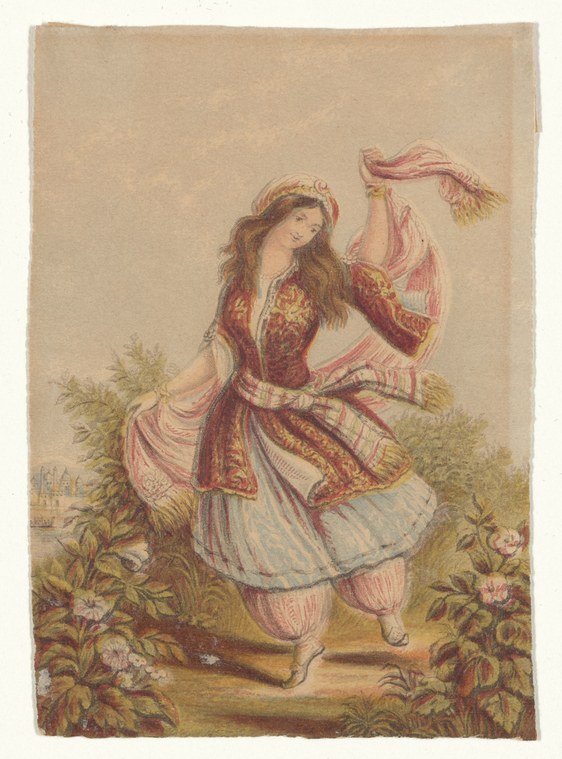
A young woman in a romantic era costume dances alone in a garden setting, captured mid-movement in a hand-colored print. She wears a deep crimson velvet jacket with ornate gold embroidery over a white chemise, paired with a full skirt of striped silk in pink and white that swirls around her legs. A pink silk scarf or shawl trails from her raised right hand, adding movement and drama to the composition. Her left arm curves gracefully across her body. She stands barefoot or in soft slippers on a path bordered by flowering shrubs and climbing roses, with a castle or manor visible in the misty background. The figure's head is tilted downward in a moment of abandon, her long hair loose and flowing. The overall mood is one of leisure, nature, and romantic fancy—she appears to be dancing for her own pleasure rather than for an audience.
The dancing
The dancer's frame is open and expansive, with her torso upright and her arms in a lyrical, expressive upper line rather than a closed ballroom hold. Her weight appears to be on one leg while the other is extended or lifting, suggesting a moment of elevation or turning. The barefoot or soft-shod condition of her feet, combined with the relaxed arm positions and the tilt of her head, indicates an interpretive or theatrical approach to movement rather than the structured technical positions of classical ballet. There is a quality of spontaneity and self-expression rather than formal training.
The dance depicted
This appears to represent a Romantic era imagination of dance, likely influenced by the stylized movement vocabulary of Romantic ballet as it emerged in the 1830s–1840s (works such as La Sylphide). However, the barefoot execution, garden setting, and absence of pointe work suggest this is not depicting theatrical ballet as performed on stage, but rather a Romantic-era fantasy of dance in nature—a common subject in prints and popular illustrations of the period. The solo, female figure absorbed in movement recalls the *sylph* or nature-spirit figure that was central to Romantic ballet aesthetics, but executed here in an idealized outdoor context.
How it was made
This is a hand-colored print, most likely a chromolithograph or color engraving dating from the mid-19th century, based on the delicate color application, the fine line work, and the layered effect of translucent pigments. The technique allowed for mass reproduction and circulation to a middle-class audience, making Romantic imagery widely accessible. The hand-coloring—particularly the subtle gradations in the fabric textures and the luminous quality of the silk—indicates this was a luxury print, likely from a portfolio or bound collection of dance or literary-themed illustrations. The slight variations in color application and the visible paper texture are consistent with hand-coloring over a lithographic or engraved base.
About this work
This is a Romantic-era illustrated print depicting an idealized female dancer in a garden, combining the aesthetic vocabulary of Romantic ballet with a leisure or nature fantasy. The work belongs to the broad category of 19th-century dance imagery aimed at a cultivated middle-class audience, representing not actual stage practice but the era's imaginative investment in dance as an expression of nature, feeling, and feminine grace. The print circulated as part of a collection held by the New York Public Library, likely as one of a series of orientalist or picturesque figure studies popular in the 1830s–1860s.
How to look at it
Notice the tension in the print between theatrical costume (the embroidered jacket, structured skirt) and romantic fantasy (the barefoot stance, solitary garden, abandoned gesture). The artist has chosen a moment of movement—the body tilted, the scarf floating—that suggests not technical precision but emotional expression and surrender to feeling. Observe how the landscape frames and contains the dancer, making her part of a unified natural world rather than a performer separated from an audience. The downward gaze and the curve of the body suggest interiority—the dancer is moved by feeling, not executing steps.
The period
This print was created during the height of the Romantic era in dance and visual culture, roughly 1830–1860, when ballet underwent a dramatic shift away from neoclassical form toward themes of the supernatural, the exotic, and the emotional. Marie Taglioni's La Sylphide (1832) and Giselle (1841) established the ethereal, transcendent female dancer as a cultural ideal. Parallel to the stage, popular prints, lithographs, and illustrated books circulated imagery of graceful, light, emotionally expressive female dancers, often in naturalistic or picturesque settings. The titled 'orientalist images of dance' in the catalogue suggests this print may be part of a larger collection exploring non-European or fantastical dance subjects—a major theme in 19th-century visual culture, where 'the Orient' (a European fantasy) was imagined as a realm of sensuality, exoticism, and uninhibited movement. The hand-coloring and printing technique place it within the thriving market for luxury prints aimed at art collectors and educated households.
Where it lives
The print is held by the New York Public Library as part of their collection of printed dance imagery. The catalogue record titles it as part of a group described as 'Orientalist images of dance in prints' and notes the collection slug as 'Prints depicting dance,' suggesting it is one of a series.
Dance in this work
Questions about this work
Is this a real person or an invented character?
The image is a commercial print—an idealized fantasy figure rather than a portrait of an actual dancer. Such prints circulated widely in the 19th century as luxury items for the home, inspired by Romantic ballet and popular literature, but not representing any specific performer or real event.
Why is she barefoot if this is supposedly about ballet?
This print blends theatrical Romantic ballet aesthetics (the costume, the graceful frame) with a picturesque fantasy of natural, uninhibited movement. Barefoot dancing was associated with freedom, nature, and authenticity in Romantic culture—it represents an imagined realm beyond the artificial constraints of the stage, even though real ballet dancers of the era wore pointe shoes.
What does 'orientalist' mean in the catalogue title?
In 19th-century European art and culture, 'Orientalism' referred to imaginative representations of non-European (especially North African, Middle Eastern, and South Asian) peoples and cultures. Orientalist imagery in dance prints often featured exoticized costumes, sensual movement, and fantastical settings—serving European fantasies rather than documenting actual dance practices. The catalogue suggests this print may be part of such a collection, though the current image shows more European Romantic aesthetic than explicit 'oriental' costuming.
What technique is used to make this print?
This is a hand-colored print, likely a chromolithograph or color engraving from the mid-19th century. The base image was printed (engraved or lithographed) and then colored by hand, using translucent pigments that allow the underlying line work to show through. This technique allowed publishers to create multiple copies while maintaining an artisanal, luxurious appearance.
More dance artwork





