49 works in this view — arrow keys or swipe to move between them.
Dance in Art
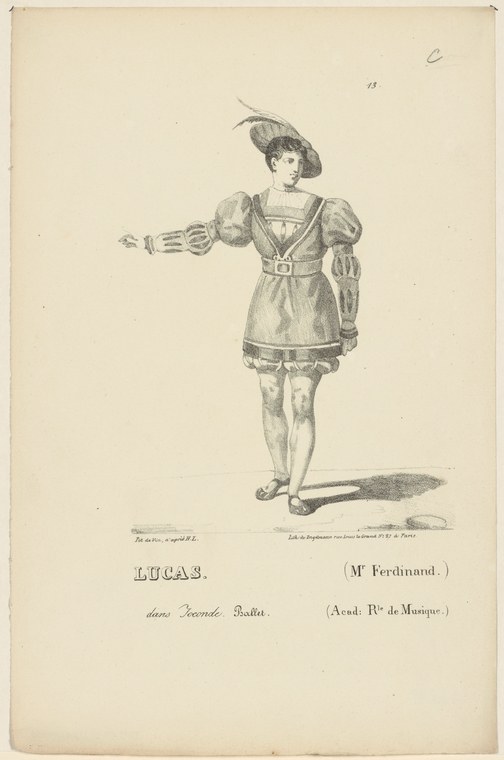
Lucas. (Mr. Ferdinand) dans Joconde. Ballet.: (Acad. Rle de Musique)
Unknown artist
- Collection:
- Prints depicting dance
- Source:
- New York Public Library
- Rights:
- Public domain — free to use, share and adapt.
- Recorded as:
- Public Domain
Character portrait engravings are among the most reliable visual evidence we have for how dancers dressed, posed, and presented themselves in early 19th-century ballet and theatrical dance. This image documents a specific dancer, role, and ballet production at a moment when many such works are otherwise known only through written records; it shows us not technique but theatrical presentation and costume design.
What you are looking at
A single male dancer is depicted in a three-quarter stance against a plain background, wearing early 19th-century theatrical costume: a belted tunic or jacket with puffed sleeves, knee-length skirt, and fitted stockings. He wears a plumed hat tilted at an angle and extends his right arm outward in a gestural pose suggesting address or appeal, while his left arm hangs at his side. The figure is rendered in fine linear detail characteristic of engraving technique, with careful attention to the play of light and shadow across the fabric and musculature. The pose is not one of active locomotion but of theatrical presentation—a moment of pause or declaration within a narrative scene. The artist has captured the dancer's weight settled on both legs, with the body turned to present a three-quarter profile to the viewer.
The dancing
The dancer stands in a composed, frontal-facing position with weight evenly distributed. The right arm is extended outward at roughly shoulder height in an expressive gesture; the left arm remains relaxed at the side. The torso is upright and the head turned slightly to face the viewer. There is no suggestion of turnout or the balletic positions of the period; the stance is more naturalistic and dramatic than balletic. The extended arm and turned head create a sense of address or communication toward an unseen audience or scene partner.
The dance depicted
This is a character from a ballet or opera-ballet, identifiable from the costume and theatrical setting as a figure from Romantic or early 19th-century theatrical dance. The inscription identifies the dancer as Mr. Ferdinand in the role of Lucas from *Joconde*, a ballet performed at the Académie Royale de Musique (the Paris Opéra). The pose is characteristic of dramatic portraiture in theatrical dance prints of this era—not a depiction of active choreography but a presentational image of a named dancer in character. The gesture suggests a moment of narrative importance rather than pure dance technique.
How it was made
This is a finely detailed engraving, executed with precise linear work and careful cross-hatching to create volume and texture. The technique allows for wide distribution of the image and suggests a commercial print intended for sale to opera patrons or ballet enthusiasts. The inscription at the base, in French, indicates this was a professional theatrical souvenir or promotional print. Engravings of this type were produced in Paris during the 1830s–1850s and circulated among the opera-going public, serving both as documentation of celebrated dancers and as mementos of specific performances.
About this work
This is a character portrait engraving of a celebrated Parisian dancer of the Romantic era, documented by name and role. Mr. Ferdinand is shown as Lucas, a character in the ballet *Joconde* at the Opéra. The print belongs to a now-familiar genre of 19th-century theatrical portraiture—images of individual dancers or character types, distributed to the opera public as both artistic documentation and commercial product. Such prints are crucial historical records, preserving the likenesses of celebrated dancers, the costumes and roles they inhabited, and the visual conventions of mid-19th-century European ballet and theatrical dance.
How to look at it
Notice the carefully rendered details of costume and fabric—the puffed sleeve, the structured jacket, the plume in the hat—which signal both the character type and the era of the ballet. The extended arm and turned head create a moment of dramatic address rather than pure dance movement; this is theatrical presence rather than choreographic action. The plain background and centered pose are conventions of theatrical portraiture, emphasizing the individual performer and role rather than narrative context. The engraving technique itself—with its fine lines and subtle tonal range—was the standard medium for circulating such images to a broad audience.
The period
This engraving dates to the heyday of Romantic ballet in Paris (1830s–1850s), when the Opéra was the center of European dance innovation and celebrity. During this period, character dances, national dances, and narrative ballets were central to the repertory. Individual dancers—particularly male character dancers in roles like this—achieved celebrity status, and commercial prints of them were produced in significant quantity for an eager public. The Académie Royale de Musique (Paris Opéra) was the prestigious institution where such works premiered, and prints documenting them were important cultural merchandise.
Where it lives
This engraving is held in the New York Public Library's collection of prints depicting dance, classed as a historical theatrical print from the 19th century. Such works are classified by subject (dance and theatre) rather than by artist or date, reflecting their primary value as documentary records of performance and costume.
Dance in this work
Questions about this work
Who was Mr. Ferdinand?
Ferdinand was a celebrated male dancer at the Paris Opéra during the Romantic era. Beyond this print and the historical record of his roles, little is widely known. He is documented here as a performer in *Joconde*, a ballet of the period, and this engraving preserves his likeness and costume in the role of Lucas.
What was Joconde?
Joconde was a ballet performed at the Académie Royale de Musique (Paris Opéra). The title refers to the Mona Lisa (known as La Joconde in French), suggesting a narrative ballet drawn from art historical or romantic sources. The ballet belongs to the repertory of mid-19th-century European theatrical dance.
Why are there so many prints of single dancers in old costumes?
During the 19th century, theatrical prints of individual dancers in costume were commercial products, comparable to later photo postcards or posters. They served as mementos for opera patrons, visual records of celebrated performers, and promotional material for the theatre. They are now invaluable historical documents showing us how dancers dressed and presented themselves.
What does the pose tell us about the dance?
The pose does not show us active choreography but rather theatrical presentation—a moment of dramatic address or emotional expression. It suggests that *Joconde* included narrative and character work, not purely abstract dance. The naturalness of the stance (without exaggerated turnout) is typical of character and dramatic roles in Romantic-era ballet, as opposed to the ballet d'action.
More dance artwork





