49 works in this view — arrow keys or swipe to move between them.
Dance in Art
Orientalist images of dance in prints
Unknown artist
- Collection:
- Prints depicting dance
- Source:
- New York Public Library
- Rights:
- Public domain — free to use, share and adapt.
- Recorded as:
- Public Domain
This print demonstrates how 19th-century European theatrical dance was marketed, documented, and celebrated through mass-produced imagery, and how orientalism and classical revival shaped both the choreography and the public imagination of dance. For dance historians, it is a window into costume practice, the visual grammar of Romantic and post-Romantic ballet, and the role of prints in circulating dance culture before photography became dominant.
What you are looking at
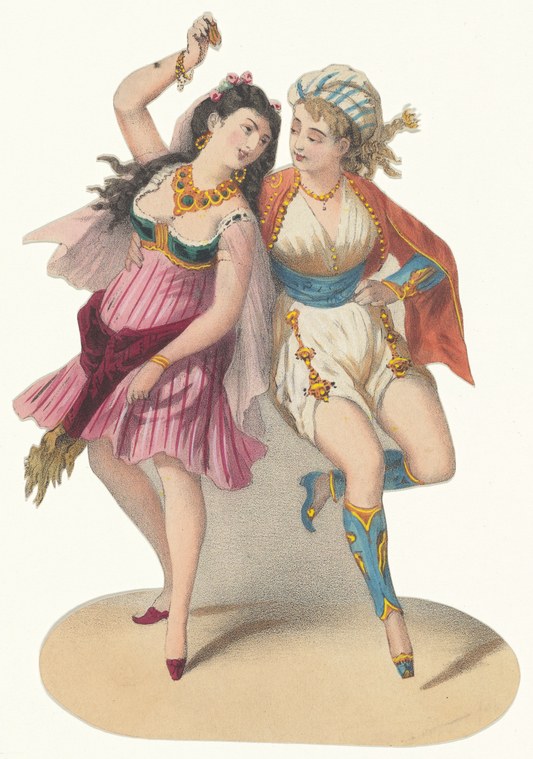
Two female figures in classical dress execute a dynamic leap or hop against a neutral ground. The figure on the left wears a pink pleated skirt with dark red hem, a deep orange-gold embroidered collar, and gold hoop bracelets; her dark hair is styled with a braided crown and she gestures upward with one arm while the other trails behind. The figure on the right, in white with gold star embroidery and a blue-bordered wrap or shawl, wears a white cap with blue striping and gold fringe; she extends one leg behind her in an elevated position. Both dancers' bodies are weightless and airborne, suggesting either a moment of apotheosis or a highly stylised representation of classical movement. The composition is a hand-coloured print with soft modeling, set against warm cream ground, executed in a late 19th-century chromolithographic style typical of theatrical souvenir prints or dance costume studies.
The dancing
Both figures are airborne or en relevé, with no indication of a partnered hold or frame; they move in parallel rather than in contact. The figure on the left has an upward-reaching arm gesture suggesting elevation or exultation, while her companion's extended rear leg suggests either an attitude or an attempt at flight. The weight distribution is unclear—both seem suspended rather than grounded—and the footwork is impossible to determine from this stylised rendering. This is classical-academic gesture language rather than vernacular partnered movement.
The dance depicted
The image depicts classical female dancers in styles associated with 19th-century European theatrical performance, most likely either Romantic ballet or classical court dance revival. The costumes—elaborate drapery, embroidered bodices, and decorated caps—suggest either a Hellenistic or orientalist fantasy, common to both ballet d'action and pantomimic theatre of the 1870s–1890s. The airborne quality and gesture vocabulary point toward ballet, though the absence of pointe shoes and the ornamental rather than athletic presentation suggest a lighter theatrical or balletic-pantomimic style rather than rigorous classical technique. The image appears to be costume documentation or a theatrical commemorative print rather than a record of actual performance.
How it was made
This is a hand-coloured lithograph or chromolithograph, evidenced by the soft chromatic gradations, the characteristic outlines, and the warm cream ground typical of 1880s–1910s theatrical prints. The technique allowed for mass production of costume documentation and souvenir imagery for audiences, theatre companies, and dance practitioners. The careful hand-colouring over a lithographic base suggests a moderately expensive object, circulated among educated theatre-goers rather than a cheap broadside. Prints of this type were essential to the documentation and celebrity-making of 19th-century dancers, as they could be produced rapidly and distributed widely.
About this work
This hand-coloured lithograph captures two female dancers in a moment of weightless, exultant movement, dressed in orientalist or classical-fantasy costume suggestive of mid-to-late 19th-century European theatrical dance. The image belongs to the tradition of theatrical costume prints and dance documentation that flourished after mid-century, when chromolithography made it possible to produce vivid, detailed images of dancers and their dress for public consumption. As a record of how classical dance was imagined and performed in the Gilded Age, it documents both the movement vocabulary and the visual fantasy through which European culture understood dance from other traditions—or projected its own classical ideals onto imagined historical and exotic settings.
How to look at it
Attend to the weightlessness of both figures: the artist has chosen to freeze a moment of maximum elevation, not a grounded position, which elevates the dancers into a realm of fantasy or aspiration rather than documentation. Note the careful ornamentation of the costumes—the embroidery, the jewellery, the headwear—which carry as much visual interest as the movement itself; this was conventional in theatrical prints of the period, where costume was as much the subject as gesture. The parallel arrangement of the two figures, both airborne, suggests choreography built on visual symmetry and elevation rather than dramatic contact or narrative development.
The period
This print dates to the era of Romantic ballet's dominance in European theatre (roughly 1830–1890), when classical Greek and oriental themes were stock subjects for spectacular ballets. By the 1870s–1900s, however, classical ballet was consolidating its technique and aesthetic under the Cecchetti method and Russian Imperial models, while orientalist pantomime and lighter classical styles remained popular in commercial and demi-monde theatre. The theatrical print was at the peak of its influence in this period; photography existed but had not yet displaced hand-coloured lithography as the primary mode of dance documentation and celebrity imagery. The image likely dates to the 1880s–1910s, when such prints were most prolifically produced.
Where it lives
Held in the New York Public Library's collection of prints depicting dance, catalogued under the broader rubric of orientalist imagery of dance. The collection designation suggests this is one of many similar prints acquired to document the visual history of staged dance and theatrical costume.
Dance in this work
Questions about this work
What dance style is this?
The image does not record a specific named dance style, but rather a classical or orientalist theatrical fantasy common to Romantic and post-Romantic ballet and pantomime. The costumes, gesture, and airborne composition suggest a choreography built on classical academic movement vocabulary, rendered in a highly stylised, weightless manner typical of 19th-century theatrical imagination.
Are these real dancers, or is this purely imaginative?
This is almost certainly a commemorative or promotional image of actual performers, designed to capture the essence and costume of a theatrical role rather than document a precise movement. The extreme stylisation—the weightlessness, the symmetry, the ornamental treatment—places it squarely in the realm of theatrical souvenir art rather than naturalistic movement documentation.
What does 'orientalist' mean in the title, and why is it important?
Orientalism refers to how European artists and theatre-makers imagined and depicted cultures from the Middle East, North Africa, and Asia, often in fanciful and inaccurate ways. In 19th-century dance, orientalism was a major source of costume, themes, and choreographic ideas; this print is an example of how European classical ballet borrowed from and refashioned oriental aesthetics to create exotic spectacle.
More dance artwork





