49 works in this view — arrow keys or swipe to move between them.
Dance in Art
Orientalist images of dance in prints
Unknown artist
- Collection:
- Prints depicting dance
- Source:
- New York Public Library
- Rights:
- Public domain — free to use, share and adapt.
- Recorded as:
- Public Domain
This print captures a crucial moment in the history of how dance was circulated and consumed: the mid-19th-century boom in chromolithographed theater prints. For audiences who could never see the original performance, such prints were the only visual record of celebrated dancers and celebrated scenes. The image is also a primary document of Orientalist taste in ballet, showing the costumes, body ideal, and compositional conventions that shaped Romantic ballet.
What you are looking at
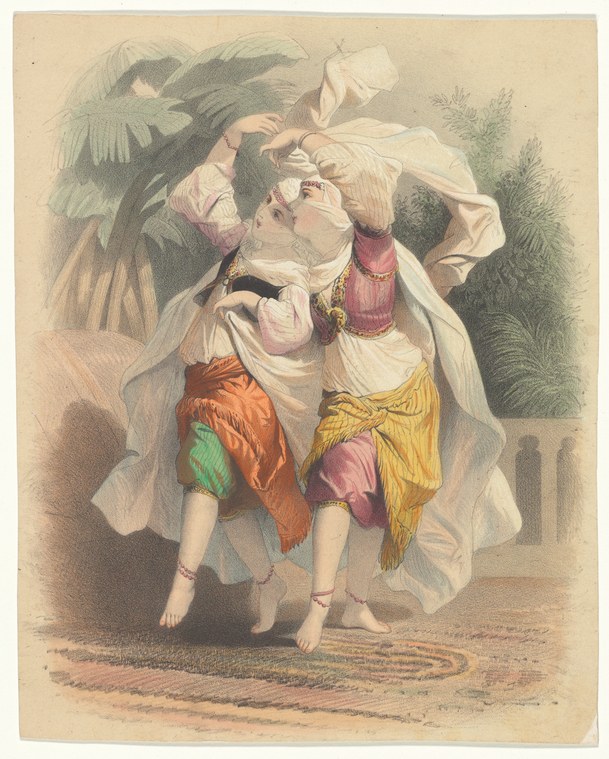
Two young dancers in Orientalist costume perform together in an outdoor setting. The figure on the left wears a white head wrapping and sheer white drapery over a rust-red and green garment with a yellow sash; the figure on the right is similarly dressed in white with pink and yellow fabrics. Both are barefoot. They are captured mid-movement, bodies inclined toward each other in an intimate, playful pose suggesting flirtation or courtship. The background shows architectural elements—what appears to be a colonnade or wall—and foliage, evoking a Mediterranean or Middle Eastern garden setting. The print uses hand-coloring over a lithographic or engraved base, with soft modeling in the flesh tones and careful attention to the translucent folds of the garments. Light falls from above, creating subtle shadows that give volume to the draped fabrics.
The dancing
The two figures are in close proximity, their bodies angled toward each other in a configuration that suggests a pas de deux or social dance for two. The dancer on the left has one arm raised; the right figure's arm placement echoes this in a mirrored or complementary line. Their posture is light and buoyant, with weight distributed to the balls of the feet in a way consistent with ballet training. The lifted quality of the torsos and the delicate arm positions suggest a theatrical rather than folk idiom. Neither figure shows tension or strain; the movement reads as grace and ease.
The dance depicted
This appears to be a Romantic-era theatrical dance, most likely a pas de deux from ballet. The barefoot execution, the ethereal drapery, the garden setting, and the intimate duet format all point to the aesthetic conventions of mid-19th-century ballet. The Orientalist costume—while fashionable in European art of the period—was often used in ballets set in fantastical or exotic locales, such as *Le Corsaire* or *La Bayadère*. The print likely documents a famous dancer or a celebrated scene, though without inscription or context the specific ballet cannot be confirmed. The artist understood the balletic body—the weight, the carriage, the port de bras.
How it was made
This is a hand-colored lithograph or engraving, executed with considerable skill. The base print—visible in the outline work and the modeling of shadow—shows fine linear control and understanding of anatomy. The hand-coloring has been applied selectively to pick out the fabrics in warm and cool tones, creating visual hierarchy and depth. The technique allowed for relatively affordable reproduction of theatrical scenes for popular circulation and for collectors of dance imagery. The softness of the lithographic line, if that is indeed the base technique, permits the delicate rendering of the dancers' forms and the translucent quality of the drapery.
About this work
This is a hand-colored print of two dancers in Orientalist costume performing an intimate duet in a garden setting. The work belongs to the tradition of theatrical dance imagery that flourished in the 19th century—a period when lithography and engraving made vivid colored prints of celebrated ballet scenes available to the broad public. The composition, costume, and technical execution all point to a Romantic-era ballet, likely from the mid-1800s, though the specific work cannot be confirmed without inscription or provenance.
The image is a document of how ballet dancers were trained, costumed, and presented during the Romantic period, and of how artists translated the ephemeral art of dance into a static visual form. It belongs in a collection of dance imagery both as an example of the Orientalist aesthetic that dominated theatrical production and as evidence of how 19th-century audiences understood and consumed dance.
How to look at it
Pay attention to the artists' choice of the moment: not a peak jump or a turn, but a tender, face-to-face proximity that emphasizes emotional connection over virtuosity. Notice the barefoot execution and the soft, upright carriage—markers of the ballet aesthetic as opposed to folk dance. The Orientalist costume—the drapery, the colors, the head wrapping—was a convention for signaling exotic locale rather than ethnographic accuracy; it functioned as stage design in fabric form. The printing technique itself is worth studying: see how the hand-coloring follows and enhances the linear work beneath, and how the choice of which elements to color creates visual emphasis.
The period
This print belongs to the age of Romantic ballet (roughly 1830–1860) and the parallel explosion in lithographic color printing. By the 1840s–1850s, hand-colored lithographs of celebrated ballet scenes were a major commercial product, sold to theater-goers, collectors, and the general public. The Orientalist costume reflects the broader taste for exoticism in European art and theater during this period—a taste driven by colonial expansion, literary Romanticism, and a hunger for visual spectacle on the stage. Ballets with Middle Eastern, North African, or South Asian settings were among the most popular of the era.
Where it lives
The print is held in the New York Public Library's collection of prints depicting dance. The catalogue record does not specify the printing technique, date, artist, or edition state, but the stylistic evidence points to the mid-19th century.
Dance in this work
Questions about this work
Is this a document of a real performance or a studio composition?
Without inscription or provenance, it is impossible to say. Many such prints purported to document famous dancers in famous roles, but artists also created imaginary dance scenes in theatrical costume. The high level of technical understanding suggests either that the artist drew from life or studied dance carefully; whether the specific duet is identifiable requires additional research.
Why are the dancers barefoot?
Barefoot dancing was a marker of both classical antiquity (which Romantics idealized) and of certain Orientalist fantasies about 'natural' or 'primitive' beauty. By the mid-19th century, ballet dancers were trained on pointe in rigid shoes, so a barefoot depiction often indicated either a fantasy moment or a deliberate choice to evoke a different aesthetic register.
What does the costume tell us?
The drapery, the colors (rust, pink, yellow, green over white), and the head wrapping are elements of Romantic-era Orientalist style rather than ethnographically accurate dress. They signal 'exotic locale' to a European viewer and would have been recognized instantly as theater costume by a contemporary audience.
More dance artwork





