49 works in this view — arrow keys or swipe to move between them.
Dance in Art
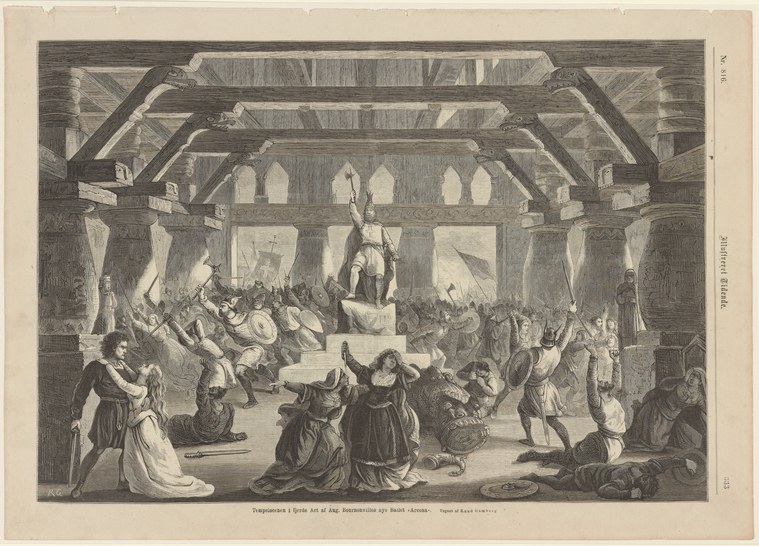
Tempelscenen i fjerde Act af Aug. Bournonvilles nye Ballet Arcona
Unknown artist
- Collection:
- Prints depicting dance
- Source:
- New York Public Library
- Rights:
- Public domain — free to use, share and adapt.
- Recorded as:
- Public Domain
This print is evidence of how 19th-century Romantic and post-Romantic ballet was preserved and marketed before film. It shows a scene from Bournonville's work, a foundational figure in Danish dance history, and demonstrates that ballet audiences and collectors valued prints of dramatic narrative moments as much as depictions of pure dance. The image reveals the theatrical and architectural context in which ballet was presented, not merely the movement itself.
What you are looking at
A grand interior hall with soaring timber-frame architecture and large arched windows depicts an elaborate theatrical or ceremonial scene. The space is crowded with figures in long robes and period dress arranged in various poses across the floor and toward an elevated platform or stage at the far end. The lighting, created through the tall arched windows, bathes the scene in a classical architectural setting that suggests either a palace, temple, or grand public building. In the foreground, several kneeling or reclining figures dominate; toward the center and back, standing figures gesture expansively or process forward. The composition is busy and crowded, with figures overlapping and at different depths, creating a sense of dramatic action unfolding across a ceremonial or theatrical moment. The print's tonal range—from deep blacks in the architecture to fine hatching on drapery and flesh—gives sculptural weight to the forms.
The dancing
The bodies throughout are rendered in classical academic style with attention to drapery, posture, and theatrical gesture. Several figures kneel with arms raised or extended in supplication or emotional display; others stand with open arm positions suggesting address or proclamation. The figures are predominantly in formal dress—long robes, mantles, and period costume that suggests neither contemporary dress nor folk dance but a historical or classical theatrical context. Weight is naturalistic and the bodies are anatomically rendered, with clear distinction between active gesture and passive witnessing poses. The density of figures and the multiplicity of poses suggests a crowd scene rather than a coordinated group dance.
The dance depicted
This engraving appears to depict a theatrical or ceremonial scene rather than a recognizable ballroom or concert dance form. The title references Bournonville's ballet *Arcona*, a work from the 19th-century Danish ballet tradition, but the image shows a scene of drama, supplication, and formal ritual rather than dance technique. The kneeling, gesturing, and processional arrangement suggest a dramatic tableau or pantomime sequence—a common structural element of 19th-century narrative ballet. The formal, classical dress and architectural setting align with the historical or mythological subject matter typical of Romantic and later 19th-century ballet, but specific dance vocabulary is not legible from the composition. This is likely a representation of the dramatic (non-dance) moment within the ballet rather than a danced passage.
How it was made
This is an engraving or etching, executed with fine lines and careful tonal modeling through cross-hatching and parallel line work. The technique allows for sharp detail in architecture and drapery and for tonal subtlety in the modeling of flesh and light. The print would have been relatively expensive to produce and distribute, suggesting circulation among educated theater-going audiences, collectors of prints, and those interested in choreographic practice. The formal composition and classical reference suggest this is a commemorative or documentary print, likely issued to document a notable theatrical production or to preserve the memory of a specific performance or ballet.
About this work
This engraving documents a scene from August Bournonville's ballet *Arcona*, a work from the 19th-century Danish ballet repertory. The print captures a dramatic interior moment within the ballet—a ritual or ceremonial tableau in a grand classical setting—rather than a passage of visible dance technique. The work belongs in a gallery of dance in art because it represents how 19th-century ballet was documented, commemorated, and circulated to audiences who might never see the performance itself. Engravings like this were primary media for spreading knowledge of important choreographic works across Europe before photography and moving image.
How to look at it
Attend first to the architectural framing—the soaring timber and arched windows establish the formal, classical register of the scene. Then trace the hierarchy of gesture: the kneeling figures in the foreground are at an emotional or narrative climax, while standing figures in the middle distance and background respond or observe. The artist has frozen a moment of maximum dramatic intensity rather than a moment of visible virtuosity; this is a scene of supplication, ritual, or recognition. Notice how the careful rendering of drapery and the academic modeling of the bodies signal that this is a serious, formally composed tableau rather than everyday action.
The artist
The artist is not recorded in the catalogue. The engraving style and the subject matter suggest a mid-to-late 19th-century European print maker, likely Danish or working in a major European artistic center. Prints commemorating specific ballet performances were often produced by house engravers or notable printmakers of the period and distributed through theater bookshops and print dealers.
The period
This print dates to the era of Romantic ballet and its aftermath in the mid-to-late 19th century, when narrative ballet with historical and exotic subjects dominated European stages. Bournonville's choreography, developed and performed primarily in Copenhagen, was known for its clarity, precision, and integration of pantomime with dance. The 1850s–1870s saw intense European interest in ballet as a literary and theatrical form, and prints served both as documentary records and as promotional material. The classical architectural setting and formal dress shown here reflect the period's taste for historical and mythological subjects rendered with archaeological ambition.
Where it lives
This engraving is held in the New York Public Library's collection of prints depicting dance. It is catalogued as a documentary or commemorative print related to a specific theatrical production, likely issued in the 19th century as part of the circulation of information about notable ballet performances.
Dance in this work
Questions about this work
What is Bournonville's Arcona?
Arcona is a ballet choreographed by August Bournonville, the major Danish choreographer of the 19th century. It belongs to the Romantic era of narrative ballet and draws on historical and exotic subject matter. Bournonville's works are still performed today and form a core of the Royal Danish Ballet repertory. This engraving documents one scene from the ballet, likely a dramatic or ceremonial moment rather than a dance sequence.
Why would someone commission or buy an engraving of a ballet scene?
Prints served multiple audiences: dancers and choreographers who wanted to study or remember performances; theater patrons who wished to own a souvenir of a notable production; collectors of fine prints and theatrical imagery; and the general public interested in fashionable entertainments. Before film, prints were the primary way theatrical spectacle was preserved, circulated, and made accessible to people who could not attend performances.
How do we know this is a Bournonville work?
The title is inscribed on the print itself (visible at the base of the engraving in the catalogue record). The architectural and costume details align with what is known of 19th-century ballet design and staging. However, the artist who created the print is not identified in surviving records.
More dance artwork





