49 works in this view — arrow keys or swipe to move between them.
Dance in Art
Orientalist images of dance in prints
Unknown artist
- Collection:
- Prints depicting dance
- Source:
- New York Public Library
- Rights:
- Public domain — free to use, share and adapt.
- Recorded as:
- Public Domain
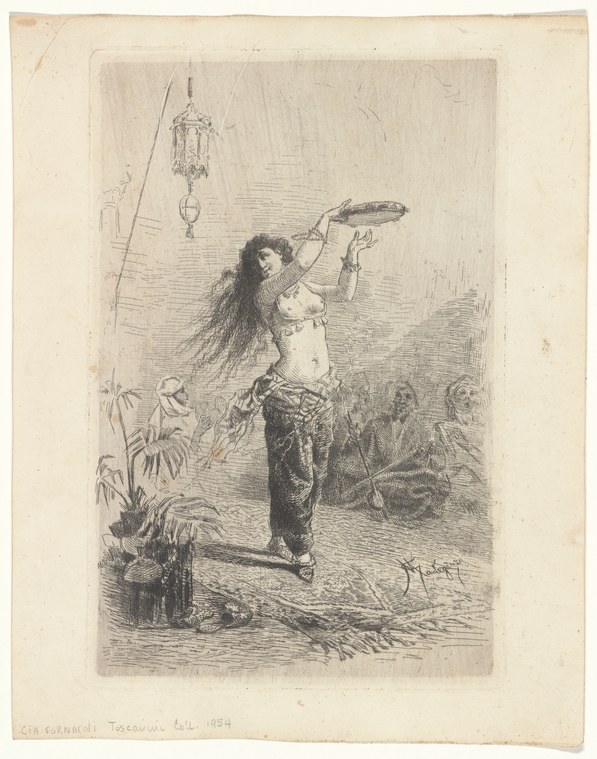
This work illustrates the historical entanglement of ballet technique with Orientalist spectacle in 19th-century popular theater—a context often overshadowed by the study of classical ballet alone. It shows how exotic dance was not an independent tradition but a hybrid form, performed by European-trained dancers in European theatrical settings, and how printmaking allowed Orientalist fantasy to circulate widely as visual culture.
What you are looking at
A semi-clad female dancer in elaborate Oriental costume dominates the composition, her body arched backward in a dramatic pose, one arm raised holding what appears to be a fan or decorative object. She wears patterned lower garments and jewelry; her long, dark hair flows loosely. The setting is indistinct but suggests an interior or theatrical space, with architectural elements barely sketched in the background. At left, potted plants with feathery foliage establish an exotic locale. In the background, shadowy figures of musicians or attendants are rendered in softer lines. The overall effect is theatrical and staged, with the dancer's body as the focal point of the composition.
The dancing
A single female figure occupies the visual center, her spine extended in a deep backward arch (cambre), supported on her legs with weight seemingly distributed through the lower body. Her raised arm extends upward with the hand holding or gesturing toward an object; the other arm is positioned lower, helping to frame the torso. The body position suggests considerable flexibility and control. No partner is present. The posture is balletic in its verticality and extension, though the extreme arch and the Oriental costume suggest a performance tradition outside European academic ballet.
The dance depicted
This appears to depict Orientalist fantasy dance as performed in late 19th-century European theatrical contexts—a genre that blended ballet vocabulary with imaginative (often inaccurate) representations of Middle Eastern or Asian dance and costume. The dramatic arch, extended arm, and balletic frame suggest the influence of European theatrical dance training, while the exotic costume and setting signal the work's engagement with Orientalism as a subject. The dancer's control and extension are consistent with ballet training, though the pose is unconventional within classical ballet propriety. The image captures the aesthetic moment favored by Orientalist artists: the exotic body in maximum display, combining European technical sophistication with fantasy dress.
How it was made
This is an etching or engraving on paper, worked in fine black lines with careful cross-hatching to create tonal variation and volume in the figure. The technique allows for intricate detail in the dancer's features, drapery, and jewelry while maintaining sharp definition. The background is left relatively open, with only the essentials of setting suggested through spare line work. The medium's capacity for precise reproduction made such prints ideal for circulation among collectors and as studies for painters; the work shows the printmaker's skill in capturing the human figure at a moment of extreme extension and precarious balance.
About this work
This is a 19th-century print depicting an exotic dancer in an Orientalist fantasy scenario—a figure type common in European art and theater of the period. The work combines the technical vocabulary of academic ballet (extension, line, balletic posture) with the visual language of Orientalism (costume, setting, narrative of display). It represents both a real theatrical tradition (Orientalist dance as it was actually performed on European stages) and an artistic fantasy (the imagined exoticized body as subject for visual consumption). The print is a document of Orientalist aesthetics in dance representation and of how European theatrical dance technique was adapted to exotic performance modes.
How to look at it
Notice the extreme backward arch of the dancer's spine and the balletic extension of her raised arm—this is a moment of maximum display, not a movement that would occur in most non-European dance traditions. Observe the contrast between the carefully rendered face, body, and jewelry and the loosely sketched background; the composition privileges the body as spectacle. The pose suggests precariousness and vulnerability; the artist has chosen to freeze a moment of exposure. The exotic costume and sparse setting tell you this is a European fantasy of the Orient, not documentation of actual Middle Eastern or Asian dance.
The artist
The artist is not recorded. The signature or inscription visible at lower left on the print has not been identified with certainty, making attribution impossible from the current information. The work is consistent with the style and subject matter of 19th-century European printmakers specializing in theatrical and exotic subjects, but without reliable documentation, individual identity cannot be confirmed.
The period
Orientalist representation flourished in European visual arts throughout the 19th century, driven by colonial expansion, travel narratives, and the aestheticization of the "exotic other." In theater and dance, Orientalist themes became increasingly popular from mid-century onward, reaching a peak in the 1880s–1890s. Dancers trained in European academic ballet were regularly cast in exotic roles, and the spectacle of the (usually nearly nude) female body in elaborate costume became a standard feature of music halls and theaters. Printmaking was a primary medium for distributing such imagery, making exotic dance spectacle available to audiences who could not attend live performances.
Where it lives
The work is held in the Prints collection of the New York Public Library. It is an original print from a holding described as "Orientalist images of dance in prints," indicating it is part of a broader collection of similar works, likely assembled to document the visual culture of Orientalism in performance.
Dance in this work
Questions about this work
Is this a real dance or an invented one?
This depicts a hybrid form. Orientalist dance was a real theatrical genre performed on European stages in the 19th century, but it was not a representation of actual Middle Eastern or Asian dance. European dancers trained in ballet performed in exotic costumes in invented scenarios. The artist has documented the balletic vocabulary while adding exotic costume, creating a fantasy image that was nonetheless based on live theatrical performances audiences could have seen.
Why is she drawn in such an extreme pose?
This pose displays the female body as the primary subject of the image—a common strategy in Orientalist art. The extreme arch and raised arm maximize the visibility of the torso and emphasize flexibility and control. This reflects the Orientalist aesthetic priority: the exotic body as spectacle for visual consumption, rather than a moment selected for its kinetic or narrative significance to the dance itself.
What does the costume tell us?
The patterned lower garment, jewelry, and bare torso are imaginative inventions, not accurate representations of any single cultural tradition. They signal "exotic" or "Oriental" to a 19th-century European viewer while maintaining enough theatrical glamour to appeal to audiences. The costume is theatrical fantasy, not ethnographic documentation.
Why was this printed and circulated?
Orientalist theater was hugely popular in 19th-century Europe, and prints allowed theaters, performers, and collectors to distribute images of celebrated dancers and exotic scenes. Prints were cheaper and more portable than paintings, making them an ideal medium for promoting theatrical spectacles and satisfying public appetite for exotic imagery.
More dance artwork





