49 works in this view — arrow keys or swipe to move between them.
Dance in Art
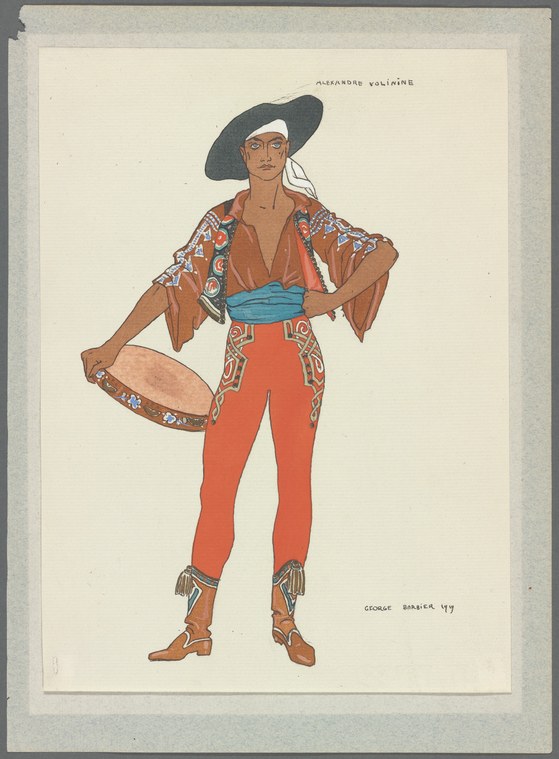
Costume design drawing for Alexandre Volinine as le Bohémien in Amarylla, Ballet de Glazounow
Unknown artist
- Collection:
- Prints depicting dance
- Source:
- New York Public Library
- Rights:
- Public domain — free to use, share and adapt.
- Recorded as:
- Public Domain
Volinine was a significant figure in early 20th-century ballet, and his roles and costumes are part of the documented legacy of the Imperial Ballet and its influence on modern theatrical dance. This design reveals the visual vocabulary of character ballet at a moment when European dance was absorbing and adapting non-European idioms, and shows how a single garment—the embroidered jacket—could anchor a whole dramatic identity. The work also illustrates the centrality of the costume design drawing to theatrical practice: this sketch is not a souvenir but a working document, and its clarity and specificity reflect the professionalism of the design process.
What you are looking at
A single male dancer stands in a composed three-quarter pose against a neutral cream ground. He wears a broad-brimmed black hat with a voluminous copper-brown jacket decorated with bold geometric and floral embroidery in blue, white, and coral; the jacket's sleeves are wide and gathered. Beneath this he wears a coral-red shirt or undershirt visible at the neck and wrists. His lower body is clad in bright red tights or leggings that extend to the ankle, paired with brown leather ankle boots fitted with decorative spurs or metal embellishments. He holds one arm akimbo with hand on hip, the other raised to display the patterned sleeve, his weight settled on one leg in a relaxed but dignified stance. The figure is rendered in a graphic, illustrative style with flat color areas and spare line work, characteristic of mid-20th-century theatrical costume design.
The dancing
The dancer is depicted as a solitary figure in a display pose—not captured mid-movement but rather presented in a composed portrait attitude that allows full view of the costume from multiple angles. His posture is upright and self-assured, with the raised arm and tilted hip drawing attention to the embroidered jacket. The stance suggests readiness and character rather than the technical positions of classical dance; the weight is easily distributed and the bearing is that of a performer presenting himself to an audience. There is no partnering, no dynamic momentum, no clear footwork detail beyond the boots.
The dance depicted
This is a costume design for Alexandre Volinine in the role of le Bohémien (the Bohemian) in the ballet *Amarylla*, with score by Glazunov. The design tells us that the ballet drew on Spanish and Latin American vernacular sources—the embroidered jacket, broad hat, red leggings, and spurred boots are the vocabulary of a romanticized bohemian or gaucho-influenced character. Volinine was a Russian imperial dancer active in the early 20th century, and this costume reflects the Ballets Russes era's appetite for exotic character roles and richly decorated Eastern European and Latin American imagery. The pose and presentation mode are typical of classical ballet's character dances (*danse d'action*), where the dancer embodies a named role rather than executing a codified vocabulary.
How it was made
This is a watercolor or gouache costume design on paper, rendered in a flat, graphic style typical of theatrical design practice in the early-to-mid 20th century. The artist has used strong outlines, controlled washes of color, and decorative patterning to convey both the structural form of the garment and its visual impact on stage. The technique allows for rapid communication of color, silhouette, and ornament to the costume maker and the company; the spare use of line and the absence of shading suggest a design meant to be read at a distance and executed accurately by craftspeople rather than a work of fine art. The style is consistent with Russian and European ballet design practice of the 1920s–1940s.
About this work
This is a costume design drawing for a named character role in an early 20th-century ballet. The work documents both the visual taste of the Ballets Russes era—its eclecticism, its appetite for exoticism, its investment in the designed object as integral to meaning—and the practical work of theatrical design, where the drawing is a bridge between choreographer's vision and costume maker's execution. The figure of Volinine in the role of the Bohemian survives in this image and in the archive of design, while the ballet itself has largely faded from the repertory. For historians and dancers, the drawing is evidence of how character and place were signaled through dress, and how a Russian imperial dancer might embody a Latin American or Southern European persona through costume and pose.
How to look at it
Pay attention to how much information the costume conveys in a single image: the broad hat and red tights identify a character type instantly, while the embroidered jacket carries both richness and specificity. Notice how the pose—upright, composed, one arm raised—is a display rather than a dance step; this is how a costume designer shows a garment to best advantage. The decoration of the jacket, especially the patterning on the sleeves and bodice, demonstrates the designer's attention to how color and ornament read from a distance and move with the dancer's body. This is a drawing made to be understood by makers, performers, and directors—clarity and completeness are its virtues.
The artist
The artist is not recorded. The signature "George Barbier" visible in the lower right corner suggests this may be the work of the French illustrator and costume designer George Barbier (1882–1932), a prolific designer for theater and ballet who was closely associated with the Ballets Russes and the theatrical world of Paris in the 1920s and 1930s. Barbier's characteristic style—fluid lines, strong color, graphic clarity, and an eye for fashion and ornament—matches this drawing. However, without a confirmed attribution in the record, this remains a strong possibility rather than a certainty.
The period
This design belongs to the golden age of Russian ballet in Western Europe, the period of the Ballets Russes and its influence on theatrical design across Europe. Glazunov was a leading Russian composer, and ballets with his scores were central to the company's repertory in the 1920s and 1930s. Character roles and national dances were a staple of ballet plotting in this era; the bohemian and the gaucho were stock figures of exoticism and romance. The design's ornamental vocabulary—bold geometric patterning, rich color, folk-inspired embroidery—reflects the period's fascination with folk art and non-Western visual traditions, filtered through a European lens. This was also the era in which costume design emerged as a distinct and honored profession in theater, with specialist designers like Léon Bakst, Alexandre Benois, and Natalia Goncharova achieving prominence.
Where it lives
The work is held in the New York Public Library's Prints collection, part of a larger archive of theater and dance design materials. It is catalogued as a costume design drawing but lacks complete provenance data in the current record.
Dance in this work
Questions about this work
Who was Alexandre Volinine?
Volinine (1882–1956) was a Russian imperial dancer trained at the Mariinsky Theatre who became known for his partnerships and his classical technique. He danced with the Ballets Russes and in Paris, and was also a choreographer and teacher. He was among the most celebrated male dancers of the early 20th century, and roles like the Bohemian in *Amarylla* were part of his repertory of character and demi-caractère parts.
What is a character dance in ballet?
A character dance is a stylized portrayal of a named role or type—a peasant, a sailor, a gypsy, a national type—as opposed to the abstract or classical vocabulary of pure ballet. Character dances are performed in soft or heeled shoes, use turned-out positions but often with the upper body more free, and tell a story or express a persona. They were a standard element of 19th and early 20th century ballet plots.
What can we learn about ballet from costume designs?
Costume designs show us how dancers were meant to be seen—what silhouette the choreographer and designer valued, what colors and ornaments mattered, and how a garment moves with a body in motion. They also document the practical work of making ballet: the designs are instructions to costume makers, evidence of collaboration, and a record of what was actually worn on stage. A design archive can tell us about a company's aesthetic, its resources, and its engagement with other cultures.
Is this drawing by George Barbier?
The signature on the drawing appears to read 'George Barbier,' and the style is consistent with his known work as a theater and ballet designer. However, the current catalogue record does not confirm the attribution. If you have information about the provenance of this drawing, the holding institution would welcome it.
More dance artwork





