49 works in this view — arrow keys or swipe to move between them.
Dance in Art
Orientalist images of dance in prints
Unknown artist
- Collection:
- Prints depicting dance
- Source:
- New York Public Library
- Rights:
- Public domain — free to use, share and adapt.
- Recorded as:
- Public Domain
This image documents the aesthetic ideal of the Romantic ballet dancer—weightless, ethereal, and characterized by upward reach and fluid drapery—at a moment when that ideal was being crystallized into the canonical works still performed today. For historians of ballet, it provides visual evidence of how dancers moved, how their costumes functioned, and how the body was conceptualized and celebrated on stage during one of ballet's most transformative periods. For artists and dancers, it demonstrates how the trained body and flowing fabric together created the illusion of supernatural grace that defined the era.
What you are looking at
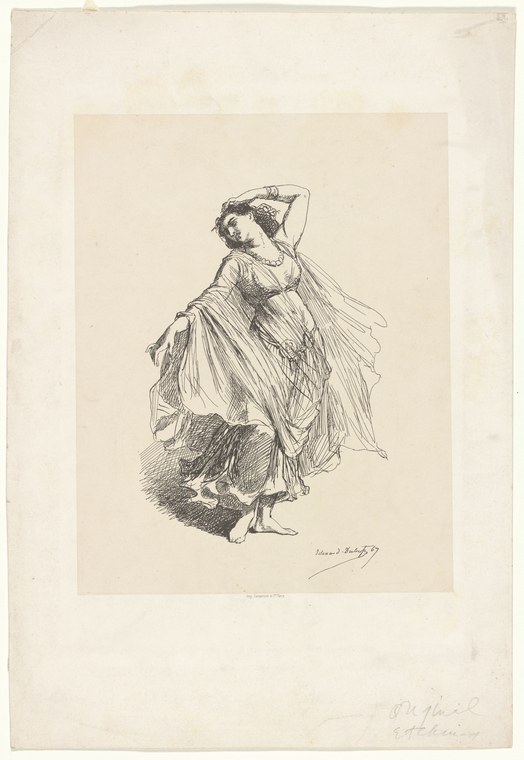
A single female figure dominates this sheet, captured in a moment of dynamic movement. She stands in three-quarter view, her body twisting with one arm raised to her head and the other extended outward. Her dress is neoclassical in cut—a high-waisted, loosely draped garment of the early 19th century—and the fabric clings to and billows around her form in a way that suggests rapid motion. The drapery is rendered with particular attention to its flow: heavy folds fall from her hips while lighter material swirls around her legs and feet, which are bare. The artist has used strong diagonal hatching to model the fabric and create shadow, giving the figure sculptural weight and volume. The composition is a study, isolated against a plain cream ground, with no architectural setting or other dancers present to contextualize the movement.
The dancing
The dancer's weight appears shifted onto her back leg, with her torso leaning backward in a counterbalance as her raised arm pulls upward and outward. Her head is tipped back, following the line of her raised arm. The opposite arm extends in a sweeping gesture at approximately shoulder height. The stance suggests a moment of spiraling or turning motion, with the body's torsion creating dynamic tension. Her bare feet and the freedom of the loose drapery suggest a romanticized or mythological treatment of the body rather than technically trained balletic technique in the modern sense, though the controlled grace of the pose speaks to trained movement.
The dance depicted
This appears to be a study for or documentation of Romantic ballet as performed in the early-to-mid 19th century, likely 1830s–1840s based on the neoclassical costume and the romantic treatment of the figure. The barefoot execution, the ethereal drapery, and the upward reach of the body are hallmarks of Romantic ballet aesthetics. The figure may represent a nymph, spirit, or sylph—the supernatural or allegorical characters that dominated the Romantic ballet repertory. While the image does not show pointe work explicitly (the feet are rendered simply), the overall vocabulary—the elongation, the upward reach, the flowing grace—aligns squarely with Romantic ballet as it was being developed and celebrated across Europe in this period. The artist has chosen to capture a moment of elevation and weightlessness rather than technical display.
How it was made
This is a pencil or ink drawing rendered with careful hatching to create tonal depth and shadow, likely produced as a preparatory study or standalone print. The technique suggests professional training in academic life drawing. The image appears to be from a print collection rather than an original drawing on paper, suggesting it was part of a series or ensemble documenting the dancers, roles, or repertory of a particular troupe or period. The restraint of the line work and the focus on drapery and movement over facial detail is consistent with 19th-century dance documentation practices, where the emphasis fell on the body and costume rather than individual portraiture.
About this work
This is a neoclassical study of a female dancer in motion, likely from the Romantic ballet era of the 1830s–1840s. The figure is rendered with sensitivity to the flow of loose, high-waisted drapery and the dynamics of a spiraling or ascending movement. The work sits at the intersection of academic life drawing and dance documentation—it is both a figure study and a record of theatrical performance. As a print from the New York Public Library's dance holdings, it represents the visual culture through which Romantic ballet was circulated, discussed, and preserved in the 19th century. The absence of stage setting and other performers emphasizes the dancer's body as the subject of study.
How to look at it
Attend to the moment the artist has frozen: not a moment of contact with the ground or a clear step, but a moment of suspension and spiral—the body at its most weightless and ethereal. Notice how the drapery is rendered more heavily and precisely than the body itself; this prioritizes the costume as both sculptural form and a vehicle for suggesting movement. The upturned face and raised arm draw the eye upward, embodying the Romantic vocabulary of aspiration and transcendence. The bare feet and simple treatment of the legs suggest that the artist was less interested in technical footwork than in the overall silhouette and the sense of spiritual elevation.
The artist
The artist is not recorded in the catalogue. However, the professional execution and the format—a print in a dedicated dance collection—suggest this was produced by or under the direction of a print publisher specializing in theatrical documentation, or by an artist attached to a specific ballet company or theater. The technique and style are consistent with French or Italian printmaking of the 1830s–1850s, when such dance documentation was a thriving commercial and artistic practice.
The period
This drawing was created during the height of the Romantic era in ballet, when the ethereal sylph—neither fully human nor entirely supernatural—became the dominant archetype on European stages. Works like *La Sylphide* (Paris, 1832) and *Giselle* (Paris, 1841) had established a new vocabulary of movement and costume that privileged weightlessness, mystery, and the illusion of flight over the technical virtuosity that characterized classical ballet. In the visual arts, Romantic printmakers and illustrators were intensely engaged in documenting and promoting these new ideals, both to circulate images of celebrated dancers and to serve as reference material for artists, choreographers, and set designers. The proliferation of such prints was enabled by advances in lithography and other reproductive techniques, which made theatrical imagery widely accessible for the first time.
Where it lives
This print is held in the New York Public Library's collection of prints depicting dance. It is catalogued only as an orientalist image of dance, though the style and period suggest it is more precisely a Romantic ballet study. Its presence in a dance-specific print collection indicates it was valued as a document of theatrical practice and aesthetic ideals.
Dance in this work
Questions about this work
Is this a portrait of a real dancer?
It may be, but the catalogue record does not identify the subject. The focus on pose and costume rather than facial features suggests the work is more interested in documenting an ideal type—the Romantic sylph or spirit—than in immortalizing an individual performer. Such prints were often issued as generic images of signature roles rather than as likenesses of particular dancers.
What does barefoot dancing mean in this period?
Barefoot or slipper-clad feet were a hallmark of Romantic ballet aesthetic, suggesting naturalness, grace, and a connection to nature and the supernatural. Dancers performed on hard floors and later on the early forms of the block pointe shoe, but in artistic representation, bare feet conveyed ethereality and freedom from constraint. The absence of elaborate heeled footwear emphasized the body's lightness.
Why is there so much emphasis on the drapery?
In Romantic ballet, costume and body were inseparable elements of the theatrical image. The flowing, high-waisted muslin dress—inspired by classical Greek and Roman art—served both to conceal and reveal the dancer's movement. Its volume and weight created visual interest independent of the body within, and when rendered in motion, the fabric itself became a demonstration of the dancer's ability to create momentum and grace.
More dance artwork





