49 works in this view — arrow keys or swipe to move between them.
Dance in Art
Jeune dame répétant une danse
Unknown artist
- Collection:
- Prints depicting dance
- Source:
- New York Public Library
- Rights:
- Public domain — free to use, share and adapt.
- Recorded as:
- Public Domain
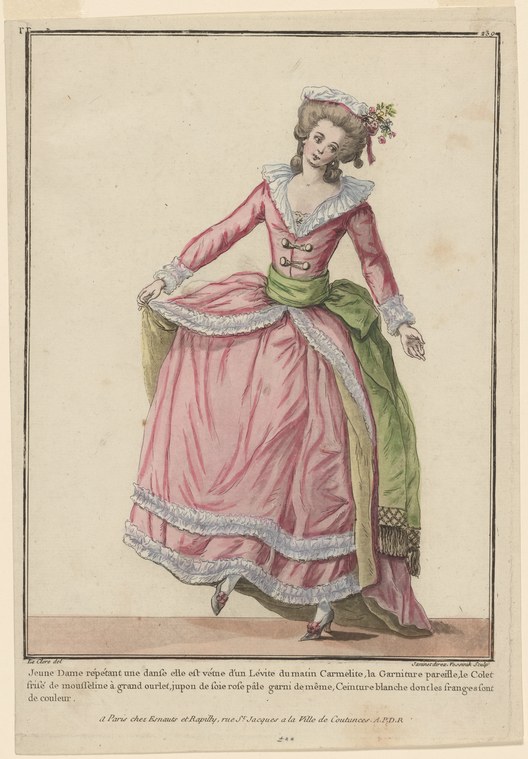
This image is evidence of how late 18th-century European dance training and performance were recorded and transmitted through prints. It shows a solitary moment of rehearsal or composition, preserving not a full choreography but a single pose that encodes a whole system of deportment and training. For anyone studying the history of female dancers, the aesthetics of the body in the 1780s, or the intersection of fashion and theatrical practice, this is a primary source.
What you are looking at
A young woman in an elegant 1780s gown stands alone in a three-quarter pose against a plain ground, as if pausing mid-rehearsal. She wears a rose-pink silk dress with a fitted bodice trimmed in darker rose and white lace, the skirt gathered and full, falling to mid-calf over what appear to be heeled slippers. Over her shoulders drapes a long green silk shawl or scarf, which she grasps in her left hand. Her hair is styled high with ringlets and adorned with flowers or ornaments. Her right arm is extended gracefully away from her body at about shoulder height, palm open and fingers delicately arranged. Her posture is upright, her weight appears to shift onto one leg, and her gaze is directed outward with an expression of concentration. The engraving employs clear outlines and hand-applied colour, showing the fine detail of lace, the sheen of silk, and the precise rendering of her refined dress.
The dancing
A single female dancer is depicted in a moment of stillness that suggests motion interrupted or sustained. Her arm carriage is open and expansive, raised to roughly shoulder height with the elbow gently flexed and the hand held in a refined, open position—characteristic of courtly or theatrical dance of the period. Her stance suggests weight on one supporting leg with the other foot lightly placed, a posture common in baroque and early classical dance. The extension and carriage of her limbs show ease and training, with no tension visible in the shoulders or neck.
The dance depicted
This is a rehearsal study (répétant une danse) of a solo or solo passage in the style of courtly or theatrical dance of the 1780s–1790s. The pose, dress, and refined gesturing are consistent with the minuet, contredanse, or early neoclassical dance of the era. The setting emphasizes practice and composition: the dancer is alone, concentrating, in a moment of held poise rather than in full motion. The shawl or scarf, while decorative, may also reference the hand-held props (ribbons, scarves) that were part of some dances of the period. Without an inscription identifying the specific dance, we cannot be certain whether this depicts a known choreography or a generic rehearsal study.
How it was made
This is a hand-coloured engraving or etching, executed with fine lines and burin work typical of late 18th-century French fashion and theatrical prints. The clean outline, the precision of the pose, and the delicate hand-colouring (particularly visible in the gradation of the pink silk and the green shawl) indicate a high-quality production intended for a educated audience. The technique allowed for wide circulation of theatrical and dance imagery, making this likely a commercial print produced for viewers with an interest in dance, fashion, or theatrical performance.
About this work
This is a rehearsal study of a solo woman dancer in refined dress, captured in a moment of held grace that reveals the arm carriage and posture of late 18th-century courtly dance. The precise attention to costume and gesture suggests this was drawn from life or from close knowledge of theatrical practice. The print belongs to a substantial tradition of French dance prints—especially from Paris—that documented fashionable and theatrical movement for a literate audience. It records not just a style of dress but a specific vocabulary of the body: the open arm, the lifted chest, the easy weight, the refined hand position that marked a trained dancer of breeding or accomplishment.
The work survives in the New York Public Library's collection of dance-related prints and engravings, a holding that documents how dance was visualized and circulated in print culture. Such images served multiple purposes—as records of performances, as aids to learning, as fashion illustration, and as testimony to the cultural value of courtly accomplishment.
How to look at it
Attend first to the arm: the extended right arm with its open palm and graceful curvature is the signature gesture of the pose, and it reveals the training and aesthetic of the period—no tension, no stiffness, a sense of ease and extension. Notice the weight and balance: the dancer appears to rest on one leg, with the other lightly placed, creating a subtle asymmetry that suggests either a moment of turning or of suspension. The shawl in her left hand is held with deliberate care, neither dropped nor strained, suggesting it is part of the choreography. Finally, observe the stillness of the face and the directed gaze: this is not a moment of exertion or spectacle, but of rehearsal and concentration—the artist has chosen to capture not performance but work.
The period
This print dates to the late 1780s or early 1790s, a transitional moment in European dance. The minuet and contredanse were still central to courtly and theatrical practice, but the early romantic ballet was emerging. The dress and aesthetic are fully neoclassical—the high waist, the simple silk, the delicate flowers in the hair—reflecting the broader artistic turn toward antique simplicity. French dance prints of this era were among the most sophisticated in Europe, and Paris was the centre of dance innovation and documentation. The emphasis on a single female dancer in refined concentration reflects both the growing visibility of women as soloists and the increasing interest in capturing the internal moment of artistic focus.
Where it lives
The print is held in the New York Public Library's collection of prints depicting dance (Prints depicting dance, NYPL). It is one of many such French theatrical and dance prints from the late 18th century that circulated in Europe and America and are now dispersed in major institutional collections. The collection status suggests it was valued as a document of dance history and practice.
Dance in this work
Questions about this work
What is she wearing, and what does the dress tell us?
She wears a high-waisted silk gown with fitted bodice and full skirt, in fashionable pink with white lace trim, and a long green silk shawl draped over her shoulders. The dress is neoclassical in cut (1780s–1790s) and refined, indicating she is a dancer of respectable social standing, either a professional performer or an accomplished amateur of the aristocracy. The shawl may be a prop integral to the choreography or simply an elegant accessory of the period.
Is she performing or rehearsing?
The title itself—'Jeune dame répétant une danse'—tells us she is rehearsing or practicing ('répétant'). The solitary setting, the concentrated gaze, and the moment of stillness all suggest a moment of study rather than performance. This may be a study for the artist's own reference, or a print intended to teach or record a specific movement or position.
What dance is this?
The catalogue record does not name a specific dance, and the pose alone does not identify one uniquely. The arm carriage and posture are consistent with the minuet, contredanse, or early neoclassical theatrical dance of the late 1780s. Without an inscription or further documentation, we cannot say with certainty what choreography is being rehearsed.
Who was the artist?
The artist is not identified in the catalogue record. The print itself may bear a signature or inscription (visible in the lower margin of the image), but without access to the original or a detailed examination, we cannot attribute it. The style and quality suggest a professional Parisian workshop, likely commercial theatre print production.
More dance artwork





