49 works in this view — arrow keys or swipe to move between them.
Dance in Art
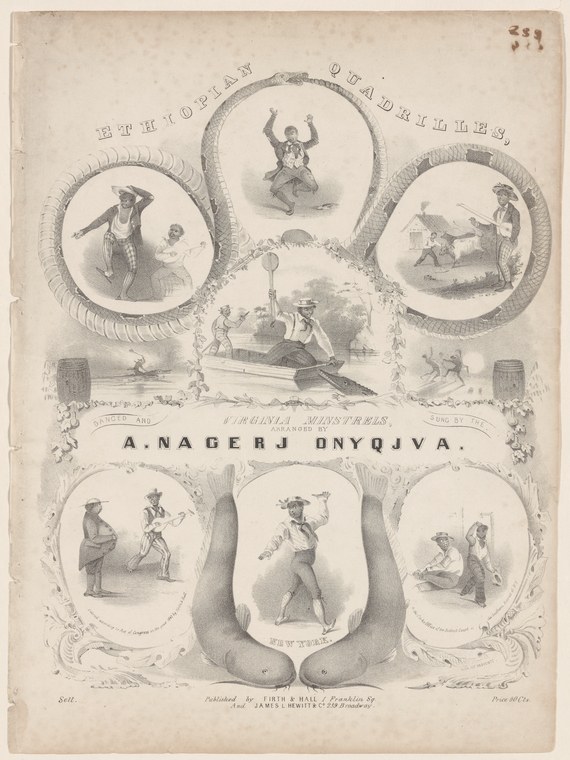
Ethiopian quadrilles,: danced and sung by the Virginia minstrels, arranged by A. Nagerj Onyqjva
Unknown artist
- Collection:
- Prints depicting dance
- Source:
- New York Public Library
- Rights:
- Public domain — free to use, share and adapt.
- Recorded as:
- Public Domain
The Virginia Minstrels were among the most widely circulated and imitated performers of the mid-19th century, and this print is rare documentary evidence of how their movement vocabulary was understood and marketed. It shows the direct lineage between vernacular African American dance traditions (leaps, flexibility, rhythmic partnering) and commercial theatrical performance, a genealogy that minstrelsy attempted to claim, obscure, and profit from. For dancers and historians, it is essential evidence of what was actually performed on the minstrel stage and how that performance was sold to audiences.
What you are looking at
A densely composed engraving organized around a large serpent or eel form that frames eight circular vignettes of dancers. At the top center, a single figure leaps with arms raised in exuberant elevation. To the left and right, pairs of figures perform in various attitudes—one couple shows a woman being lifted or supported by a man; another shows figures in dynamic interaction. The lower register contains three more circular scenes with standing, gesturing, and partnered figures. At the base sits a central oval cartouche containing reversed text reading "A. NAGERJ ONYQJVA," flanked by decorative scrollwork. The entire composition is framed with botanical vine ornament in the corners. The print is hand-drawn in fine stippled and linear engraving technique, rendered in black ink on aged cream paper, with the characteristic tonal modeling of early-19th-century reproductive engraving.
The dancing
The dancers are rendered in a lively, gestural style with high contrasts of elevation and repose. Several figures show acrobatic or contortionist elements—particularly the central leaping figure with arms overhead, and the lifted or supported pairs suggesting weight transfer and partnering. The dress is period (early 19th century) but the bodies are exaggerated in their flexibility and extension; some figures appear to bend or twist in ways that suggest trained performers rather than ballroom dancers in conventional hold. Footwork is not resolved in detail, but the overall articulation of limbs and torsos emphasizes virtuosity and display.
The dance depicted
The title references "Ethiopian quadrilles" danced and sung by the Virginia Minstrels, a renowned 19th-century blackface minstrel troupe. This print appears to document or celebrate their performance style, which blended social dance forms (quadrilles) with acrobatic performance, comedy, and theatrical display. The variety of poses suggests not a single quadrille figure but a medley or suite of minstrel performance moments—leaps, contortions, partnered lifts, and poses that would have been characteristic of the minstrel stage. The serpent framing device may evoke both the flexibility required and the theatrical exoticism marketed to audiences. The reversed inscription suggests this was a reversed printing block or that the title itself became obscured or distorted in the production process.
How it was made
This is a wood or steel engraving rendered in the stippled and line-work manner characteristic of commercial theatrical prints of the 1840s–1860s. The fine detail and tonal gradation indicate skilled reproductive engraving, likely created for mass circulation as a broadside or theatrical souvenir. The technique allowed wide distribution to audiences and created a permanent record of the performers' staged personas. The aged, foxed paper and worn impression suggest this is an early impression from the original plate, making it a primary document of minstrel performance iconography.
About this work
This is a theatrical broadside engraving documenting the "Ethiopian Quadrilles" performed by the Virginia Minstrels, a celebrated blackface minstrel ensemble of the mid-19th century. The print captures not the formal structure of the ballroom quadrille but the acrobatic, extemporaneous performance style that minstrelsy drew from and merged with African American vernacular dance traditions. The eight framing vignettes show a repertoire of movement—leaps, contortions, partnered lifts, and gestural display—that would have been instantly recognizable to audiences who attended minstrel shows. The serpentine frame and decorative ornament elevate this as a spectacular object, not merely a record but a work designed to excite and entertain the viewer even in print form.
This work is vital to understanding the complex and troubling history of 19th-century American performance. The Virginia Minstrels were internationally famous and their style influenced theatrical dance and popular performance worldwide. Yet their popularity and technical skill were inseparable from blackface caricature and racial appropriation. Studying such prints requires holding both the genuine athleticism and artistry of the performers and the racist framework within which they and their audiences operated. The print is a historical artifact of performance, popularity, and ideology.
How to look at it
Examine the variety of poses within each vignette: the centrality of the leap with arms overhead is striking and unusual for ballroom dance, suggesting acrobatic or athletic prowess was being foregrounded. Notice the partnering poses—how figures support, lift, or gesture toward one another—which suggest a different kind of intimacy and physical contact than formal ballroom quadrille would allow. The serpent frame is unusual; consider what it might convey about the performers' bodies (flexibility, exotic difference, animalistic othering in racist terms) and what the ornamental frame implies about theatrical spectacle. The reversed or corrupted inscription at the bottom is another puzzle: it may hint at the ways these performers and their names were appropriated, distorted, or commercialized.
The artist
The artist is not recorded in the catalogue. The reversal of the inscription—"A. NAGERJ ONYQJVA"—may represent either a printing or transcription error, or deliberate obscuring or garbling of a name. The engraver's identity thus remains uncertain, though the quality of the work suggests a professional theatrical print workshop. The style is consistent with commercial theatrical broadside production in London or New York in the 1840s–1860s.
The period
The Virginia Minstrels were founded in 1843 and became the most successful and influential minstrel ensemble of the era. The quadrille was the dominant fashionable ballroom dance across Europe and America in the 1840s–1860s, and minstrelsy's "Ethiopian Quadrilles" represented both a parody and a genuine reworking of ballroom form through vernacular performance traditions. This print dates to the height of minstrelsy's international popularity, when such ensembles toured extensively and their performances were reproduced in prints, sheet music, and theatrical ephemera. Simultaneously, this was the period in which ballroom dance was becoming increasingly codified and formalized through dance manuals and instruction.
Where it lives
The work is held by the New York Public Library in its collection of prints depicting dance. It is a broadside or theatrical souvenir print, likely produced and distributed in the 1840s–1860s during the peak of the Virginia Minstrels' popularity. Such prints were sold at performances, in music shops, and as theatrical ephemera.
Dance in this work
Questions about this work
Who were the Virginia Minstrels?
Founded in 1843, the Virginia Minstrels were a blackface minstrel ensemble that became one of the most famous and influential performance groups of the mid-19th century. They performed a combination of comedy, song, and dance, drawing heavily on and distorting African American performance traditions. They toured internationally and inspired countless imitators.
What is a quadrille?
A quadrille is a formalized ballroom dance for four couples in a square formation, structured in five figures and popular across Europe and America from the early 19th century onward. Minstrelsy's "Ethiopian Quadrilles" took the name of this ballroom form but performed it through extemporaneous, acrobatic, and vernacular movement, not the formal patterns of ballroom dancing.
What does the serpent framing mean?
The serpent is unusual and multivalent: it may represent flexibility and athletic prowess, theatrical spectacle and danger, or evoke exoticized difference. In the context of racist minstrelsy, it may also carry implications of othering or animalization. Its meaning would have been legible to contemporary audiences but is now ambiguous to us.
Is this a historical document of actual performance?
Yes and no. The print captures the kinds of movements and poses that were performed on the minstrel stage and marketed to audiences, making it evidence of what was valued and displayed. However, as a theatrical print, it is also a stylized, selective, and commodified representation, not a neutral record of movement.
More dance artwork





