49 works in this view — arrow keys or swipe to move between them.
Dance in Art
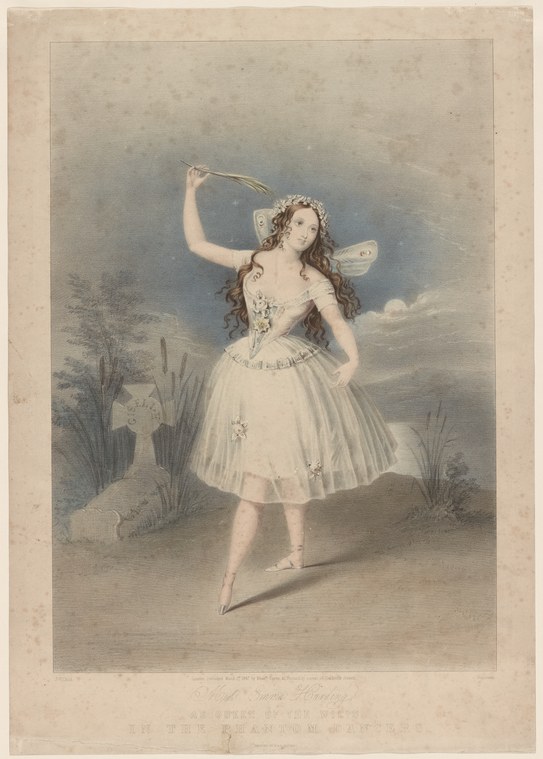
Miss Emma Harding as Queen of the Wilis, in the Phantom dancers
Unknown artist
- Collection:
- Prints depicting dance
- Source:
- New York Public Library
- Rights:
- Public domain — free to use, share and adapt.
- Recorded as:
- Public Domain
This image is a primary document of Romantic ballet aesthetics and performance practice. It shows us how the Wilis were visualized and performed in the 1840s–1860s, what the pointe technique looked like in practice, and how theatrical portraiture was used to immortalize celebrated dancers in their signature roles. For historians of dance, it is evidence of the technical and artistic achievement of a named dancer, Emma Harding, whose performances would otherwise be known only through playbills and reviews.
What you are looking at
A young woman in classical ballet costume stands alone in a moonlit woodland setting, captured mid-movement in a pose of ethereal suspension. She wears a fitted bodice with decorative embellishment and a full skirt of gossamer-like layers, poised en relevé on the points of her feet. Her long hair flows loosely down her back, and she wears a small crown or tiara. Her right arm is raised in a graceful curve, the left extended, and her gaze is directed upward in an attitude suggesting reverie or spiritual transcendence. The background is atmospheric and hazy, with hints of trees or foliage and luminous clouds suggestive of moonlight; the stage floor beneath her feet is rendered in soft perspective. The overall tonality is cool and silvery, achieved through a restrained palette of grays, blues, and cream tones that emphasize the otherworldly character of the scene.
The dancing
The dancer's body is composed in a pose of classical elegance—weight carried on one leg en pointe, the other leg extended or held in fifth position, creating a vertical line from her core through her crown. Both arms are raised in a soft, rounded frame characteristic of Romantic-era ballet vocabulary: the raised arm follows the line of her head, the other extends at shoulder height with a gentle curve. Her torso is upright and elongated, her neck extended, creating the impression of weightlessness. The pose suggests a moment of balance or suspension between movements, possibly a preparation or held attitude. There is only one figure, isolating her in space and emphasizing the solitary, dreamlike quality of the moment.
The dance depicted
This is a Romantic ballet scene, almost certainly a representation of the famous *Giselle* or one of the *Wilis*—the spectral female spirits of the ballet *Giselle* (Adolphe Adam, choreography attributed to Jules Perrot and Jean Coralli, 1841). The catalogue identifies her as "Miss Emma Harding as Queen of the Wilis, in the Phantom dancers," which confirms this is a dramatic moment from the second act, in which the Wilis—jilted brides who died before their wedding day—haunt a forest at night. The ethereal costume, the moonlit setting, the pointe work, and the upraised arms in an attitude of supernatural grace are all signatures of the Romantic ballet aesthetic and the Wilis narrative. The pose captures the otherworldly hovering quality that became iconic for these roles—a body that seems to defy gravity, suspended between the earthly and the spectral.
How it was made
This is a hand-colored lithograph, a reproductive print technique well-suited to capturing the soft atmospheric effects and silvery tonality essential to Romantic ballet imagery. The artist has used selective color—most of the composition rendered in muted grays and blues, with the figure's bodice and face receiving warmer, flesh-toned hues—to concentrate the viewer's attention on the dancer while maintaining the dreamy, nocturnal mood. Lithography allowed for relatively rapid and inexpensive production of theatrical prints, making such images accessible to a broad audience of theater-goers and ballet enthusiasts. The technique's capacity for tonal subtlety is evident in the soft gradations of the sky and the luminous quality of the moonlit setting.
About this work
This is a portrait of a principal dancer in one of the defining roles of 19th-century ballet, frozen in a moment of supernatural grace. Emma Harding is shown as the Queen of the Wilis, the ghostly antagonists of *Giselle*, in a pose that embodies the Romantic ballet ideal: weightless, ethereal, poised between the human and the otherworldly. The print captures both the technical feat of Romantic pointe work and the dramatic imagination of the era—a moment when ballet seized on supernatural narratives and female dancers became the vehicles for exploring themes of loss, longing, and the boundaries between life and death. As a theatrical portrait, it documents not only a famous performer and role but also the visual and kinetic language through which mid-19th-century audiences understood ballet as an art form.
How to look at it
Attend to the dancer's pointe work and the pose—notice how the artist has rendered the foot en relevé, creating a visual foundation for the impression of supernatural suspension. The upraised gaze and the soft, rounded arm positions are deliberate choices that convey spiritual transcendence rather than human strength. The moonlit atmospheric setting—achieved through the restrained use of color and the soft, hazy treatment of the background—is essential to meaning; without it, the pose might read as simply elegant, but with it, it becomes enchanted. The choice of a solitary figure, isolated in space, emphasizes the alien and otherworldly nature of the Wilis and the Romantic ballet's preoccupation with loneliness and loss.
The period
This print dates to the height of the Romantic ballet era, when European audiences were captivated by narratives of the supernatural and tragic love. *Giselle*, first performed in Paris in 1841, became the quintessential Romantic ballet and established the Wilis as one of the most iconic ensembles in dance history. The print documents a moment when ballet was experiencing rapid technical development—pointe work was becoming more central and refined, and dancers were expected to master feats of apparent weightlessness and grace. Theatrical portraiture in lithographic form was a major industry in the 1840s–1860s, with prints of celebrated dancers circulating widely and serving as souvenirs, publicity, and records of performance style. This particular image likely dates from the height of *Giselle*'s early popularity, when Emma Harding was dancing the role.
Where it lives
This print is held in the New York Public Library's collection of prints depicting dance. It is one of thousands of theatrical portraits produced in the mid-19th century to commemorate celebrated performances and performers.
Dance in this work
Questions about this work
Who was Emma Harding?
Emma Harding was a principal dancer of the mid-19th century, celebrated for her performances in Romantic ballets. This print documents her in one of the most prestigious roles of her era—the Queen of the Wilis in *Giselle*. Beyond what theatrical records and images such as this one tell us, biographical details are limited, as was common for dancers of the period.
What are the Wilis?
The Wilis are the ghostly protagonists of the second act of *Giselle*. They are the spirits of young women who died before their wedding day, condemned to dance through the night and lure men to their deaths. The Queen of the Wilis is their leader and antagonist to the ballet's heroine. They became one of the most iconic ensembles in Romantic ballet, representing the era's fascination with the supernatural and the tragic.
How was this print made?
This is a hand-colored lithograph, a technique in which an image is drawn on a stone or metal plate using a greasy medium, then printed and colored by hand or in stages. The process allowed for soft tonal effects and subtle color gradations, making it ideal for capturing the atmospheric, moonlit quality that is central to the image's meaning. Lithography was the dominant medium for theatrical portraiture in the 19th century.
What does pointe work have to do with the supernatural?
In Romantic ballet, pointe work became associated with the otherworldly and the ethereal. The illusion of weightlessness created by dancing en relevé—balanced on the very tips of the toes—made dancers appear to hover or float, perfectly suited to depicting supernatural beings like the Wilis. The technique was relatively new and still developing in the 1840s, and it quickly became a visual marker of Romantic ballet's preoccupation with transcendence and the uncanny.
More dance artwork





