49 works in this view — arrow keys or swipe to move between them.
Dance in Art
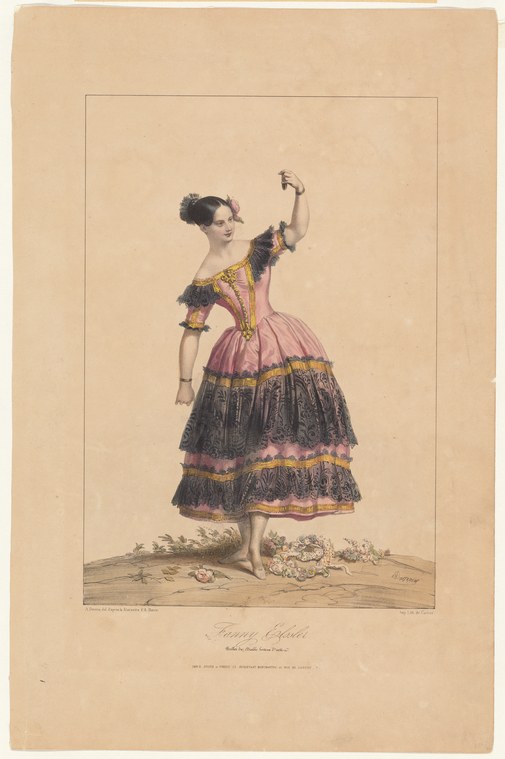
Fanny Elssler, ballet du Diable boiteux
Unknown artist
- Collection:
- Prints depicting dance
- Source:
- New York Public Library
- Rights:
- Public domain — free to use, share and adapt.
- Recorded as:
- Public Domain
Fanny Elssler was one of the two supreme ballerinas of the Romantic era (the other being Marie Taglioni), and her interpretation of Romantic roles defined the period for international audiences. This image preserves her likeness, costume, and the physical language of Romantic ballet at a moment when that aesthetic was at its height and beginning to spread globally. For historians of dance and visual culture, the hand-colored engraving is a crucial artifact: it shows us what Romantic ballet looked like, how it was marketed, and how dancers of genius were memorialized in the pre-photographic era.
What you are looking at
A young woman in theatrical dress stands alone against a plain background, captured in a moment of expressive gesture. She wears a Romantic-era costume: a fitted bodice in rose-pink silk with black lace trim and puffed sleeves, and a voluminous skirt composed of three tiers—the upper layer rose-pink, the middle and lower tiers black lace with gold ribbon borders. Her dark hair is styled up and back. Her right arm is raised expressively overhead with the hand curved; her left arm extends to the side at shoulder height, palm up. She stands on the ball of her right foot, with her left leg extended or lightly touching the ground, suggesting the lifted, weightless quality of Romantic ballet. The setting is minimal: a line suggesting terrain at her feet, with a few delicate flowering plants or grasses rendered in soft pencil, lending an outdoor, pastoral quality despite the plain background. The entire composition is contained within a ruled rectangular frame on aged, cream-colored paper.
The dancing
A single female dancer captured in a pose of controlled expression and lyrical arm movement. Both arms are held at or above shoulder height in an open, welcoming frame—the raised arm curved gracefully, the other extended horizontally with an open hand. Her torso is upright and engaged. Her stance on the ball of the foot, with apparent lightness and lift through the supporting leg, demonstrates the technique of Romantic-era ballet. The pose reads as momentary and expressive rather than grounded, consistent with the ethereal, otherworldly aesthetic of mid-19th-century theatrical ballet.
The dance depicted
This is a Romantic ballet dancer, almost certainly performing in or associated with *Le Diable boiteux* (The Lame Devil), a popular ballet-pantomime of the 1830s–1840s. The dancer is named in the inscription as Fanny Elssler, one of the great ballerinas of the Romantic era and a celebrated exponent of both classical technique and character dances. The costume—the pink silk bodice and tiered black lace skirt—is consistent with Romantic-period staging. The pose itself is characteristic of Romantic ballet: the lifted, ethereal quality; the expressive arm placement; the suggestion of weightlessness and spiritual presence rather than athletic display. Elssler was famous for combining technical brilliance with dramatic intensity and earthy charisma, qualities that the artist has attempted to capture here.
How it was made
This is a hand-colored engraving or aquatint, executed with fine line work in the figure and softer tonal handling in the dress and background. The image bears evidence of hand coloring in the rose-pink bodice, black lace, and gilt detailing. The technique—combining engraved line with hand-applied watercolor or gouache—was the standard method for circulating theatrical portraits in the 1830s and 1840s. This allowed for wider distribution than oil painting and more vivid color than print alone, making such works affordable to theater enthusiasts and dancers' admirers, and helping to establish Elssler's image across Europe and America.
About this work
A hand-colored engraving of the ballerina Fanny Elssler in Romantic-era costume and pose, likely from a production of *Le Diable boiteux*, one of the defining works of the Romantic ballet period. The work is a theatrical portrait of the Romantic movement's ideal of the dancer: ethereal, expressive, technically refined, and commanding of the stage. It documents both the costume conventions and the aesthetic principles of mid-19th-century ballet, capturing the dancer at the height of her fame and influence. The image circulated among the ballet-going public as both a souvenir of performance and an advertisement of Elssler's artistry.
How to look at it
Notice the moment chosen: not a leap or dramatic turn, but a poised, expressive stillness—the dancer suspended in emotion and control rather than action. This reflects Romantic ballet's interest in the dancer's inner state and the body as vehicle for feeling. Observe the line of the supporting leg and the lift through the torso, which convey the peculiar weightlessness that Romantic technique cultivated. The costume is essential: the tiered skirt and fitted bodice established a visual vocabulary of Romantic theatricality that endured for decades. The background—minimal, with only suggestive foliage—directs all attention to the body and face, a convention of theatrical portraiture that emphasized the dancer as the subject, not the setting.
The period
The Romantic era in ballet (roughly 1830–1850) was marked by a radical shift toward the ethereal, the exotic, and the otherworldly. Marie Taglioni in *La Sylphide* (1832) established the aesthetic of the weightless, spiritualized female dancer; Fanny Elssler rose to prominence in response, not by imitating Taglioni but by bringing fire, earthiness, character, and dramatic intensity to Romantic roles. Both dancers became icons, and their images circulated widely in prints, engravings, and lithographs—a crucial form of theatrical publicity and fan culture. *Le Diable boiteux*, adapted from a Spanish picaresque novel and choreographed as a ballet-pantomime, was one of the great vehicles for Elssler's talents; it allowed her to combine the ethereal Romantic vocabulary with character dances and dramatic storytelling. The hand-colored engraving was the dominant medium for reproducing such portraits, combining the precision of line engraving with the immediacy of hand-applied color.
Where it lives
The work is held in the New York Public Library's *Prints Depicting Dance* collection, a major institutional source for visual documentation of theatrical dance from the 18th century onward. Such hand-colored engravings were produced in relatively large runs for sale to theater audiences and collected by enthusiasts of dance and theater.
Dance in this work
Questions about this work
Who was Fanny Elssler?
Fanny Elssler (1810–1884) was an Austrian dancer and one of the two supreme ballerinas of the Romantic era. Born into a dancing family, she trained and performed across Europe and had a legendary career in the United States (1840–1842). She was known for combining technical brilliance with dramatic intensity, earthy sensuality, and a gift for character dances—a contrast to Marie Taglioni's ethereal, spiritual style. Both dancers were icons, but Elssler brought a different temperament and physicality to Romantic ballet.
What is *Le Diable boiteux*?
*Le Diable boiteux* (The Lame Devil) was a ballet-pantomime choreographed by Joseph Mazilier, with music by Gioachino Rossini and others. It premiered at the Paris Opéra in 1836 and became one of the great vehicles for Fanny Elssler. The plot, drawn from a Spanish picaresque novel, allowed for a mix of ethereal Romantic ballet vocabulary and colorful character dances, which suited Elssler's unique talents perfectly.
How were theatrical portraits like this one made and distributed?
Hand-colored engravings were produced by professional printmakers and engravers, often working from drawings or paintings made after live performance or from sittings with the dancer. The print was engraved, then run off in multiple copies, and each copy was individually hand-colored with watercolor or gouache. This made them affordable enough for middle-class theater enthusiasts to collect while still visually striking. They circulated as souvenirs, advertisements, and fan memorabilia, helping to spread the dancer's fame and image across borders.
What does her pose tell us about Romantic ballet technique?
The lifted weight, the open and expressive arm placement, the sense of weightlessness and emotional presence rather than athletic display—these are hallmarks of Romantic ballet. The dancer appears suspended in an inner state rather than performing a technical feat. This reflects the Romantic movement's fascination with the ethereal, the emotional, and the supernatural, and with the dancer's body as a vehicle for feeling and storytelling rather than virtuosity alone.
More dance artwork





