49 works in this view — arrow keys or swipe to move between them.
Dance in Art
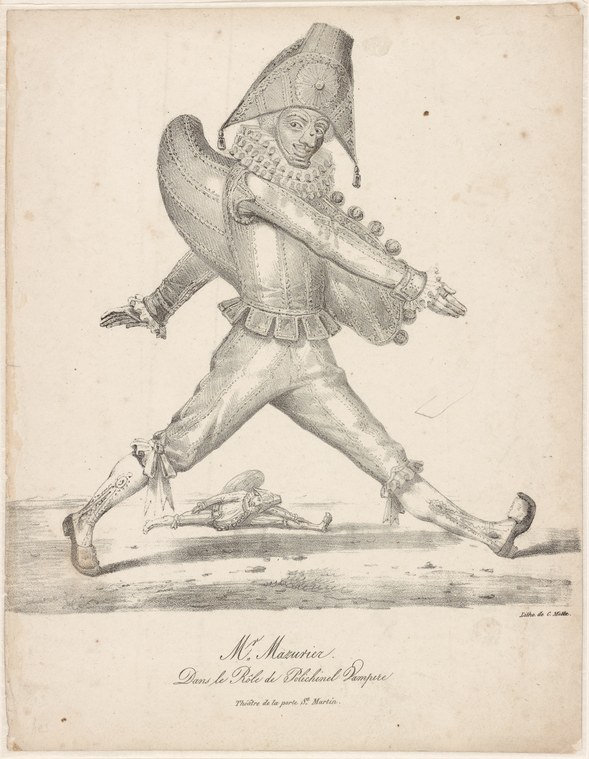
Mr. Mazurier dans le rôle de Polichinel vampire, Théâtre de la Porte St. Martin
Unknown artist
- Collection:
- Prints depicting dance
- Source:
- New York Public Library
- Rights:
- Public domain — free to use, share and adapt.
- Recorded as:
- Public Domain
Mazurier's Polichinelle represents a crucial moment in the history of dance when comic pantomime and acrobatic solo performance were beginning to be recognized as legitimate theatrical arts requiring serious physical training. The exuberant energy frozen in this print shows a body trained to move in ways that were neither classical ballet nor folk dance, but hybrid theatrical technique—a reminder that not all serious dance history happens on the opera house stage. For historians of commedia dell'arte, popular theatre, and the development of theatrical dance beyond ballet, this image provides rare visual evidence of how a celebrated performer actually moved.
What you are looking at
A male figure in theatrical costume strikes an exuberant pose against a plain background. He wears a tall conical hat with a geometric pattern, a fitted tunic with horizontal stripes and decorative buttons, and tights. His posture is emphatic: one leg extended in a wide stride, the other bent, arms spread wide with palms open—a gesture of flamboyant display. He appears to be mid-leap or mid-stride, captured at a moment of maximal extension and energy. The figure's face is young, with delicate features, and his expression conveys playfulness and theatrical confidence. The engraving technique renders fine detail throughout the costume and musculature, with careful hatching suggesting volume and shadow. The figure dominates the composition, leaving substantial empty space around him that emphasizes the boldness of his pose.
The dancing
A single male dancer occupies the full height of the composition, executing what appears to be an exaggerated, virtuosic movement combining elements of elevation and extension. His weight is distributed dynamically across a wide stance; the forward leg is fully extended with pointed foot, while the rear leg bends to generate the lift suggested by the raised heel. Both arms are fully extended laterally at roughly shoulder height, with open hands and slightly flexed wrists—a posture of display rather than technical precision. The body reads as supple and trained, with no visible tension; the musculature of the legs and torso is clearly articulated. This is solo male performance technique, emphasizing showmanship and physical confidence over formal classical line.
The dance depicted
This is a figure from the commedia dell'arte tradition—specifically Polichinelle (Pulcinella), one of the stock comic characters. The title identifies the dancer as Monsieur Mazurier, performing in *Polichinelle Vampire* at the Théâtre de la Porte Saint-Martin in Paris. The commedia tradition was a semi-improvised popular theatre that relied on physical comedy, acrobatic movement, and recognizable masked or costumed characters. The pose captures the character's essential quality: exuberant, anarchic physical abandon. Polichinelle was traditionally a figure of grotesque agility—hump-backed, hook-nosed, absurd—but in the hands of a skilled dancer like Mazurier, the role became a vehicle for demonstrating strength, flexibility, and comedic timing. The movement shown here is not codified ballet but virtuosic physical theatre: it emphasizes surprise, speed, and the body's capacity to exceed normal limits of extension and balance.
How it was made
This is an engraving, a print made by incising lines into a metal plate (likely copper) and printing from the raised surface. The technique allows for fine linear detail and tonal variation through hatching and cross-hatching—visible throughout in the rendering of the costume's geometric patterns, the musculature, and the shadows defining the figure's form. The engraving would have been pulled by hand from the plate, making each impression unique but allowing for multiple editions to be distributed. As a print rather than a painting, this work was affordable and mobile—designed for circulation among theatre-goers, collectors of theatrical imagery, and the curious public. The quality of the line work and the care taken to render anatomical detail suggest this was a professional commercial product, not a rough sketch.
About this work
This is a theatrical print documenting the performance style of a celebrated dancer and comedian of the early 19th-century Parisian stage. Monsieur Mazurier was renowned for reviving and modernizing the commedia dell'arte character of Polichinelle, transforming him from a grotesque buffoon into a figure of athletic virtuosity. The engraving captures the essence of his appeal: a solo male body in extreme extension, displaying flexibility, strength, and an almost balletic grace while maintaining the character's essential absurdity. The work sits at the intersection of popular theatre, physical virtuosity, and commercial print culture—it is both a document of a specific performance and a generic type image that would have been sold to theatre enthusiasts as a collectible souvenir.
How to look at it
Attend to the extreme width of the stance and the full extension of the forward leg—this pose is held at the peak of a dynamic movement, not a stationary classical position. The openness of the arms and the outward rotation of the hips suggest a body trained for visibility and dramatic effect rather than the contained verticality of ballet. Notice how the engraver has rendered the face with subtle expression: there is a smile, and the eyes seem engaged, suggesting that this character's movement is inseparable from persona and entertainment. The empty space around the figure emphasizes isolation—this is a solo performer, designed to be watched and admired in the round, commanding the stage alone.
The period
This print dates to the early 19th century, when Paris was the centre of European theatrical innovation. The Théâtre de la Porte Saint-Martin, where Mazurier performed, was a venue known for spectacular pantomime, vaudeville, and physical comedy—cheaper, louder, and more anarchic than the Opéra. During this period, commedia dell'arte was undergoing a revival across Europe, particularly in France, where it influenced popular pantomime and physical theatre. Simultaneously, classical ballet was consolidating its aesthetic under figures like Marie Taglioni, but ballet was only one form of theatrical dance; popular stages hosted acrobats, pantomime artists, and comic dancers whose technique was equally demanding but differently valued. Mazurier represents the latter tradition—a virtuoso of a form that was entertainment rather than high art, yet required genuine physical mastery.
Where it lives
This engraving is held in the New York Public Library's collection of prints depicting dance, a collection that assembles commercial theatre imagery, dance documentation, and visual records of performance across centuries and cultures. As a theatrical souvenir print, it circulated among theatre patrons and collectors during and after Mazurier's run.
Dance in this work
Questions about this work
Who was Monsieur Mazurier?
Mazurier was a celebrated French dancer and comedian of the early 19th century, specializing in pantomime and the commedia dell'arte tradition. He was particularly famous for his revival of the character Polichinelle, which he transformed from a grotesque buffoon into a figure showcasing athletic virtuosity and trained physical technique. He performed at the Théâtre de la Porte Saint-Martin and other Parisian venues, and was one of the most celebrated physical performers of his era.
What is Polichinelle, and why does the costume look like that?
Polichinelle (Italian Pulcinella) is a stock character from commedia dell'arte, a form of semi-improvised popular theatre that originated in Italy and spread throughout Europe. The character is traditionally depicted with exaggerated physical traits—a humped back, prominent nose, and distinctive costume. The tall hat, striped tunic, and geometric patterns visible in this print are part of Polichinelle's instantly recognizable costume. By Mazurier's time, the costume had evolved into something more elegant while retaining its comic associations.
Is this ballet?
No. This is theatrical dance from the commedia dell'arte and popular pantomime tradition, distinct from classical ballet. While both require trained bodies and physical virtuosity, they developed different aesthetics and techniques. Ballet emphasizes vertical alignment, turned-out legs, and ethereal qualities; this tradition emphasizes horizontal extension, comic character, acrobatic display, and physical surprise. Both were valued forms of theatrical entertainment, but they occupied different social and artistic spaces in 19th-century Paris.
What does the pose tell us about how Mazurier danced?
The extreme width of the stance, the full extension of the forward leg, and the open arm position suggest a dancer trained for visibility, flexibility, and dynamic energy. The pose captures movement at its peak—a moment of maximum extension and drama. This differs from classical ballet poses, which tend to be more contained and vertically oriented. The exaggerated gesture suggests that Mazurier's style was one of theatrical display and physical surprise rather than refined classical technique.
More dance artwork





