49 works in this view — arrow keys or swipe to move between them.
Dance in Art
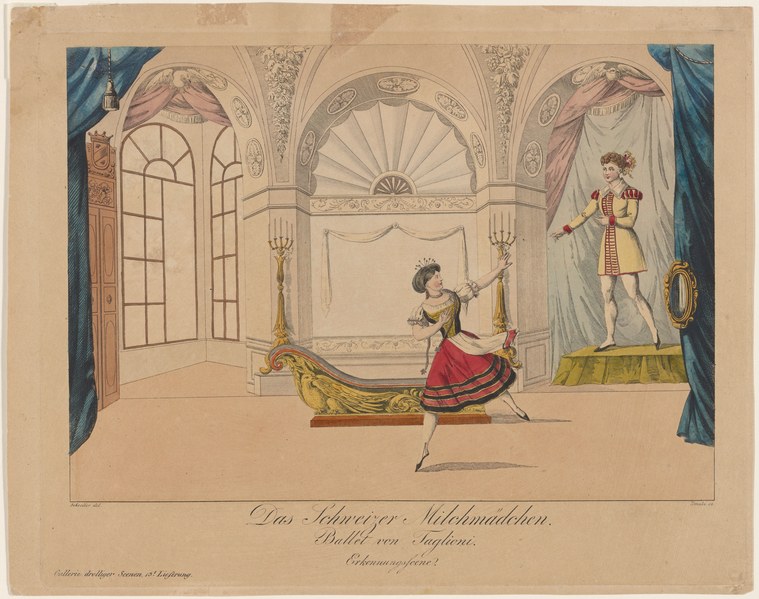
Das schweizer Milchmädchen, Ballet von Taglioni, Erkennungsscene
Unknown artist
- Collection:
- Prints depicting dance
- Source:
- New York Public Library
- Rights:
- Public domain — free to use, share and adapt.
- Recorded as:
- Public Domain
Taglioni was the first global dance celebrity, and prints like this one were how her performances circulated to audiences who could not see her on stage. The image documents the technical vocabulary of Romantic ballet—the attitude, the ethereal line, the narrative integration of virtuosity—at the moment it became the dominant international standard for the art form.
What you are looking at
A woman in a red skirt and embroidered bodice performs a solo dance in an elegant neoclassical interior, her body in a striking attitude derrière with one leg raised behind her. She dances on a wooden stage or platform in the center of a grand hall with cream and gilt walls, arched ceilings decorated with ornamental medallions, and tall arched windows to the left admitting soft light. Two figures in period dress watch from the sides—one standing on an elevated platform to the right in yellow and red costume, another visible in the background. Heavy blue curtains frame the scene at the edges. The composition captures a moment of virtuosic display, the dancer's extended leg and arched back suggesting the height of her technical achievement.
The dancing
The central dancer stands in a pronounced attitude derrière with significant extension, her torso upright and arms raised in an open frame characteristic of early 19th-century ballet technique. Her weight appears fully engaged on a supporting leg; the raised leg reaches high behind her with a pointed foot. Her posture—chest open, spine curved, limbs elongated—shows the balletic ideal of the period. Two secondary figures frame the action but do not dance; they are positioned as audience members or perhaps characters in the narrative.
The dance depicted
This is a scene from *La Laitière Suisse* (The Swiss Milkmaid), a ballet choreographed by and famously performed by Marie Taglioni in the early 19th century. The title identifies this as the 'Erkennungsscene' (recognition scene), a narrative moment where the heroine is revealed or recognized through dance. Taglioni's technique and style—visible in the high extensions, the ethereal carriage, and the use of attitudes—became the exemplar of Romantic ballet and influenced the genre decisively.
How it was made
This is a hand-colored engraving or aquatint, characteristic of early 19th-century theatrical prints. The technique allowed for precise draftsmanship in the architectural detail and careful control of tone in the colored passages—the soft modeling of flesh and the richness of the fabrics. Such prints were widely circulated to promote performances and memorialize famous dancers and roles, making them primary documents of how Romantic ballet was understood and consumed by its public.
About this work
This engraving documents a celebrated moment from Marie Taglioni's *La Laitière Suisse*, one of the defining works of Romantic ballet. The print captures the dancer at the peak of her technical and dramatic power, posed in the architectural grandeur that befitted the scale of her fame. It belongs in a gallery of dance imagery as both a record of a specific ballet and as evidence of how 19th-century printmakers understood and celebrated the dancer's body—as an object of virtuosity, beauty, and narrative significance. The work commemorates not just a dance but a performer who redefined what ballet could be.
How to look at it
Observe how the engraver has frozen the dancer at the apex of her movement—the leg fully extended, the body fully open—rather than in a transitional moment. This was the convention: to capture the figure in perfect repose, displaying maximum extension and control. Notice also how the perspective and the architectural setting frame her body, making her the undisputed center of attention. The two secondary figures are rendered small and peripheral, emphasizing the isolation and spectacle of the star performer.
The artist
The artist is not recorded in the catalogue. The print bears the notation 'Lithogr. del Zumo St Eugène' (or similar), suggesting a commercial theatrical lithography workshop of the period, likely based in Paris or Vienna where Taglioni performed most frequently. Such prints were typically created from eyewitness sketches or studio designs, often published by the theaters themselves to capitalize on the fame of celebrated roles.
The period
The 1830s and 1840s marked the height of Romantic ballet, a period in which ballet moved away from the neoclassical vocabulary of the previous century toward narrative, fantasy, and the supernatural. Taglioni's debut in *La Sylphide* (1832) crystallized the Romantic ideal: the dancer as ethereal, otherworldly figure, employing pointe work and extensions to suggest weightlessness. *La Laitière Suisse*, a lighter comic vehicle, showcased her technical brilliance in a humanistic context. Theatrical prints of this period served as advertisements, souvenirs, and vehicles for international celebrity—they made distant audiences feel connected to the performances and stars they depicted.
Where it lives
The work is held in the Prints depicting dance collection at the New York Public Library. It is a commercial theatrical print, one of thousands produced in the 19th century to promote and memorialize performances.
Dance in this work
Questions about this work
Who was Marie Taglioni and why was she famous?
Taglioni (1804–1884) was a Swedish-Italian dancer who became the first international ballet superstar. She originated the role of the Sylph in *La Sylphide* (1832), which defined the Romantic ballet ideal: ethereal, supernatural, weightless. She danced on the tips of her toes and achieved unprecedented extensions and fluidity. She was the first dancer to be globally famous through prints, lithographs, and descriptions in newspapers—she transcended the theater and became a public figure.
What is an 'attitude' and why does it matter here?
An attitude is a balletic pose in which one leg is raised behind the body, the thigh turned out, the supporting leg straight, and the torso upright—usually with arms in an open frame. It was codified in the 18th century and became one of the central poses of Romantic ballet. Taglioni's attitude, shown here, was famously soft and elongated rather than rigid, and her extensions were higher and more fluid than those of previous generations. The attitude became shorthand for 'the balletic body.'
What was 'La Laitière Suisse' and what role did it play in Taglioni's career?
*La Laitière Suisse* (1828) was a lighthearted ballet with a Swiss pastoral setting, created before Taglioni's revolutionary *La Sylphide*. It allowed her to demonstrate not only technical brilliance but also dramatic range and comedic timing. The 'recognition scene' shown here is the dramatic climax where the heroine reveals her true nature or identity through dance—a typical Romantic ballet structure.
How were theatrical prints like this one used in the 19th century?
Theatrical prints were sold in theater lobbies and through print shops as souvenirs, advertisements, and mementos of famous performances. They circulated information about new works and new stars to a broad public and helped create what we would now call 'celebrity.' For dancers and choreographers, they were also records—a way to document roles and movements for posterity, since film and photography of dance did not exist.
More dance artwork





