49 works in this view — arrow keys or swipe to move between them.
Dance in Art
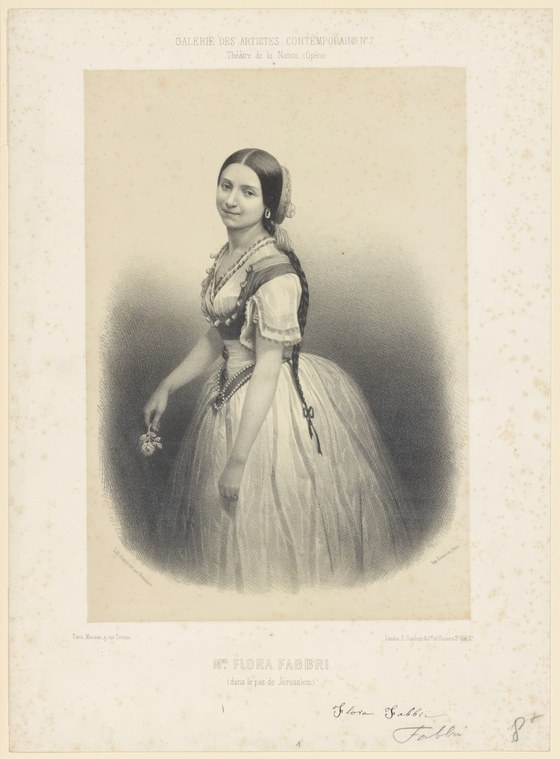
Mme. Flora Fabbri (dans le pas de Jérusalem)
Unknown artist
- Collection:
- Prints depicting dance
- Source:
- New York Public Library
- Rights:
- Public domain — free to use, share and adapt.
- Recorded as:
- Public Domain
Mme. Fabbri and the pas de Jérusalem are otherwise undocumented in major ballet histories, making this print one of the few surviving records of her performance and a piece of choreographic ephemera from a period when most ballet existed only in live performance and such images. The lithograph also demonstrates how theatrical portraiture functioned as a commercial and promotional medium, allowing dancers to extend their fame beyond the theatre and maintain a public identity in print. For researchers of mid-19th-century ballet practice and the business of dance, this is precisely the kind of evidence—detailed, dated, widely distributed—that reconstructs the lived landscape of performance.
What you are looking at
A three-quarter-length portrait of a young woman in theatrical costume, rendered in a soft lithographic technique with careful tonal gradation. She is dressed in a white muslin or gauze dress with puffed sleeves and a deep neckline, typical of Romantic-era stage wear. A dark ribbon or sash is tied at her waist and trails to one side; her dark hair is gathered back with a light-colored net or snood. She wears what appears to be a decorative brooch or ornament at the bodice. The figure is posed in a three-quarter stance, weight shifted subtly, one arm held at her side with the hand visible, the other arm less distinct. The background fades to soft shadow, focusing attention entirely on the dancer and the fine detail of her costume. The image is signed in the lower right, and the title below identifies her as "Mme. Flora Fabbri (dans le pas de Jérusalem)." This is a fashionable theatrical portrait, the kind produced for public distribution and display.
The dancing
The dancer is shown standing in a relaxed but composed pose, neither mid-movement nor formally still. Her weight appears to rest on one leg, creating a gentle contrapposto. Both arms are held low and away from the body—a frame consistent with Romantic ballet of the period, where the arms remained soft and unforced. The pose suggests a moment of pause rather than climactic action, as if she has just arrived onstage or is about to move. Her gaze is direct but softly modulated, engaging the viewer without theatrical intensity.
The dance depicted
The title references "le pas de Jérusalem" (the Jerusalem step), a character dance or choreographic sequence that was likely part of a larger theatrical work, though the specific ballet or opera is not established by the record. The costume and pose are consistent with the Romantic ballet conventions of the 1830s–1850s, when character dances and national or exotic numbers were common vehicles for virtuosity and dramatic narrative. The softness of the portrait and the absence of pointe work visible in the feet suggest this may have been a demi-caractère role rather than a purely classical ballet number. Without access to contemporary reviews or the full work, the exact nature of this step cannot be determined from the image alone.
How it was made
This is a lithographic print, identifiable by its soft halftone effects, the gentle gradation from dark to light, and the characteristic texture of crayon or tusche on stone. The signature at the lower right indicates the artist drew directly on the lithographic stone. The technique allowed for rapid reproduction and wide circulation—these portraits were commercial products sold to theatregoers as memorabilia. The soft, flattering rendering was particularly suited to theatrical portraiture, where idealization was expected. The inscription in French below the image indicates this was a work aimed at a French or Francophone audience, consistent with the dominance of Paris in mid-19th-century ballet culture.
About this work
This is a theatrical portrait of the dancer Flora Fabbri, printed as a lithograph for public consumption in what appears to be the mid-19th century. It documents both a specific performer and a specific choreographic moment—the pas de Jérusalem—that has otherwise left little trace in historical records. The work exemplifies the mass production of dancer portraits that emerged in the Romantic era, when lithography made it possible to distribute images of celebrated performers far beyond those who could see them onstage. It sits at the intersection of dance history and print culture, recording not a painting or sculpture but a commodified image made for fans and collectors. For the history of Romantic ballet and the international circulation of both dancers and dance imagery, it is a primary document.
How to look at it
Look first at the pose and the dress. The relaxed, unforced quality of the frame—the arms held softly away from the body, the weight shifted but not dramatically—is typical of Romantic ballet portraiture, where heroic or virtuosic moments were often avoided in favour of a poised, idealized stillness. The costume details are historically precise: the puffed sleeve, the high waistline, the gathered skirt without the extreme volume of later tutus, all situate this in the 1830s–1850s. Notice that no pointe work is visible or suggested; this was a character role, not a classical one. The soft lithographic technique itself conveys the commercial intention of the portrait—it was made to be reproducible, affordable, and appealing to theatre audiences who wanted a memento of a performer they had seen.
The artist
The artist is not recorded, which was not unusual for theatrical portraits of this period. The signature on the stone is present but illegible in available reproductions. The work was likely produced by a commercial lithographic shop in Paris or another major theatre centre, where such portraits were made to order for dancers and sold through theatre lobbies and print shops. The quality of execution suggests a professional atelier rather than a major salon artist, consistent with the reproductive and commercial nature of theatrical portraiture.
The period
This portrait dates to the Romantic era of ballet, roughly 1830–1860, when the genre expanded dramatically in scope and international reach. Paris remained the capital of ballet, but successful dancers—especially those who excelled in character roles and national dances—toured extensively across Europe. The Romantic ballet incorporated storytelling, exotic settings, and choreography that drew on folk and national dance traditions; a pas de Jérusalem would have been understood as a character dance with geographical or orientalist associations. Lithography had become the dominant medium for theatrical portraiture by the 1840s, making it possible for dancers to maintain a visual presence in public consciousness between performances. The print was likely made during or shortly after a successful run of the work in which Fabbri danced the role.
Where it lives
This print is held in the New York Public Library's collection of prints depicting dance. It is catalogued as part of a broader archive of theatrical portraiture from the 19th century, a collection that serves as a primary resource for the history of professional dance in the Romantic era.
Dance in this work
Questions about this work
Who was Flora Fabbri?
Mme. Flora Fabbri was a professional dancer active in the mid-19th century, noted enough to have her portrait published as a lithograph for theatrical audiences. Beyond this print and any contemporary reviews, little biographical information survives. She appears to have specialized in character roles—dances with national or geographical associations—rather than classical ballet. The pas de Jérusalem may have been her signature role or a particularly successful vehicle for her talents.
What is a 'pas de Jérusalem'?
A pas is a choreographed dance sequence, often for a solo dancer or a small group. The Jerusalem step was likely a character dance—a type of theatrical dance that drew on or claimed to draw on folk or national traditions. In Romantic-era ballet, such dances were often inserted as dramatic or spectacular moments within longer works, or presented as independent numbers. The geographical or exotic associations in the title—Jerusalem, here—were part of the appeal to Romantic audiences, reflecting their fascination with distant places and cultures.
How was this portrait made and distributed?
This is a lithograph, a print made by drawing on a smooth limestone or metal plate with a greasy crayon or ink, then using chemical processes to make the image reproducible. Once the stone was prepared, many copies could be printed. Theatrical portraits like this were made for commercial sale—sold in theatre lobbies, print shops, and through subscriptions. They were affordable and portable, making them an early form of celebrity merchandise and a way for dancers to maintain a public presence beyond their live performances.
What does the costume tell us about the date?
The dress—puffed sleeves, high waistline, modest neckline, gathered skirt without extreme volume—is consistent with stage costume of the 1830s–1850s. The absence of a tutu as we know it from later ballet, and the relatively modest silhouette, places this squarely in the early Romantic period. The quality of the lithography and the style of inscription also support a date in the 1840s–1850s, though without additional archival evidence this remains an informed estimate rather than a certainty.
More dance artwork





