49 works in this view — arrow keys or swipe to move between them.
Dance in Art
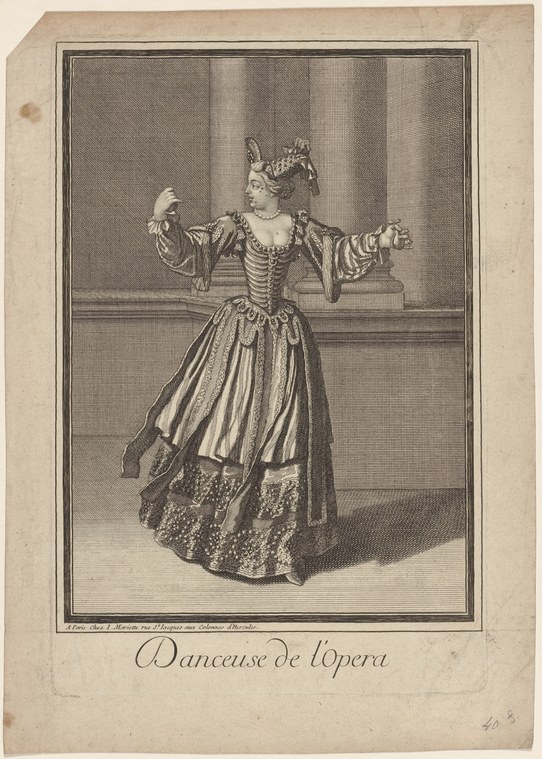
Danceuse de l'opera
Unknown artist
- Collection:
- Prints depicting dance
- Source:
- New York Public Library
- Rights:
- Public domain — free to use, share and adapt.
- Recorded as:
- Public Domain
This print preserves visual evidence of how French opera dancers were dressed, posed, and presented to public view in the 18th century—information available nowhere else in such precise form. For dance historians, the costume itself is a primary document: the cut, construction, materials, and decoration of the garment reveal period taste, technical skill, and the resources invested in theatrical spectacle. The posed, frontal composition shows how the body was instrumentalized as a display vehicle, a convention that shaped both choreography and performance.
What you are looking at
A single female dancer stands at stage center against a backdrop of draped curtains rendered in soft cross-hatching. She faces the viewer in a three-quarter pose, her body angled slightly but her gaze directed outward. Her left arm extends upward and outward in an open, expressive gesture; her right arm mirrors this on the opposite side, both hands visible with fingers articulated. Her costume is lavish: a fitted bodice with striped or ribbed detailing at the torso and sleeves, the sleeves full and draped, and a voluminous skirt that extends to the floor. The skirt shows two distinct registers—a lighter pleated section in the upper portion and a darker, ornately patterned lower section that suggests brocade or embroidered fabric, possibly with a scale or floral motif. Her headdress is elaborate, featuring what appears to be feathers or plumes rising above her hair. The lighting is frontal and even, creating soft shadows that model the depth of her costume and suggest stage lighting of the period. The composition is formal and symmetrical, emphasizing display and spectacle.
The dancing
The dancer's posture is upright and dignified, with her torso held erect and her weight evenly distributed. Both arms are raised in a symmetrical frame, open to the audience, neither arm carries the weight of a partner. Her hands appear relaxed and expressive rather than gripped or tense. The raised, open-armed position is characteristic of display or celebration—a pose designed to present the costume and the body to full advantage. There is no indication of active footwork in the image; the emphasis falls entirely on upper-body carriage and the architectural drama of the silhouette.
The dance depicted
This is an opera dancer, as the title and costume confirm. The pose and context suggest this is a mid-to-late 18th-century theatrical representation, likely French given the title and the style of the engraving. The open-armed, frontal pose is typical of operatic display—a moment of stasis or triumphant presentation rather than active choreography. The dancer is not performing a specific named dance step or style visible in the image; rather, she is posed in the formal, presentational manner characteristic of serious opera of the period, when dance was part of the spectacle and the dancer's body a vehicle for costume display. The elaborate dress and composed posture suggest this may document a famous performer or a celebrated role, though neither can be confirmed from the image alone.
How it was made
This is an engraving on paper, identifiable from the fine parallel line-work (hatching and cross-hatching) used to render shadow, texture, and form. The technique allows precise reproduction and wide circulation—engravings of popular performers and roles were commercial products sold to the theater-going public as mementos and advertisements. The delicate line-work of the costume's pleats, the feathering of the headdress, and the folds of fabric all demonstrate the engraver's skill at rendering elaborate theatrical dress. The formality and finish suggest this is a finished print intended for framing or collecting, not a preparatory sketch.
About this work
This is a French engraving of an opera dancer, almost certainly from the 18th century, presented in the formal mode of theatrical portraiture. The dancer stands alone against a stage backdrop, fully frontal, her body displayed for the viewer's inspection in a pose of composed dignity. She wears the costume of serious French opera—an elaborately decorated and constructed outfit that itself is nearly the subject of the image. The engraving is both a document of theatrical practice and a celebration of costume design and female display on the operatic stage. Such prints were commercial products: they recorded the appearance of celebrated performers and circulated as souvenirs among the urban theater audience.
How to look at it
Notice the deliberate symmetry of the pose—both arms raised, the body centered—which communicates display and formal presentation rather than narrative movement or effort. The artist has chosen a moment of stasis, not mid-action. Attend to the costume: the visible construction of the bodice, the careful pleating of the skirt, the texture of the lower fabric all suggest that dress itself is being celebrated. The headdress is rendered with particular precision, indicating its importance to the overall image. Compare this formal, frontal mode with later 19th-century dance imagery to see how the representation of the dancer's body changed as performance priorities shifted.
The artist
The artist is not recorded. The style and execution are consistent with mid-to-late 18th-century French engraving practice, but without a signature or documented provenance, attribution is impossible. The print was likely made by a commercial workshop producing theatrical portraiture for sale to the opera-going public.
The period
In 18th-century France, ballet and dance were integral to opera and court spectacle. The serious operatic tradition (tragédie lyrique and opéra seria) included substantial dance interludes and employed skilled dancers as part of the ensemble. By mid-century, ballet was beginning to develop as a semi-independent art form, but dancers still primarily worked within opera. The elaborate costumes visible in this print reflect the enormous expense and artistic attention devoted to operatic spectacle; costume was as much a subject of artistic investment as choreography. Engravings of famous dancers and roles were popular collectibles, serving both as mementos and as advertisements for upcoming performances.
Where it lives
This print is held in the New York Public Library's collection of prints depicting dance. It is classified as an object type within a broader collection rather than catalogued individually with full documentation.
Dance in this work
Questions about this work
Who was this dancer?
The print does not identify her. Without a visible signature, inscription, or documented provenance, the performer cannot be named. Such prints often circulated without clear attribution, though they may have been recognizable to contemporary audiences familiar with Paris opera.
What is the date of this engraving?
The style, costume, and engraving technique are consistent with the mid-to-late 18th century, but no date is recorded. The catalog record lists the date as unknown. Stylistic comparison with documented opera imagery from the 1740s–1770s might narrow this, but that research has not been done.
Is this a specific choreographed dance or just a costume portrait?
This is a theatrical portrait, not documentation of a specific choreographed sequence. The pose is formal and presentational—designed to display the performer and costume to the audience. It represents the mode of operatic display common to serious opera of the period, not a named dance step or performance moment.
What does the costume tell us?
The elaborate dress—with its fitted bodice, full sleeves, layered skirt, ornate lower fabric, and tall headdress—is consistent with mid-18th-century French operatic convention. The expense and craftsmanship visible in the garment reflect the high production values of Parisian opera. Such costumes were designed to be seen from a distance in a theater, with bold lines and rich decoration creating visual impact.
More dance artwork





